Forrester Pencil Sharpener of 1887, one of only two extant machines. Price $12,400.
Patents, click on any image to see larger image!
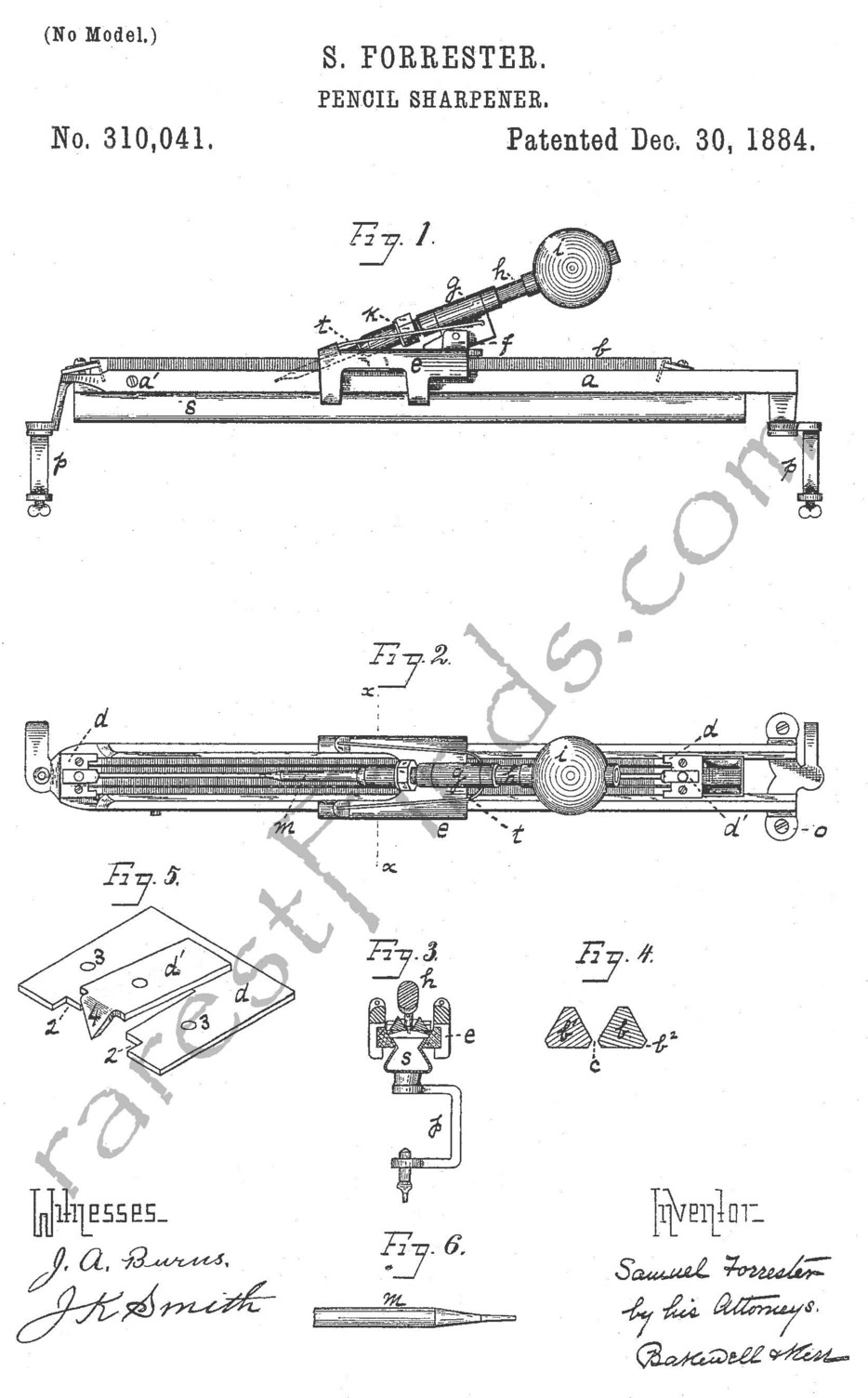
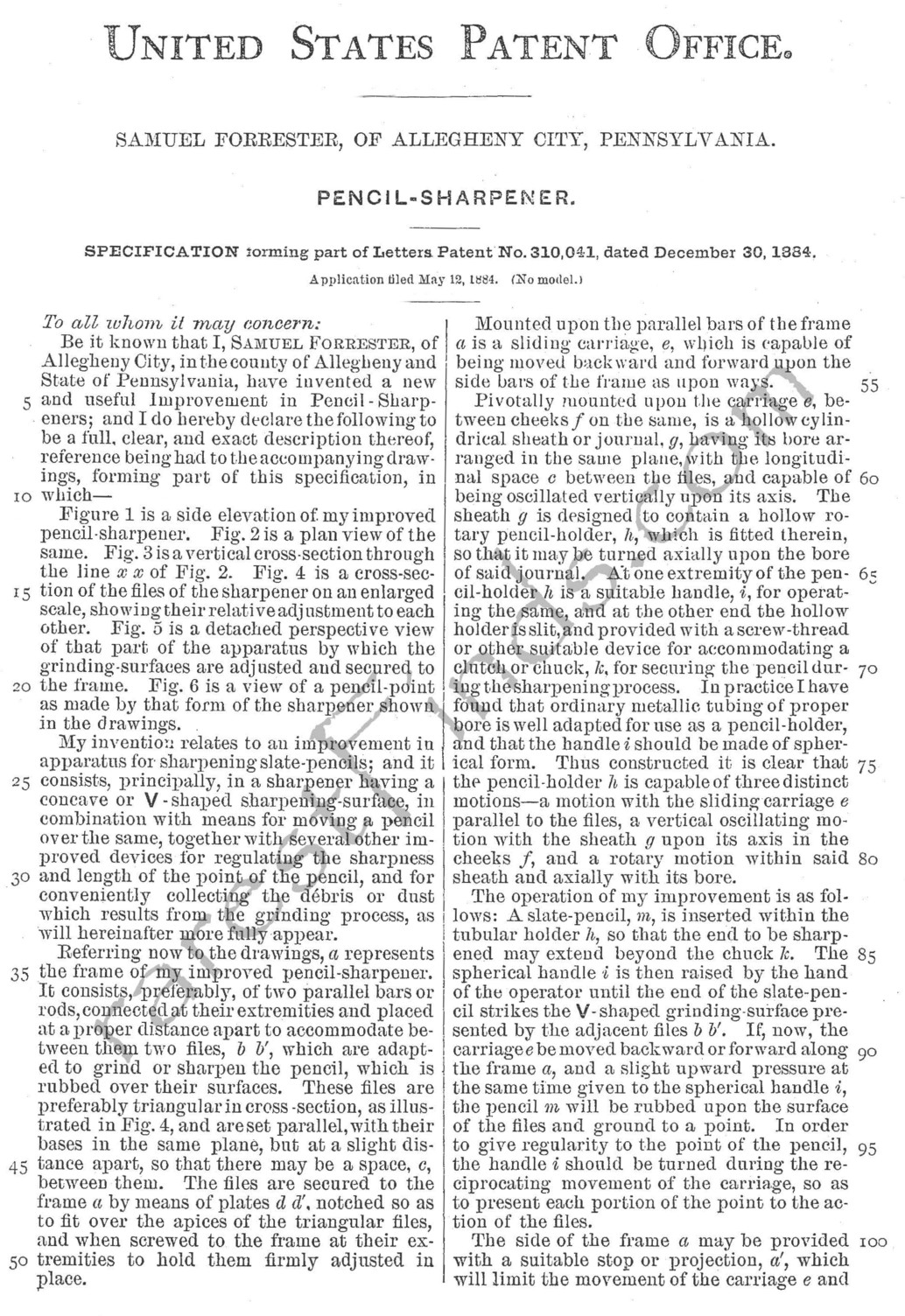
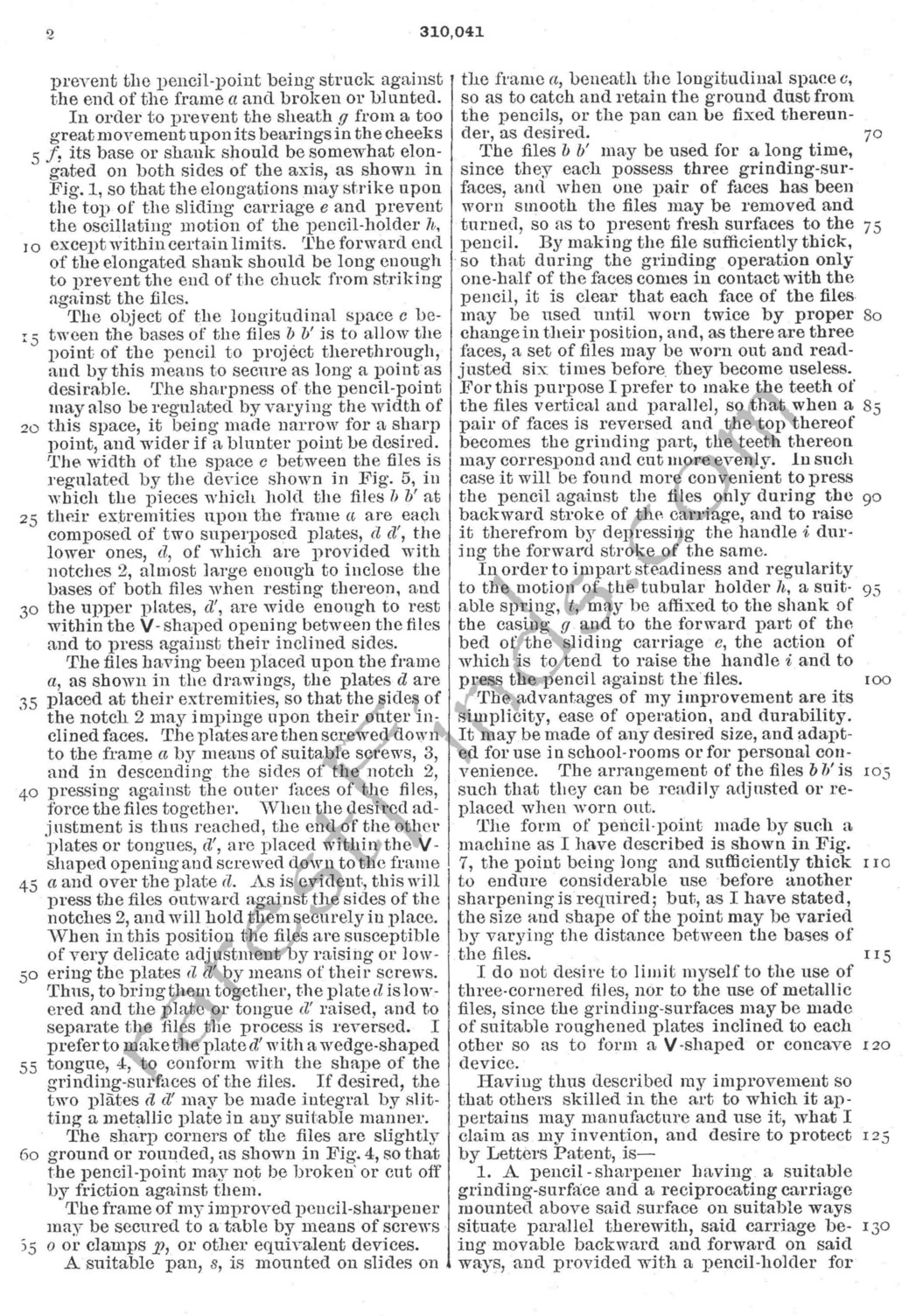
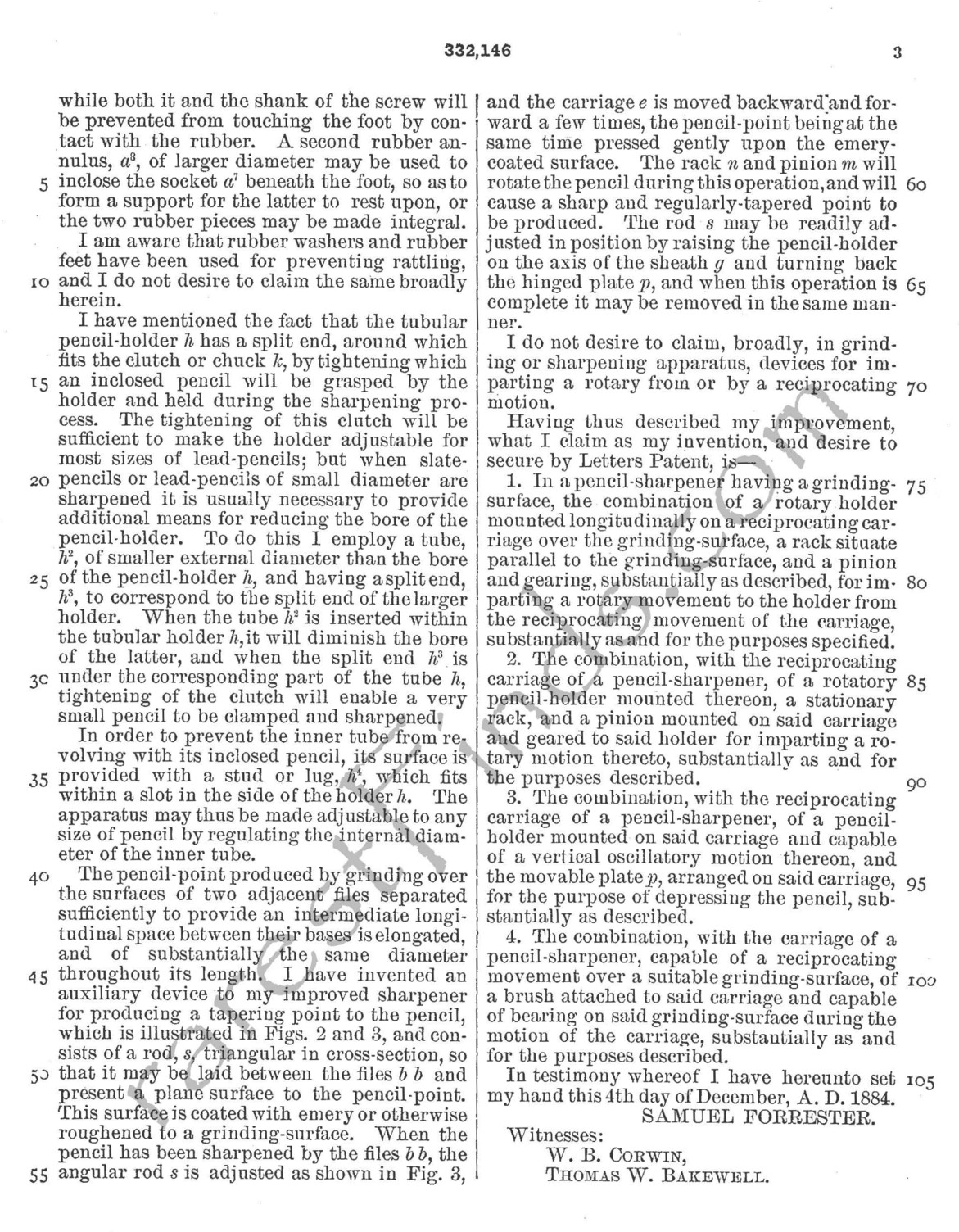
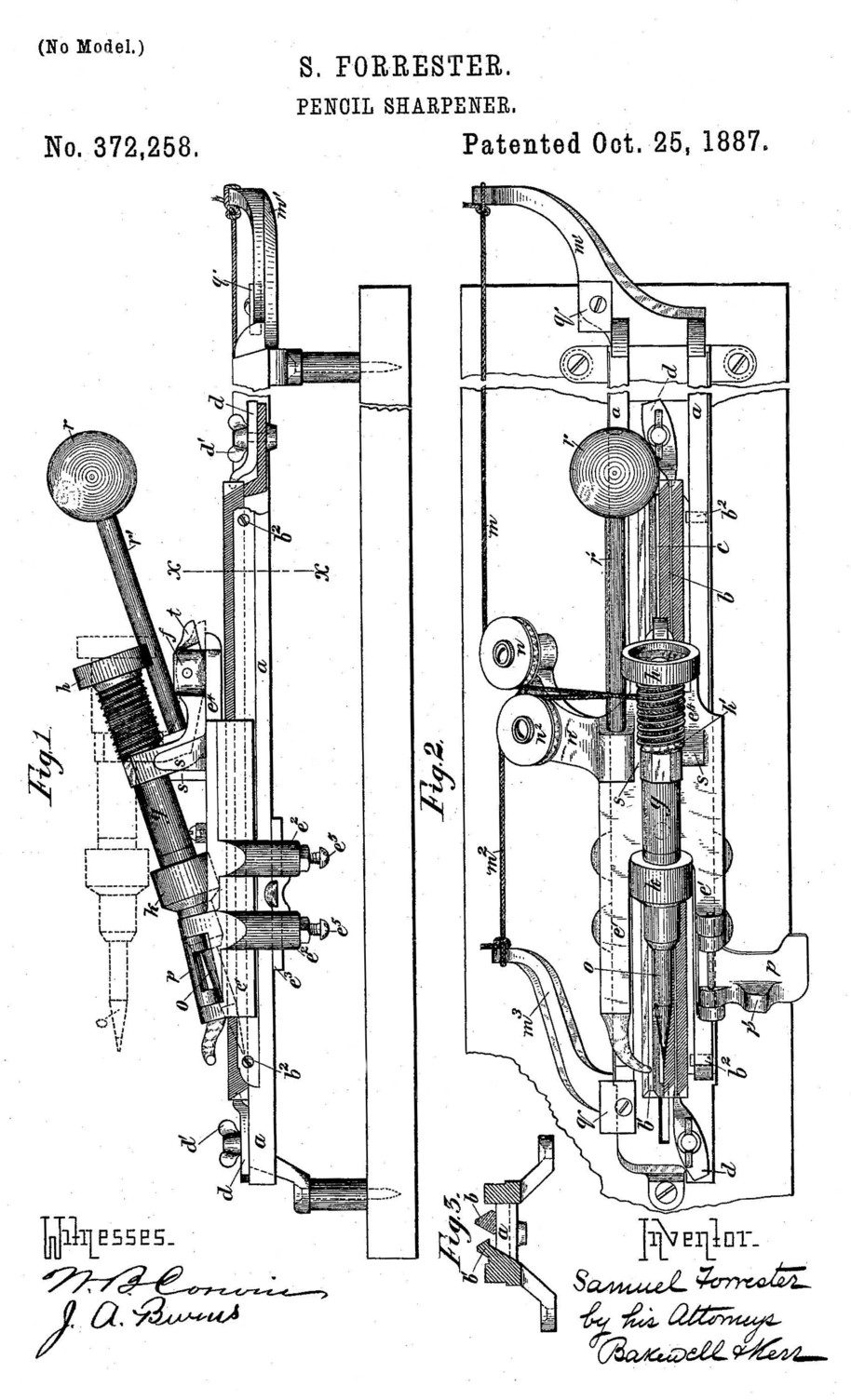
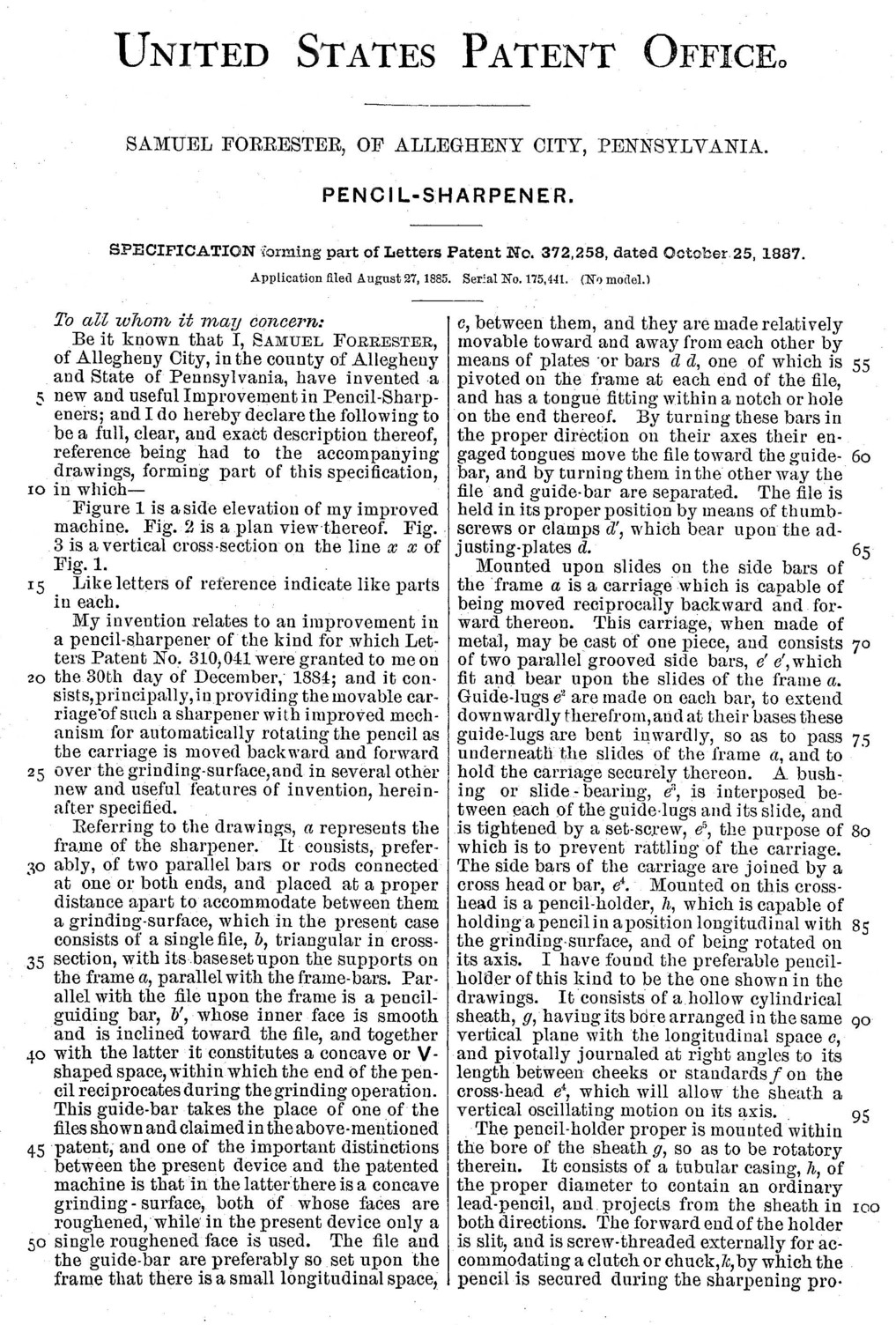
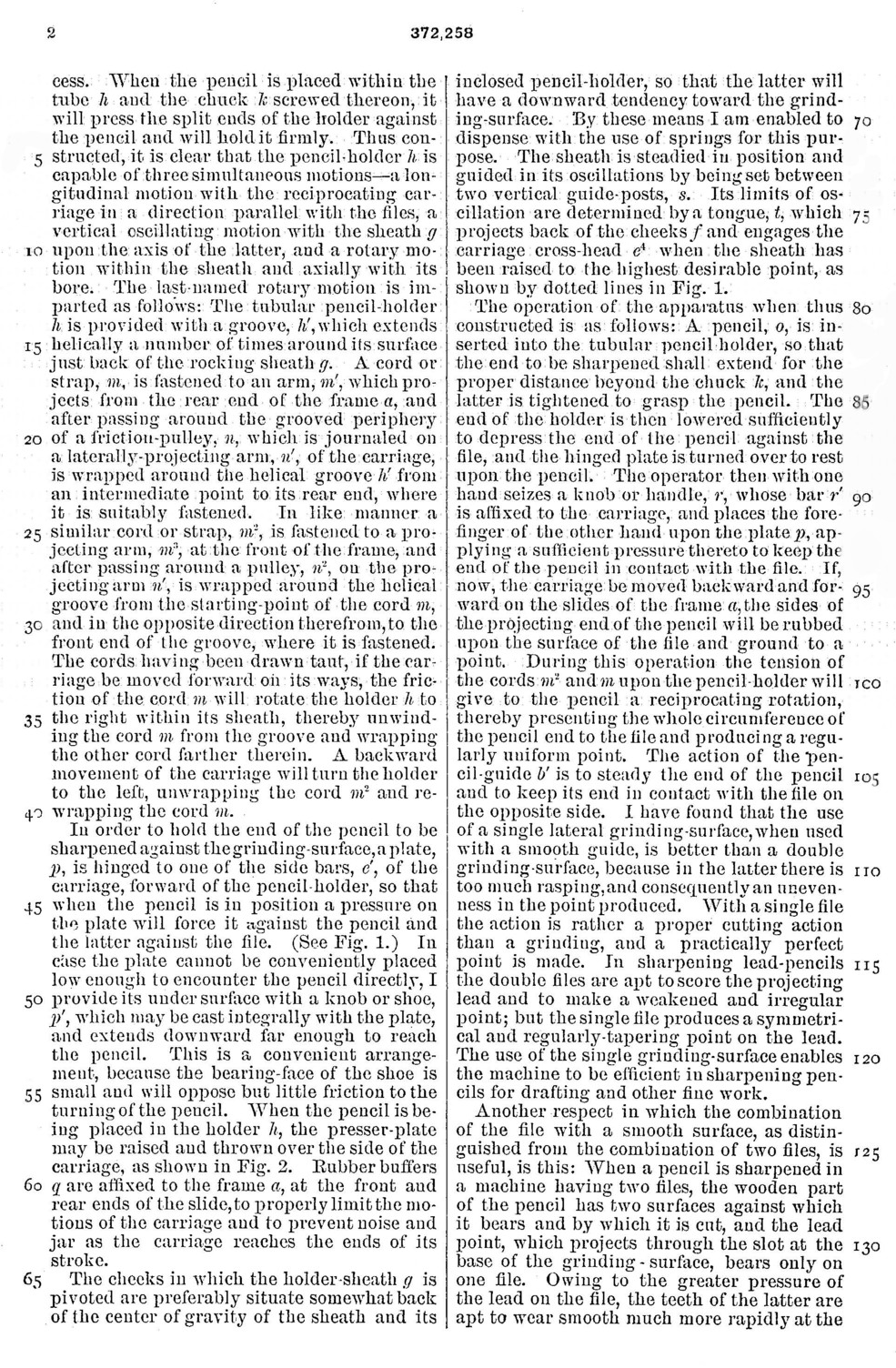
This antique, historic pencil sharpener is exceptional in every way; it is a unique design based on three patents issued to Samuel Forrester of Allegheny City, Pennsylvania. S. Forrester filed three patents for a pencil sharpener between May 12, 1884, and August 27, 1885. He also filed for a forth patent in 1908, the first patent for a foot-powered pencil sharpener.
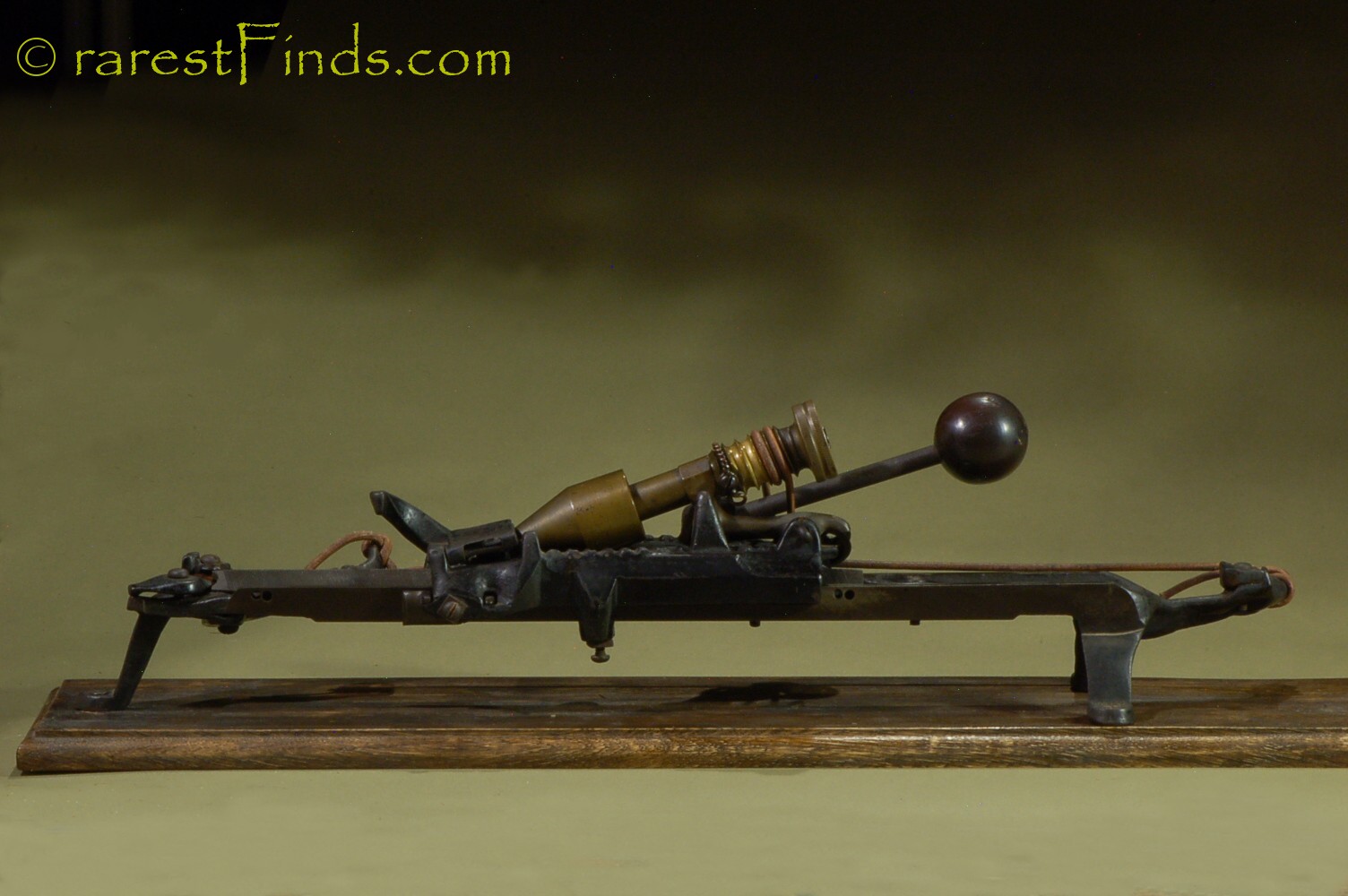
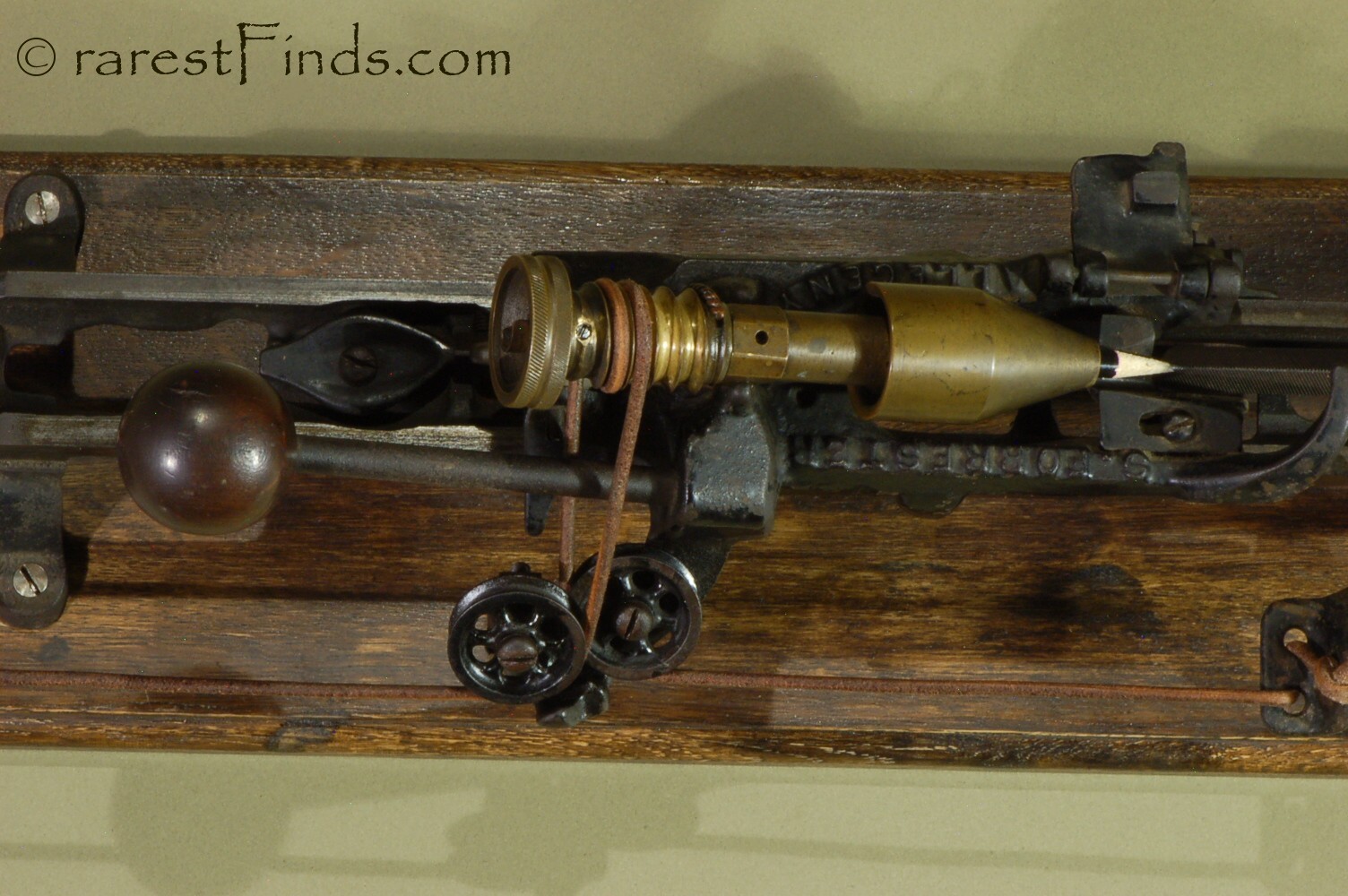
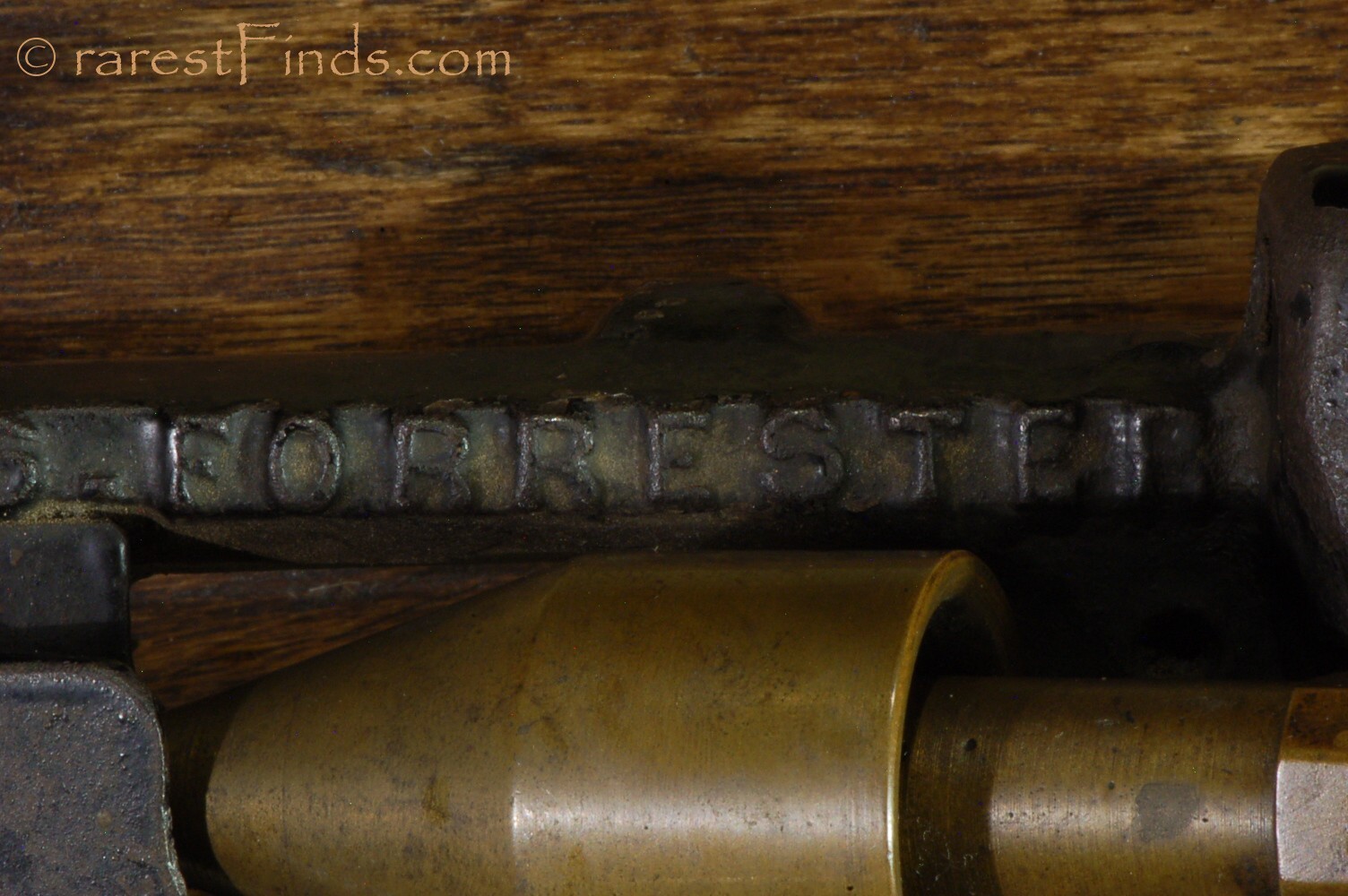
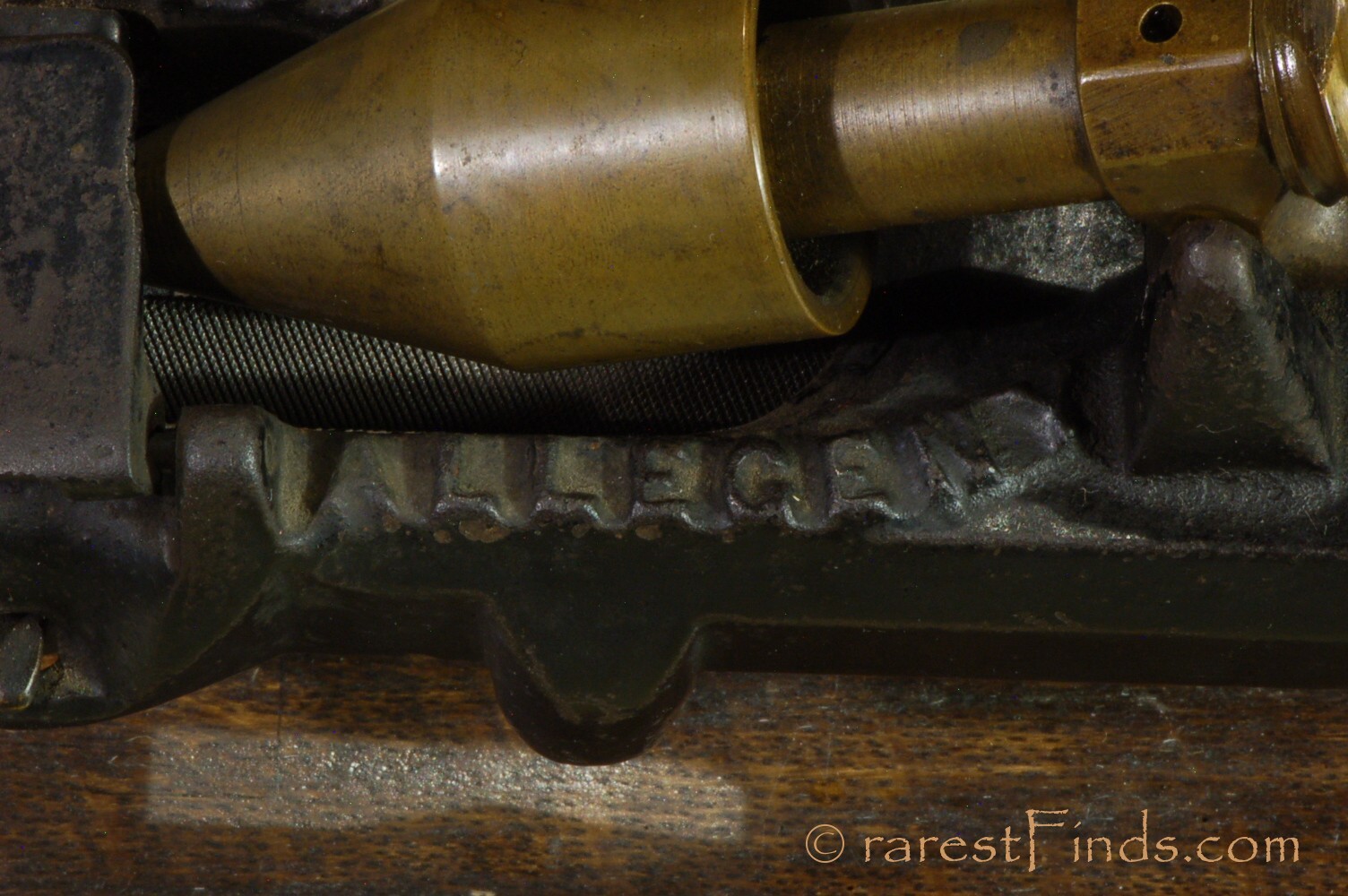
The pencil sharpener offered here is large! From side to side it measures 22¾ inches, the oak board measures 28 by 6& by ¾ inches. The Name "S.FORRESTER" and "ALLEGENY PA" is cast into the frame of the machine, see pictures 14-16.
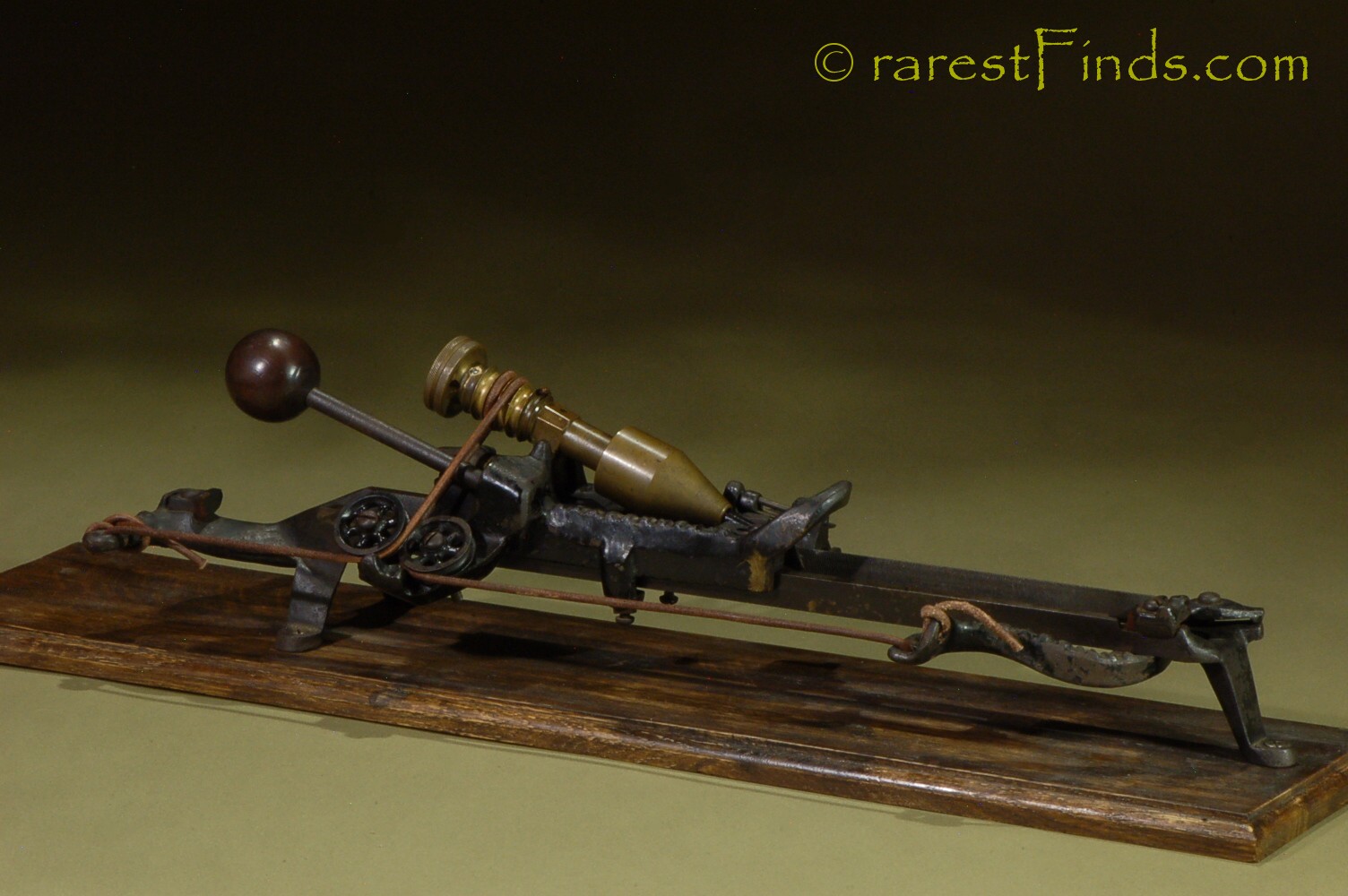
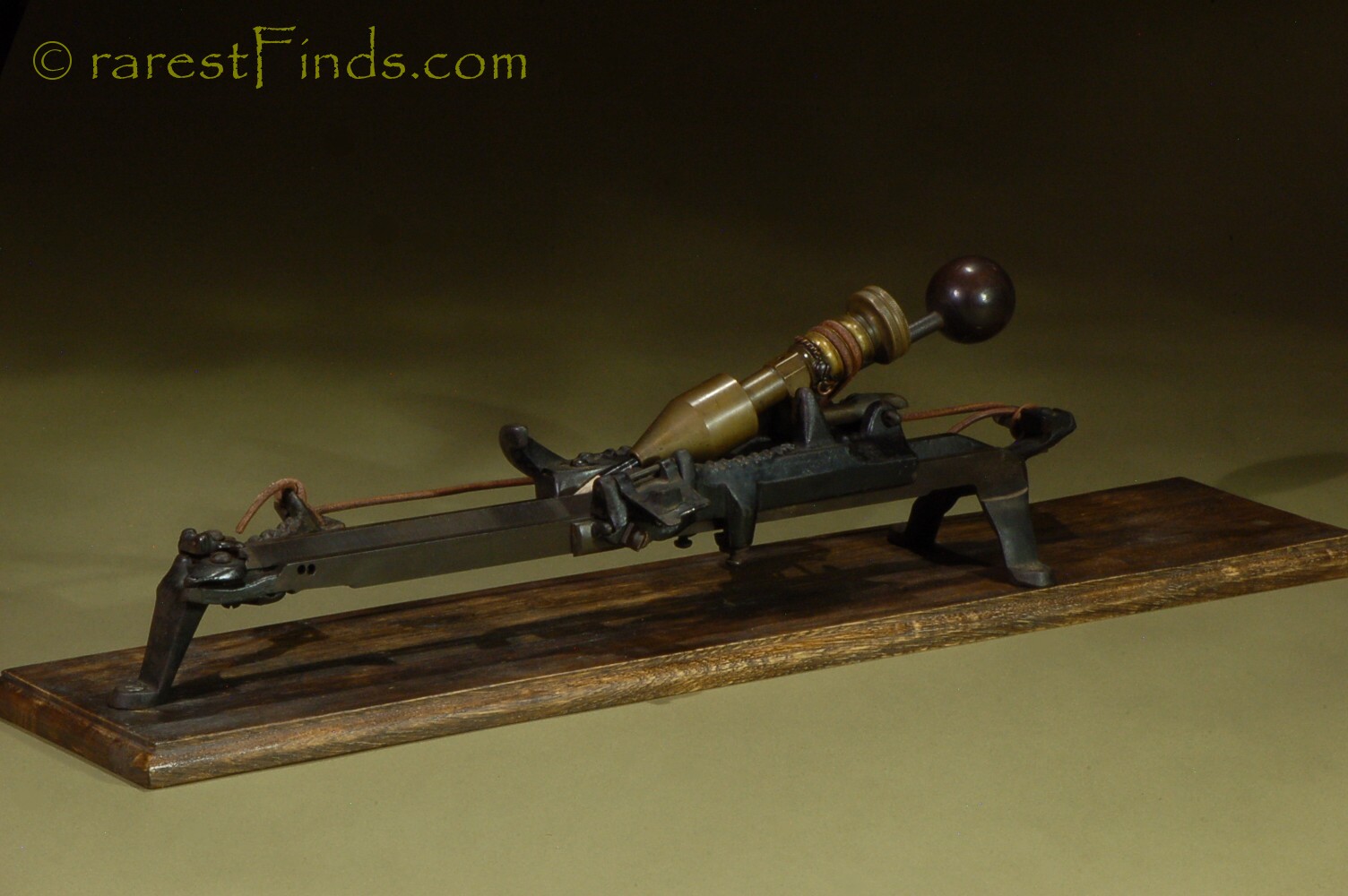
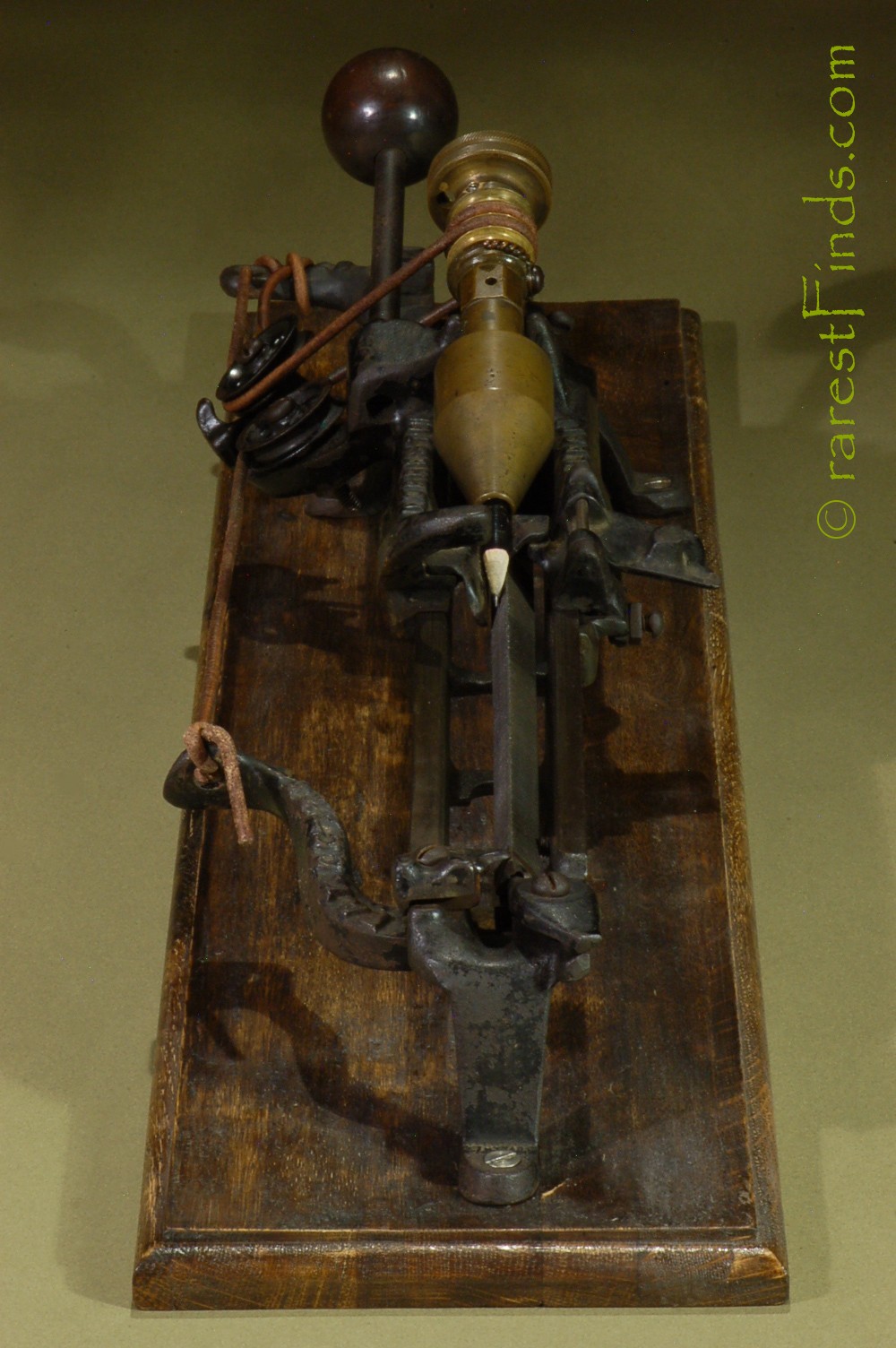
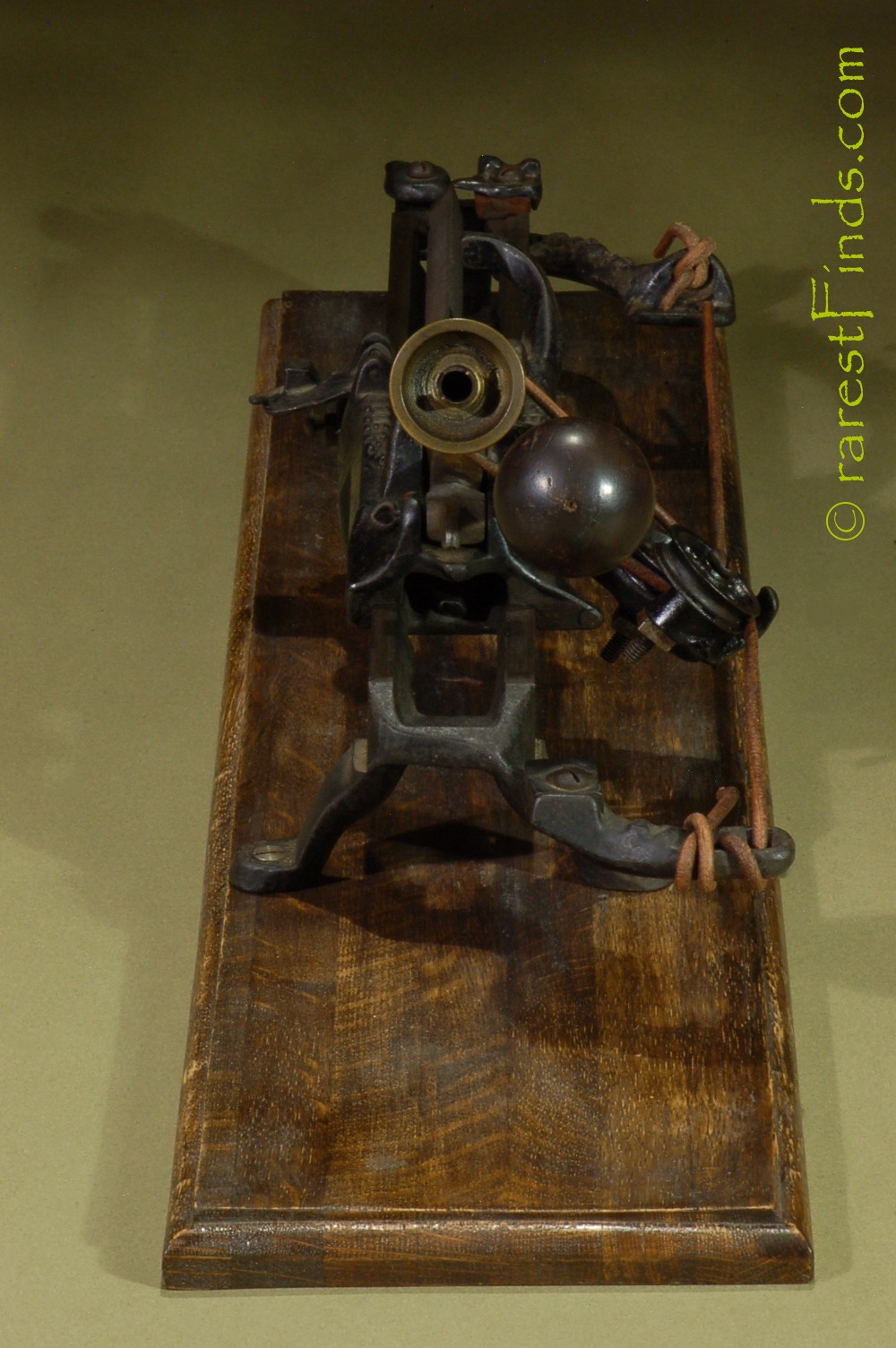
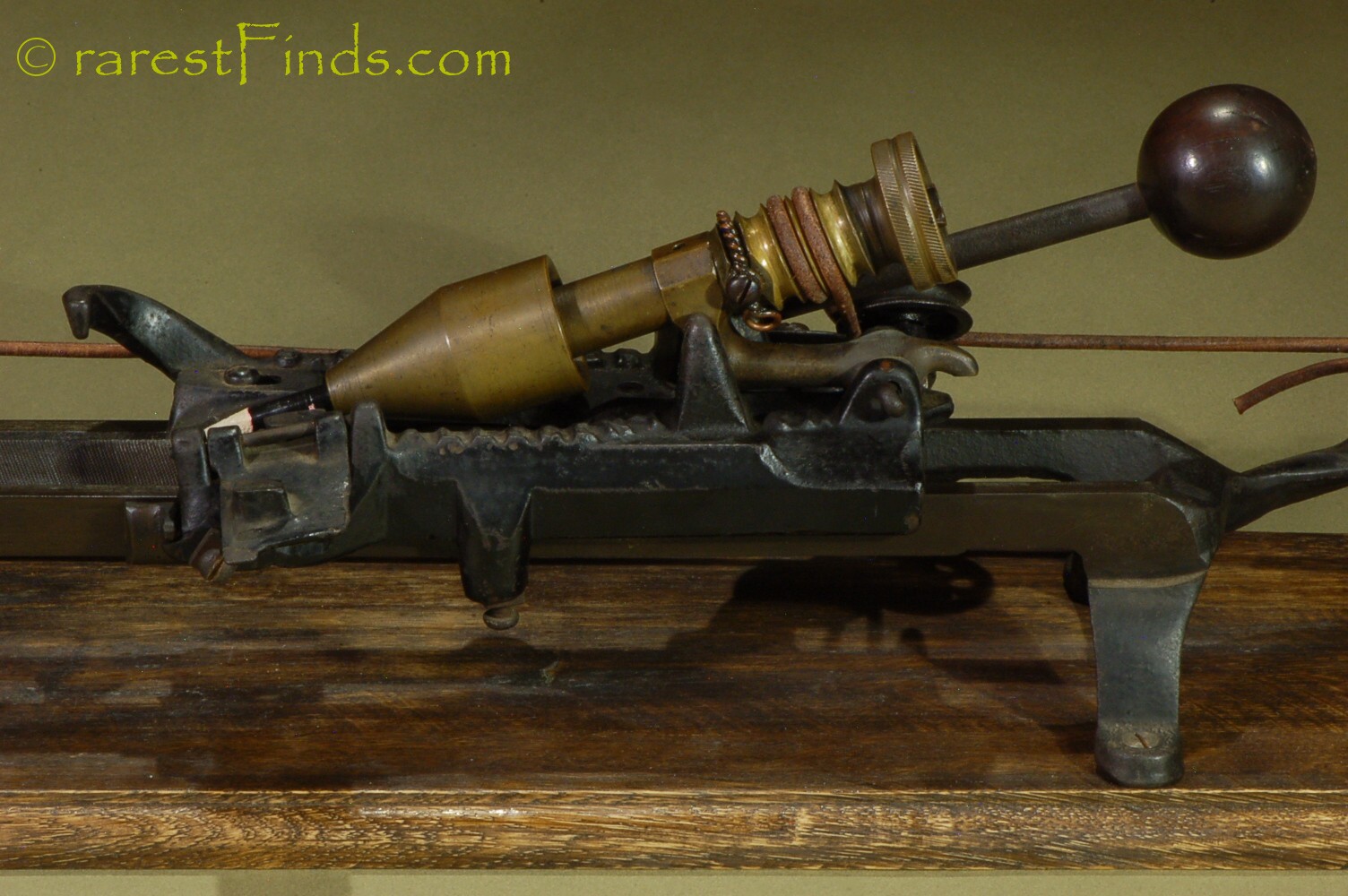
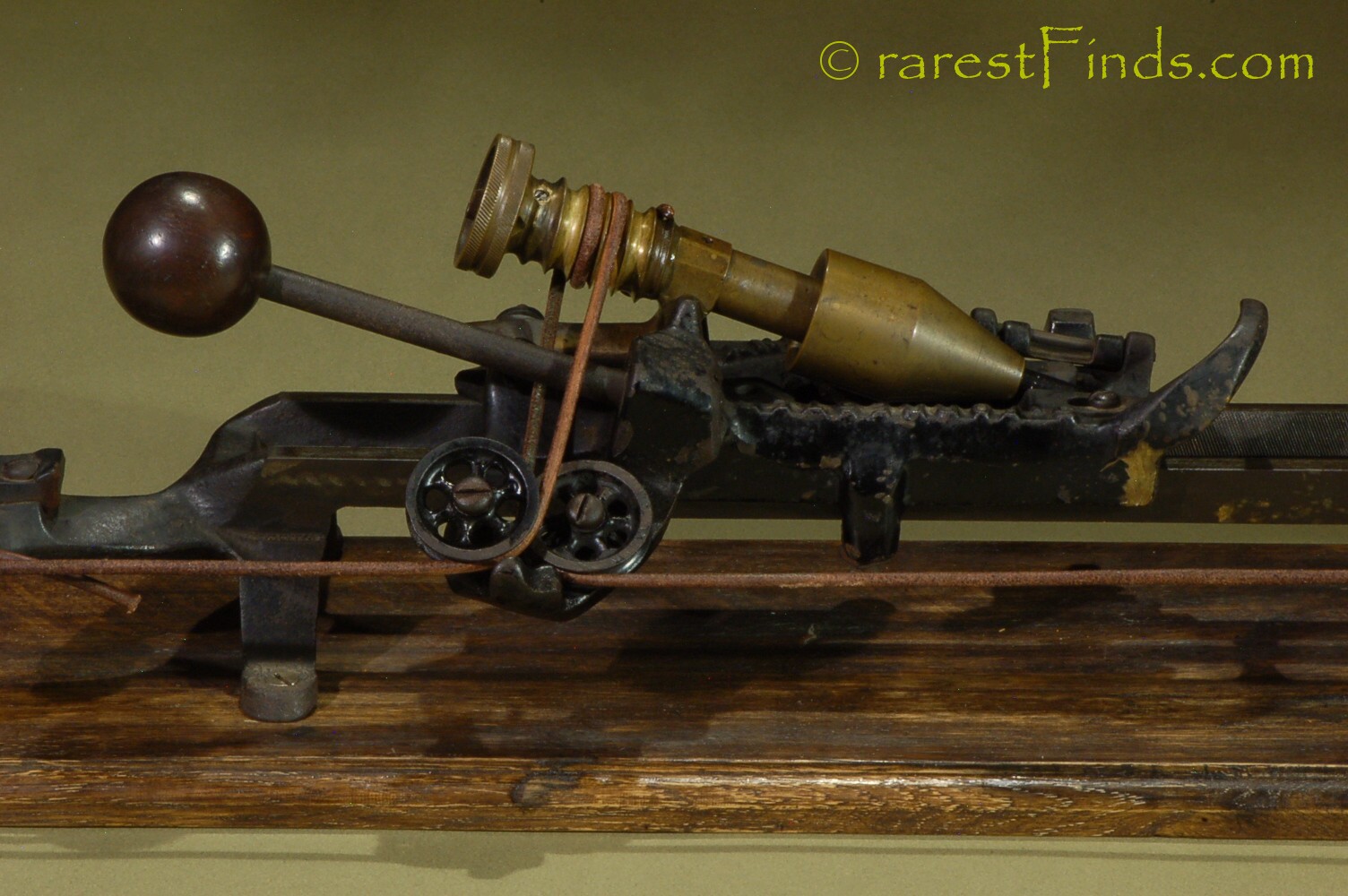
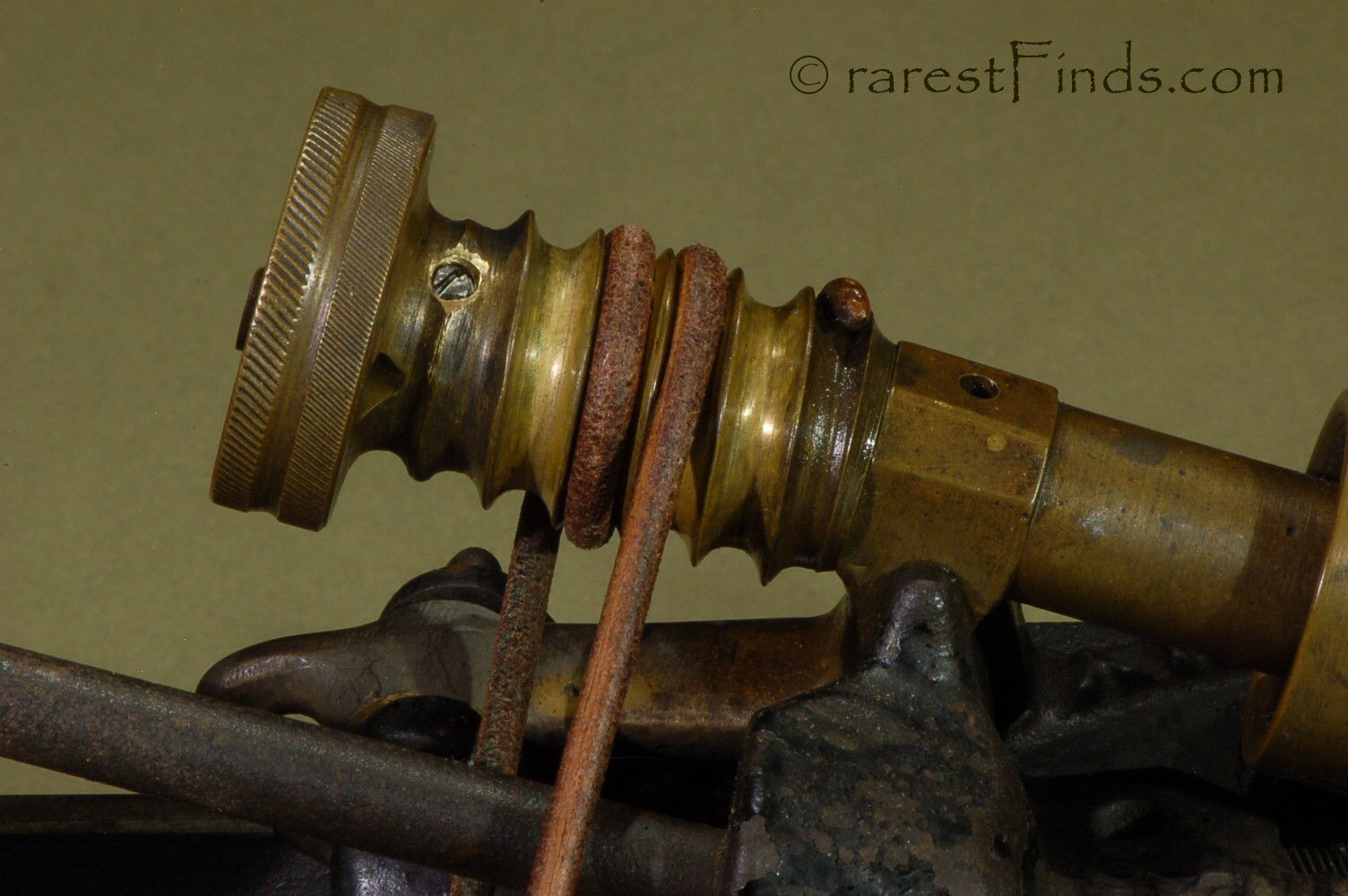
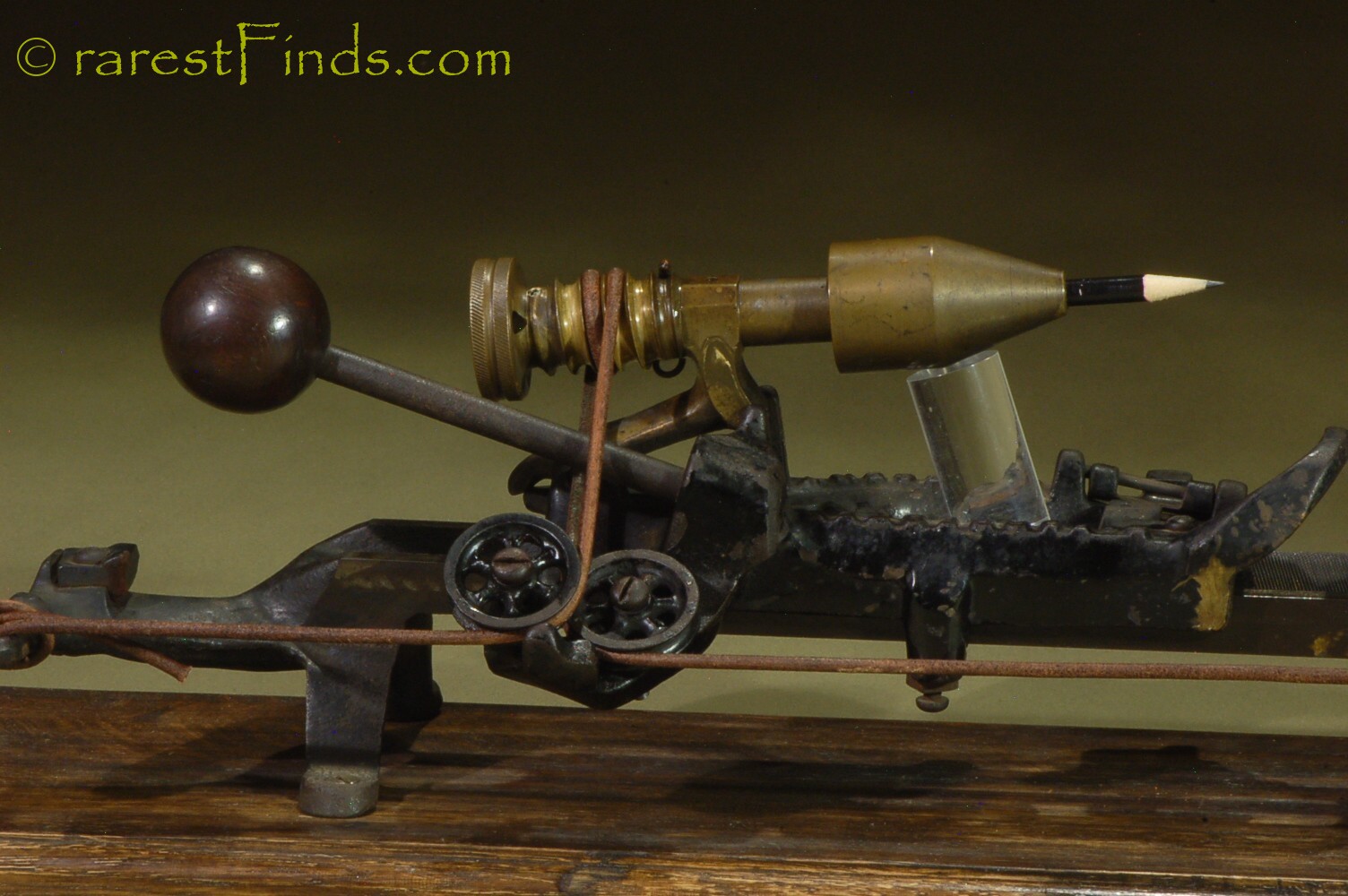
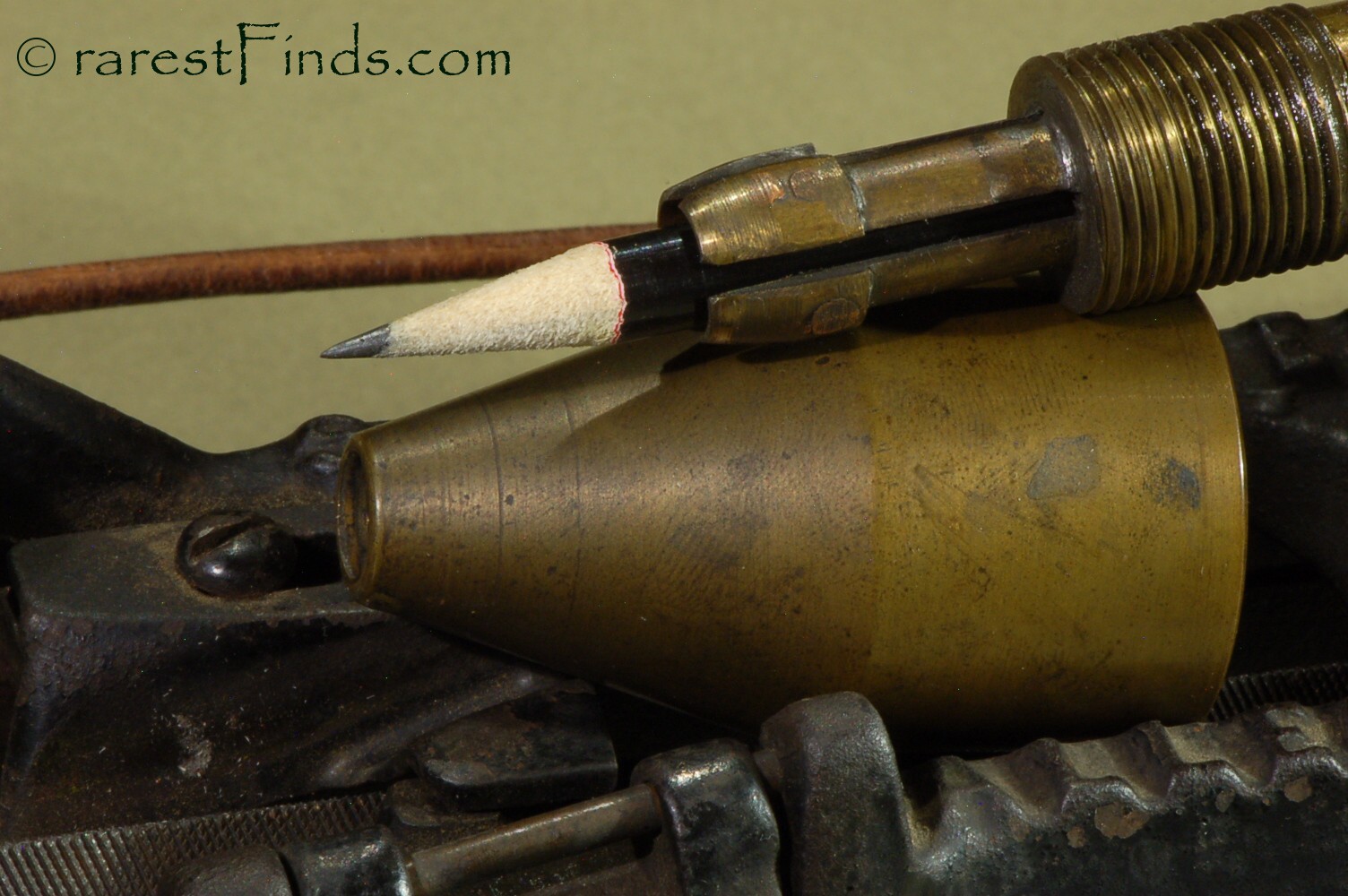
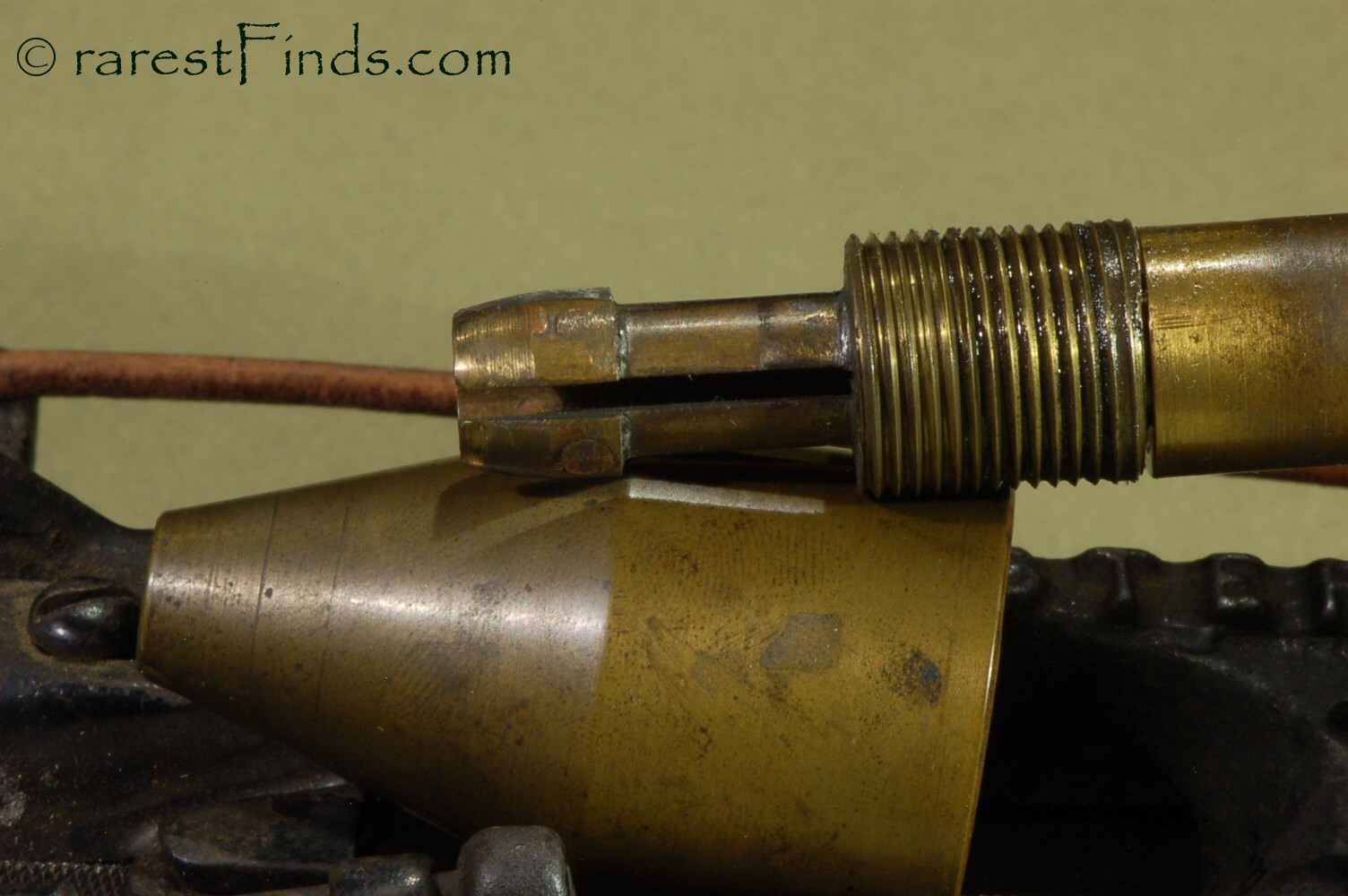
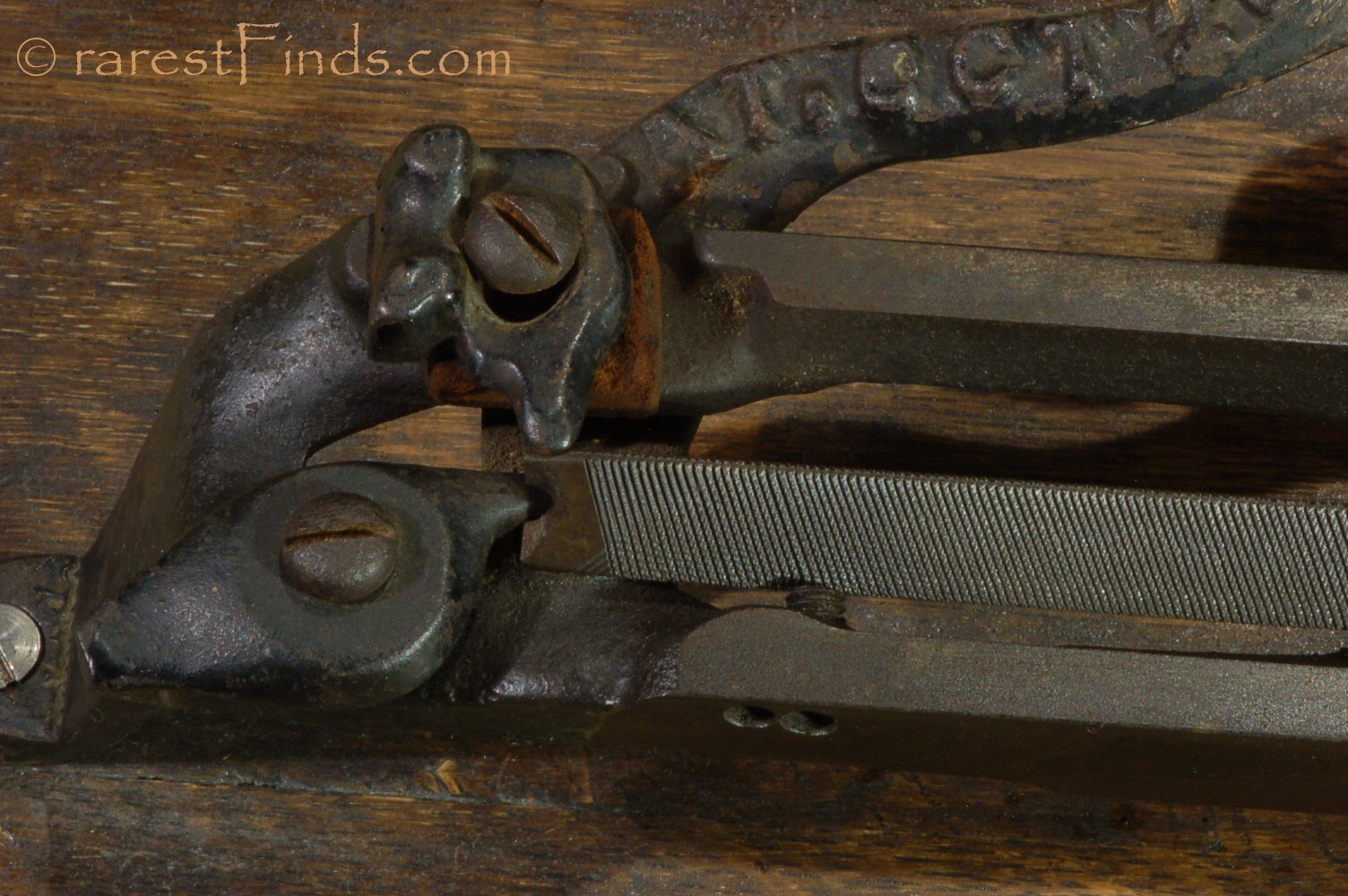
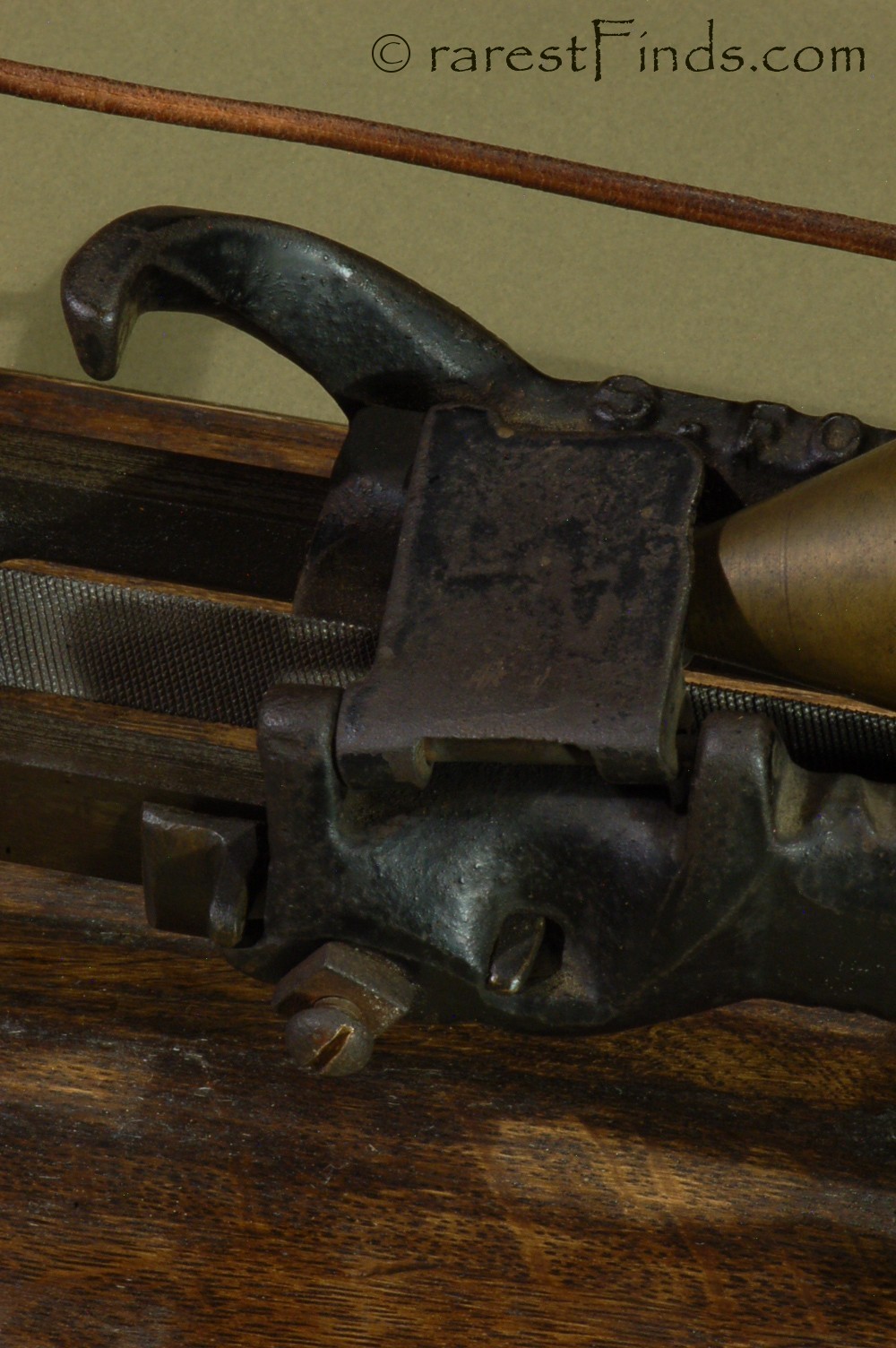
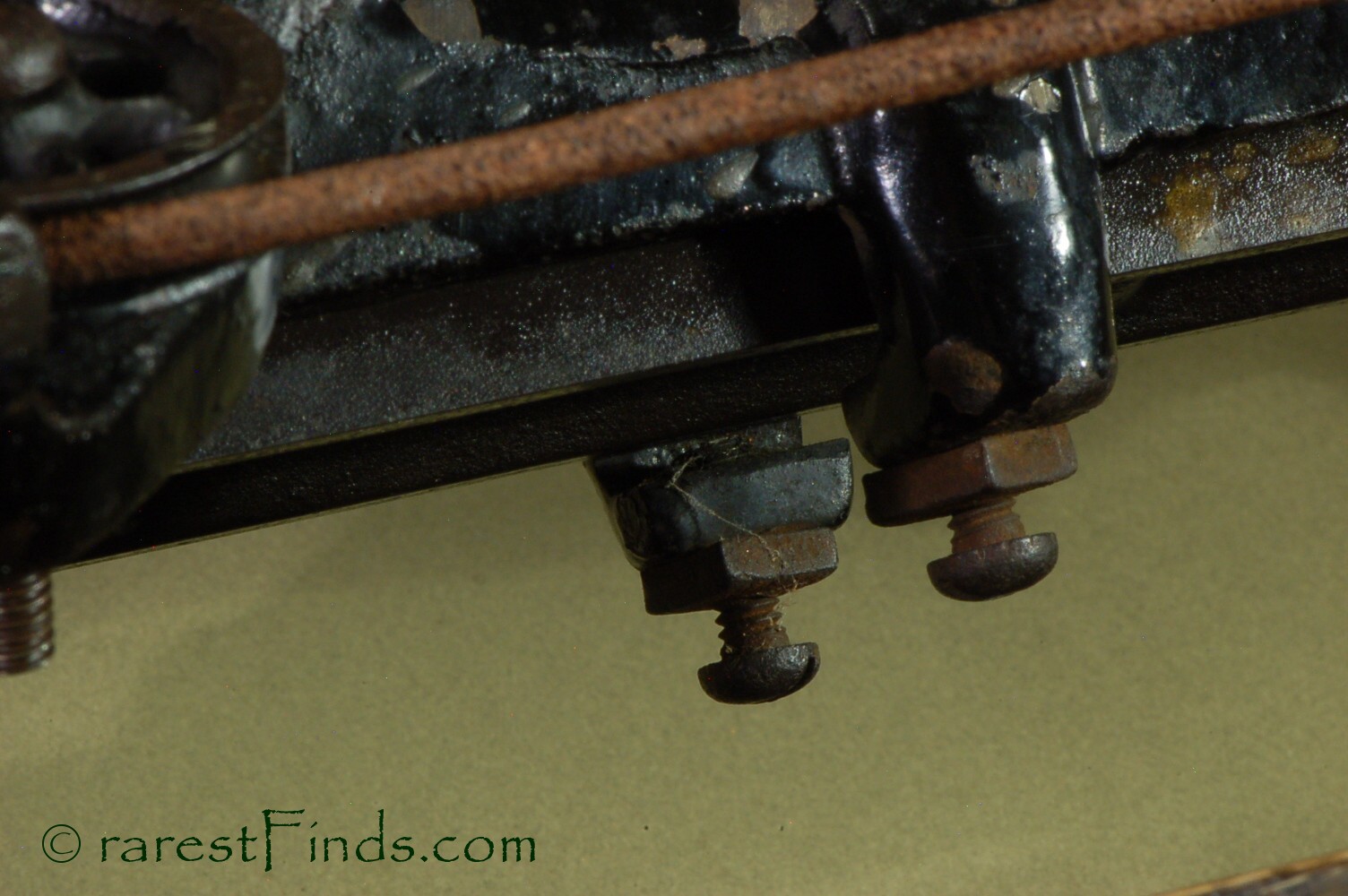
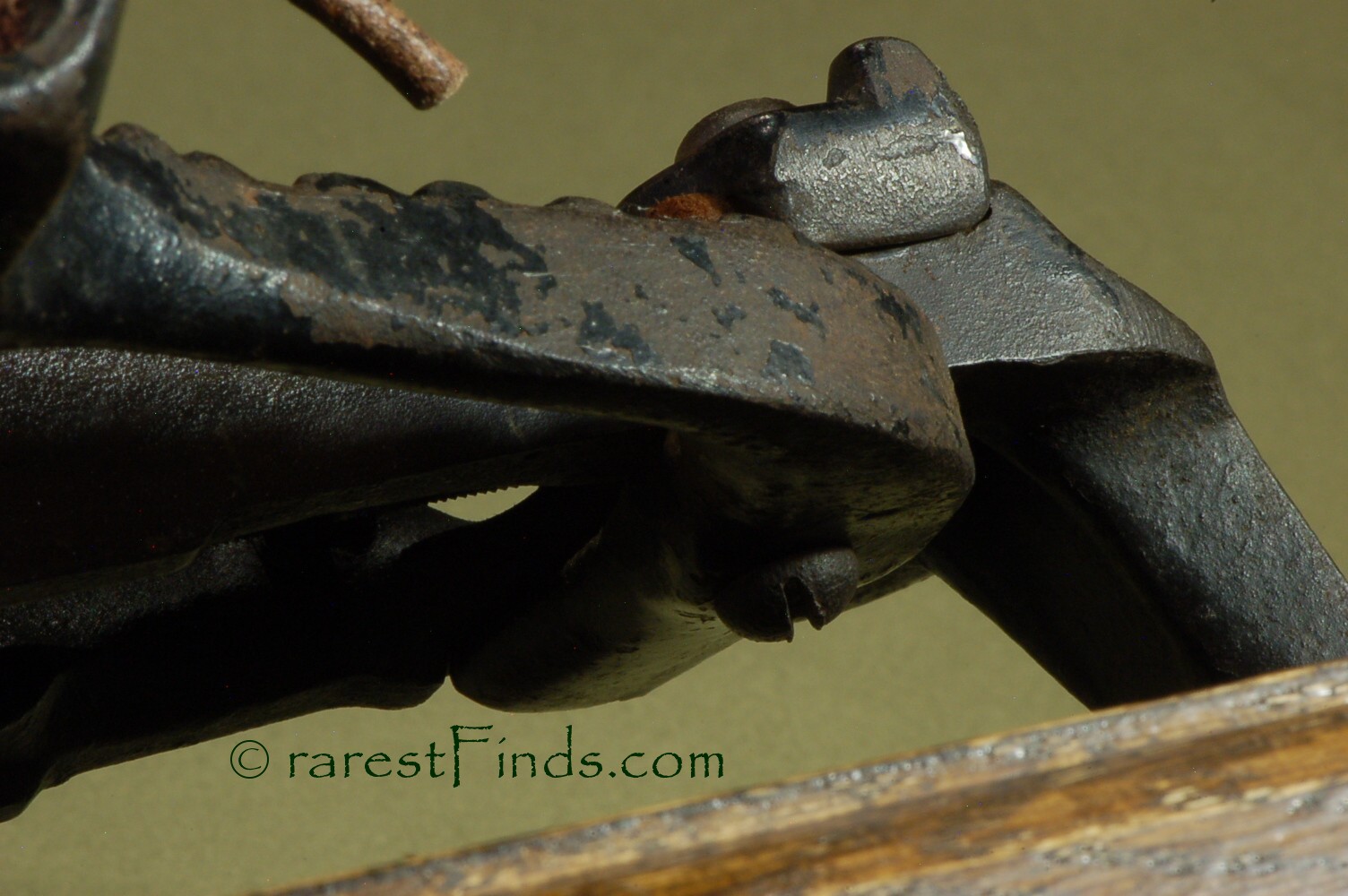
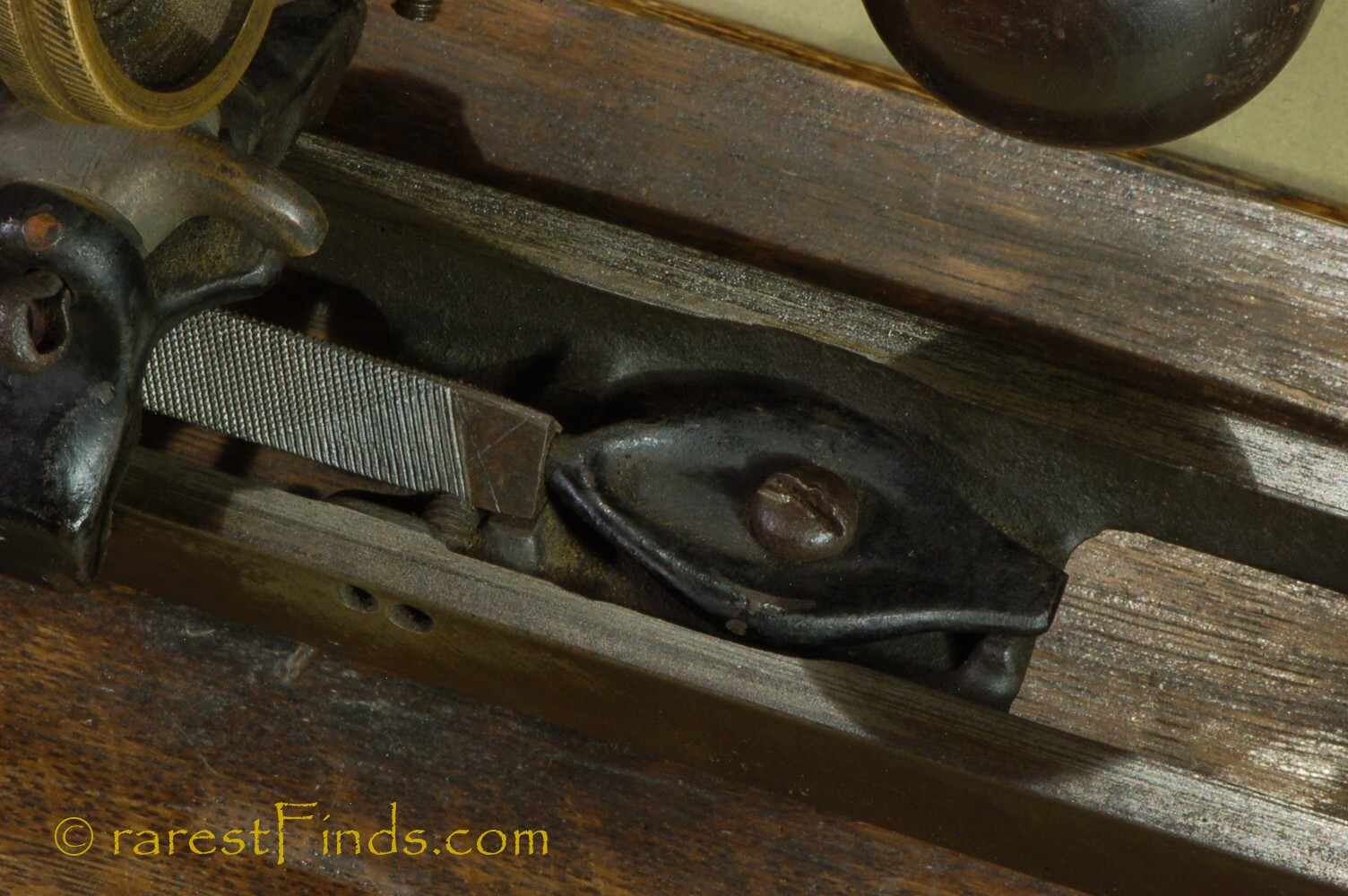
This early pencil sharpener has a stationary, precision ground bed, with two tracks, on which the carriage travels back and forth, like a carriage on a metal lathe. The carriage has a slanted brass sheath attached, into which the pencil is inserted. At the end of the sheath is a knurled knob to adjust the leather cord's position, see picture 9.The sheath has a hole to oil the sheath, see pictures 8 and 9.The sheath has at its end towards the file a brass chuck to hold or grab the pencil, not unlike you would find on a drill, see pictures 10-12. Picture 12 shows the threaded nut or sleeve removed from the three jaws holding the pencil. The sheath has a grove with five turns to accommodate the leather cord or strap. This cord is attached with a knot through holes on either end of the pencil sharpener. The arm on the left side, the side with one leg, is removable to allow the carriage to be slid onto the two tracks of the bed, see picture 21. The carriage has two set screws on the bottom to adjust the vertical play between the carriage and the bed, see picture 20. There is also a provision to adjust the horizontal play between the carriage and the front track of the bed, see picture 17; the screw is located underneath the flap which covers the spot where the pencil is being sharpened. The frame of the pencil sharpener has two legs on the right hand side and one leg on the left hand side to fasten the pencil sharpener to a table or a wooden board. The front is where you would stand in order to read the writing cast into the cast iron frame of the pencil sharpener, see picture 21. The two pulleys directing the leather strap would therefore be located on the back side of the pencil sharpener. The steel file which does the sharpening is interchangeable and has different provisions to hold it in place and to adjust its exact location, see pictures 13 and 22. There are nine screws in total which need adjusting to guarantee proper functioning of this pencil sharpener!
To operate this 19th century pencil sharpener, the operator would first insert the pencil into the sheath. The sheath can be lifted about 30 degrees to insert the pencil, see picture 10. The pencil is being hold in place by turning the chuck clock wise. There is a stop at the end on both sides of the bed to stop the carriage, see pictures 13 and 16 for the left hand stop, and picture 6 and 10 for the right hand stop. There is a flap which can be used to cover the spot the pencil is being sharpened to prevent the shavings from flying around, see picture 3 and 8 showing the flap in the open position, picture 15 and 17 show the flap in its closed position. There is no container to catch the shavings. The operator now would grab onto the large ball attached to the carriage and move the carriage back and forth. There is a lever as part of the carriage for the operator to grab onto in order to operate the sharpener with two hands, see picture 5, 10, and 17. The leather cord would turn the sheath with the pencil as the carriage is being moved back and forth. The pencil being turned by the back and forth movement will now being sharpened on the file running underneath the carriage. As mentioned above, the left and right end of the two tracks of the bed have leather pads as a stop for the carriage movement.
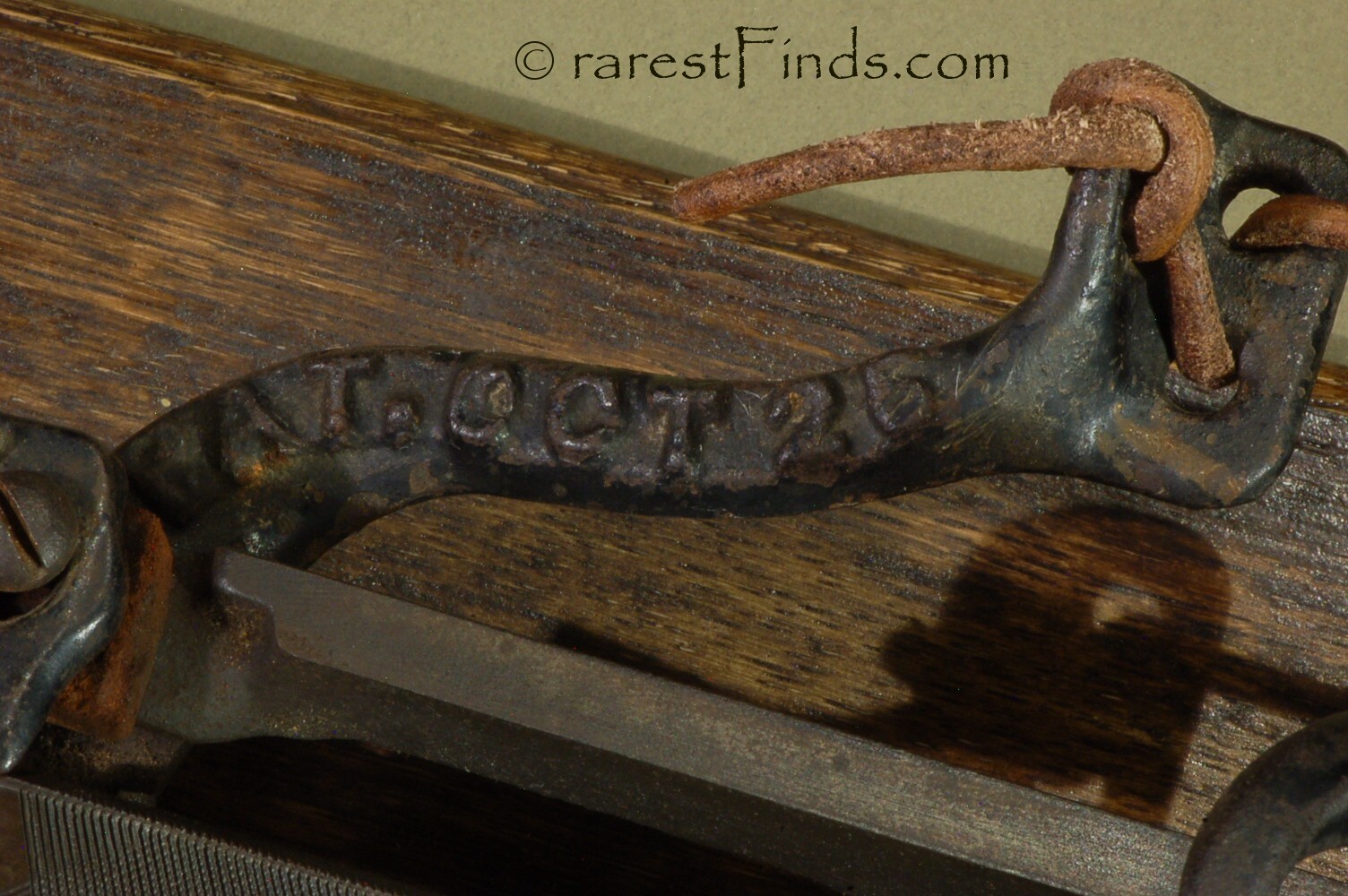
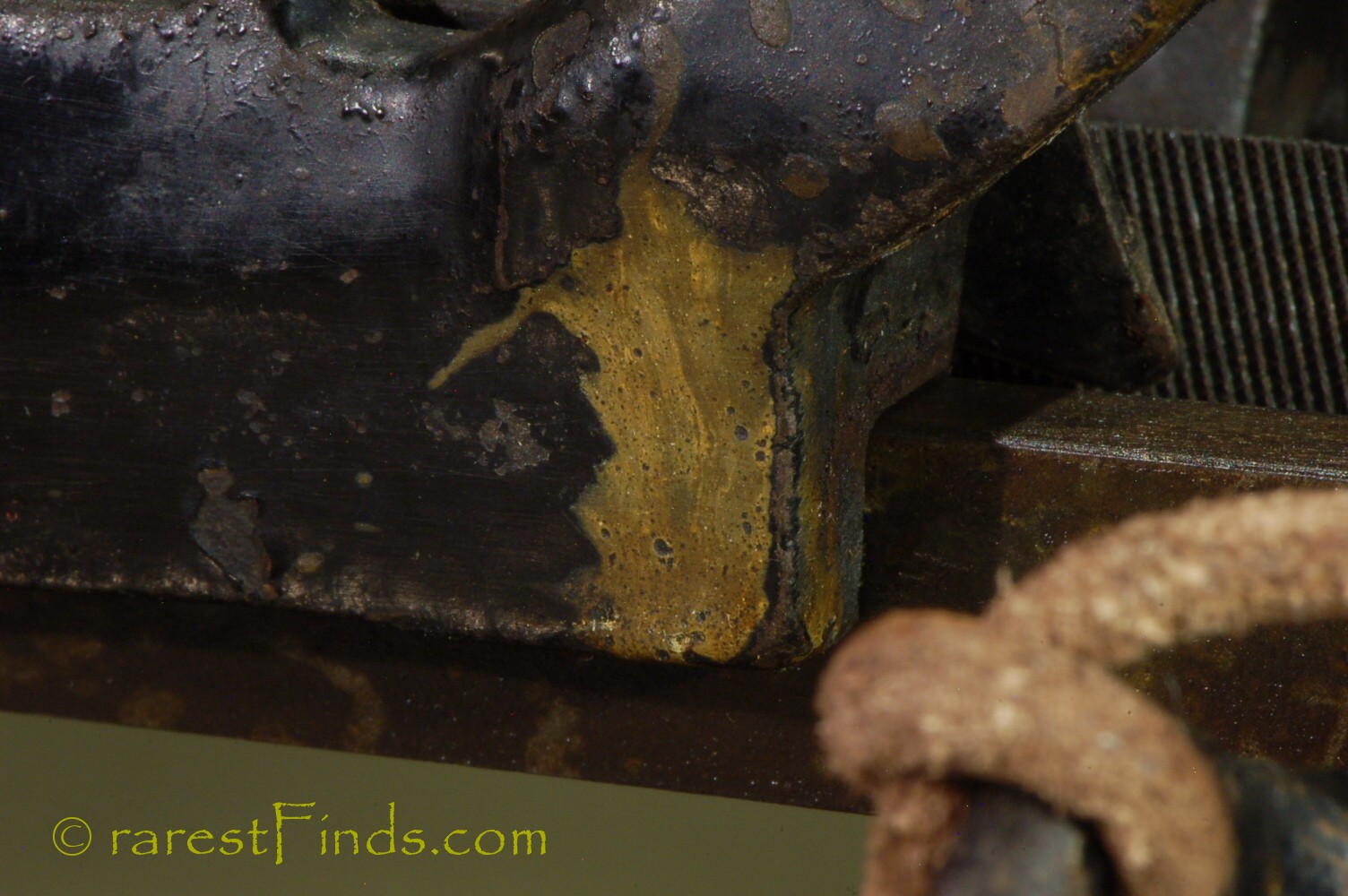
There is one Forrester pencil sharpener known to exist with the remark "PAT APPLD" cast into the cast iron frame of the pencil sharpener. Forinstant, this example of the Forrester pencil sharpener resembles the one shown in the patent papers, the cast iron frame does not have any feet, instead there are spacers keeping the mechanism above the board or table it is mounted on. The one offered here has the patent date of Forrester's third patent cast into the pencil sharpener, the patent date "Oct. 25. 1887." The machine offered here has feet which are part of the cast iron.Both of these historic known machines resemble in most part the machine protected by Forrester's third patent for a pencil sharpener, patent no. 372,258. The obvious improvement of Forrester's third patent is the use of the "cord or strap" running around "pulleys" causing a rotary motion of the "sheath" and chuck holding the pencil. However, this antique pencil sharpener is also protected by the two earlier patents.
Both of the earlier patented designs are most likely never manufactured, as there is no record indicating that they were.
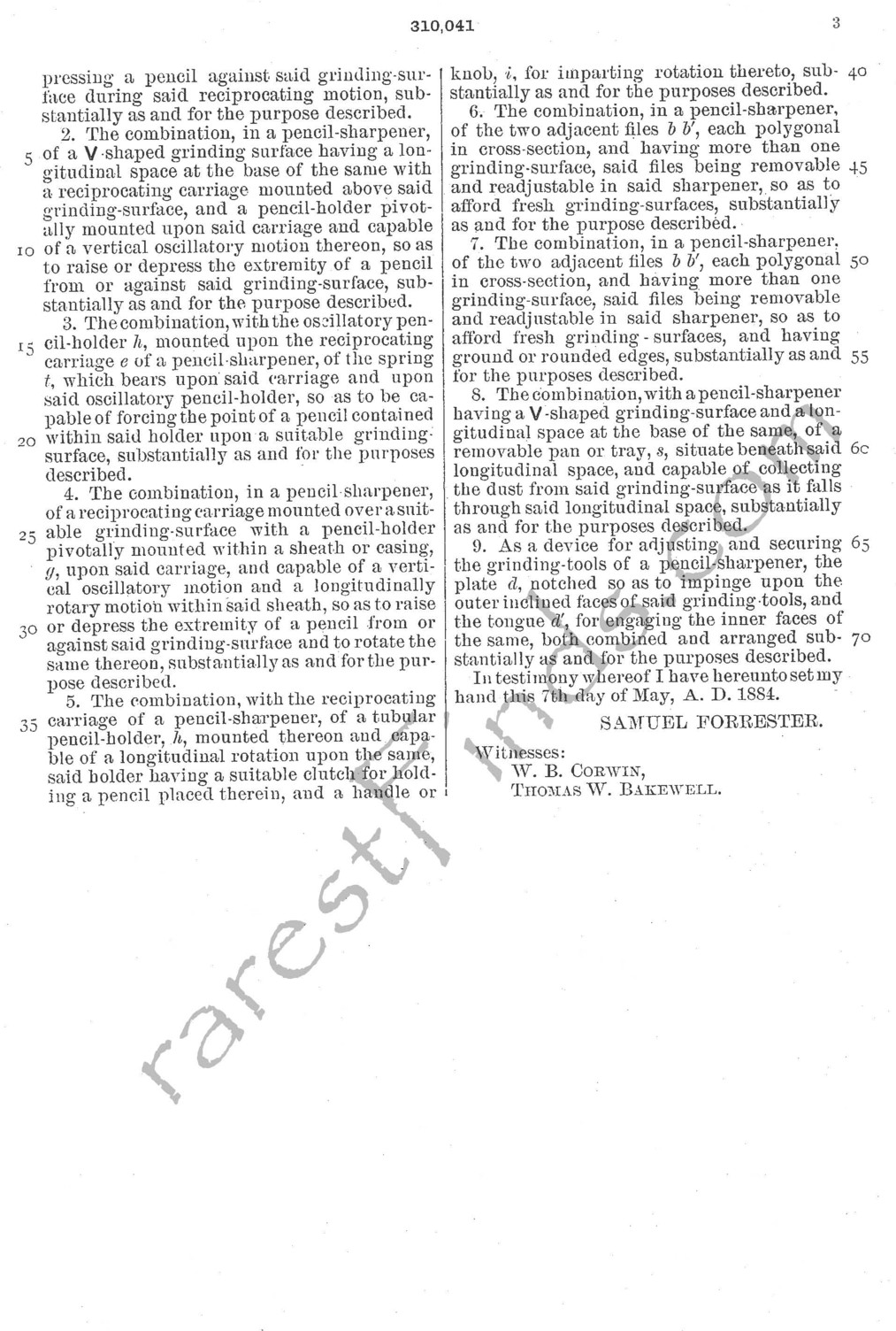
Forrester's first pencil sharpener patent was filed on May 12, 1884, and the number 310,041 issued on December 30, 1884.
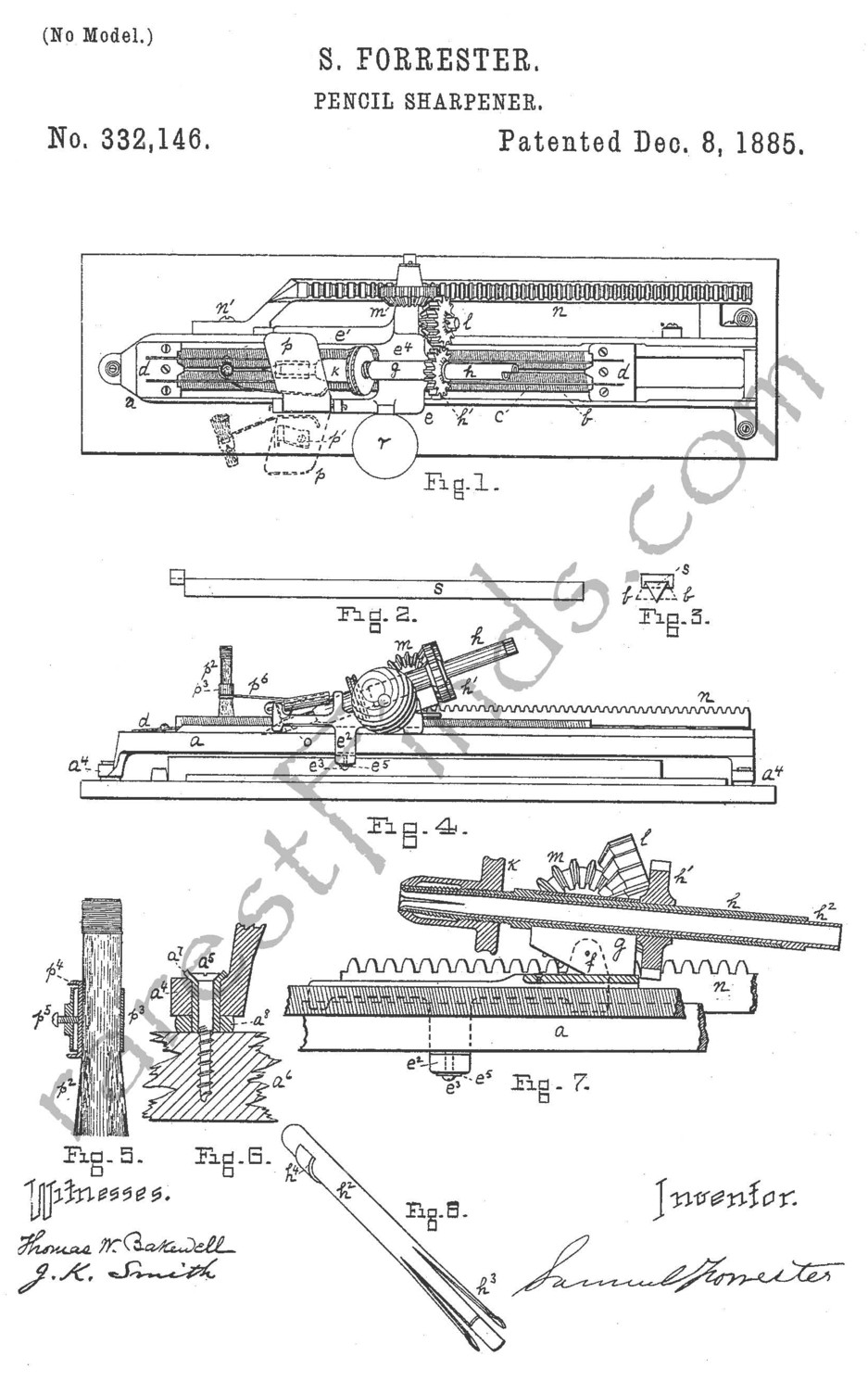
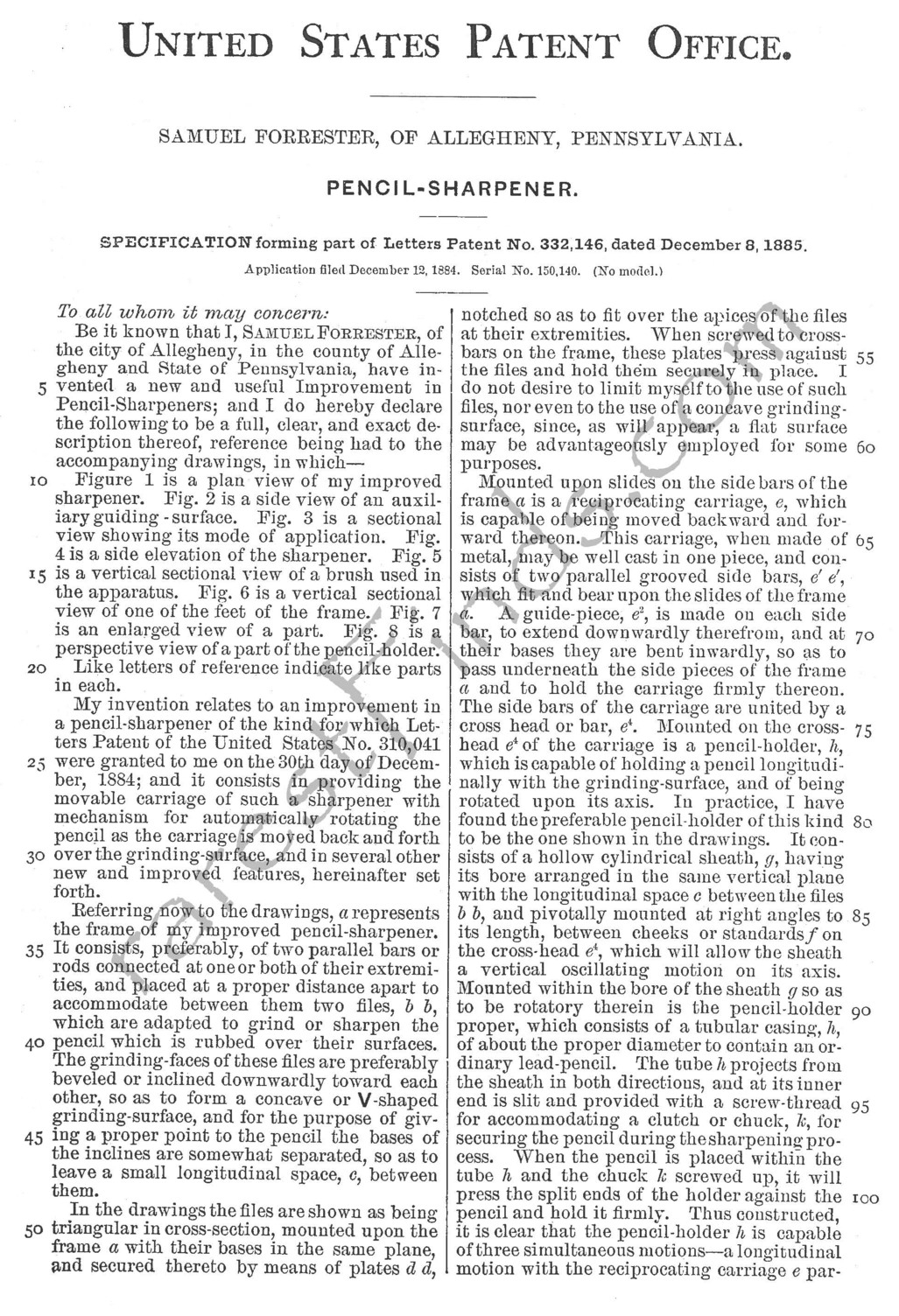
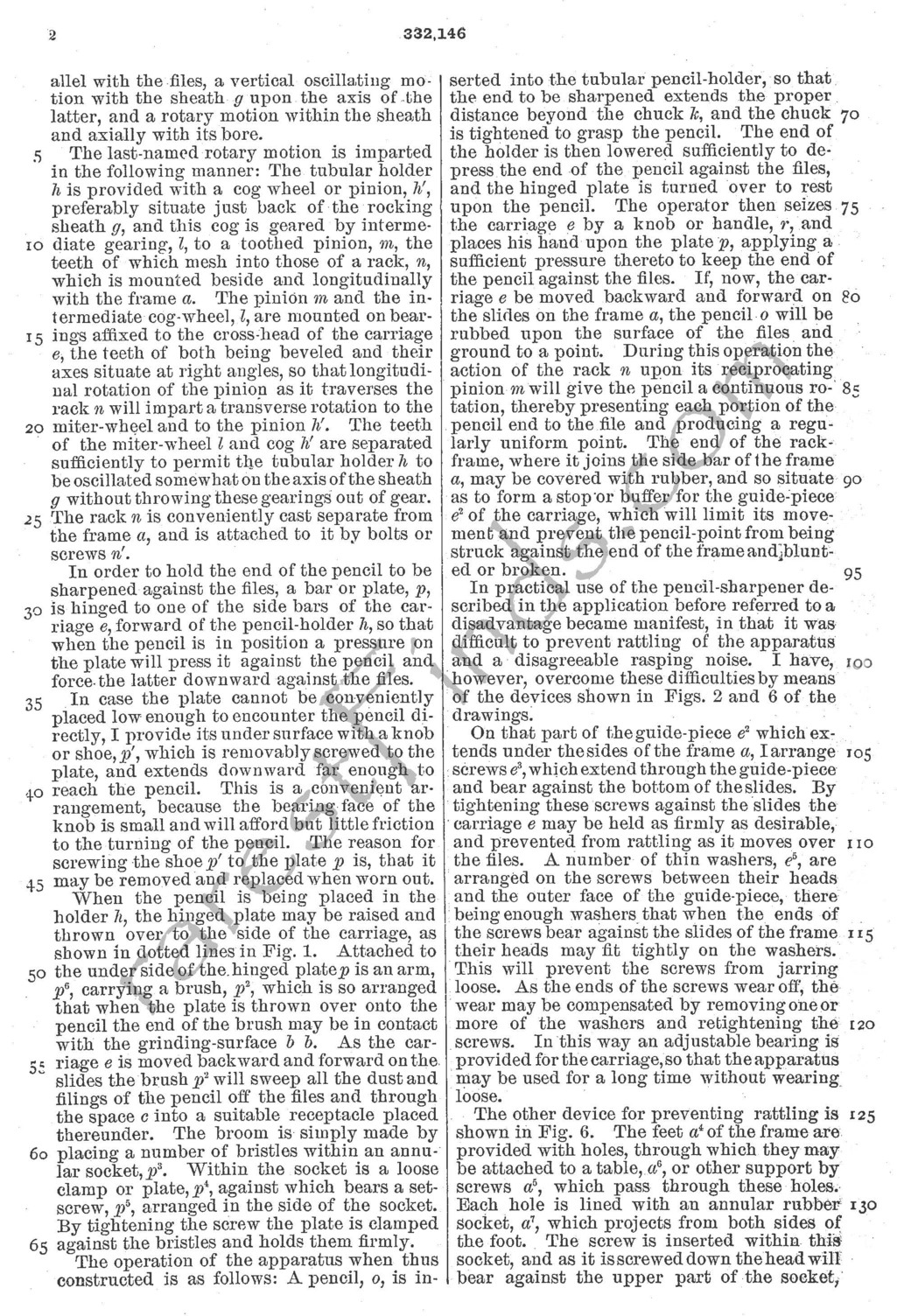
Forrester's second pencil sharpener patent was filed on December 12, 1884, and the number 332,146 issued on December 8, 1885. The reader may noticed that Forrester applied for his second patent before the first even issued. This could be an indication that Forrester realized that his design was flawed, and applied for his second patent before the first one even was granted.
Forrester repeated the same thing with his third patent which he filed again before his last patent, the second patent, was even granted. He applied for his third patent on Aug. 27, 1885 but his second patent with number 332,258 was only issued on December 8, of the same year. His third patent issued on October two years later, on Ocotber 25, 1887.
As already mentioned above, the Forrester pencil sharpener offered here has the latest patent cast into the pencil sharpener frame, the date October 25, 1887.
The only other Forrester which is known to exist and pictured on the Office Museum website seems to have the remark, "patent appl'd." all the way on the left on the arm where the leather belt is attached to. Samuel Forrester, without any doubt, invented the most complex pencil sharpener ever invented. It is not surprising that the machine was a total failure. This must be the reason for the fact that it is also the rarest pencil sharpener among the 19th century pencil sharpeners. Despite its complicated construction and function, it does not even work well.
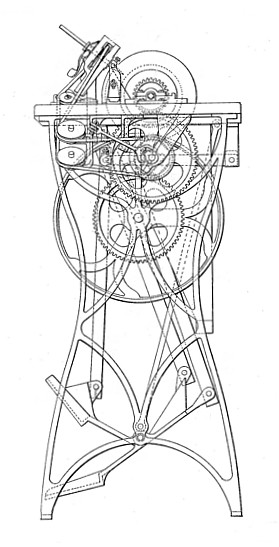 Forrester was the first to apply for a patent for a foot-powered pencil sharpener, and did so on July 23, 1908. He died on October 15th, 1913, before this patent issued on October 27, 1914. The number of the patent for the first foot-powered sharpener is 1,115,298. His invention of the foot-powered pencil sharpener was meant to be used in pencil factories to sharpen pencils and was mounted on a cast iron table like treadle sewing machines at the time, see image on the left.
Condition:
This Exceedingly rare pencil sharpener shows surface patina consistent with its age. Everything moves and with some patience the machine even sharpens a pencil. The file is somewhat dull and the machine does not work well. I could not find any replaced parts or any damage. There is nothing missing. some of the parts, like screws are too long for the purpose (the two screws holding the two pulleys are way too long). There are holes which did not serve a purpose any longer and Forrester filled in in order to be able to use the castings. These holes must have been part of a design that was abandoned later on. A further indication that the machine was only produced in very small numbers.
History:
When Samuel Forrester was born on December 20, 1839, in Pittsburgh, Allegheny, Pennsylvania, United States, his father, Hugh Addison Forrester, was 32 years old, and his mother, Nancy Ferguson, was 26.
Samuel Forrester married Henrietta "Nettie" Gallagher and they had at least one son. They lived in Allegheny, Pennsylvania. Samuel Forrester died at the age of 73, and was buried in Union Dale Cemetery, Pittsburgh, Allegheny, Pennsylvania.
S. Forrester served in the civil war from August 20st 1861, till September 3rd, 1864 as 1st Lt. in the Marine Corps.
Forrester applied for a total of seven patents. His first patent was granted on December 7th, 1869, patent no. 97,623 for a CARRIAGE AXLE; the second patent issued on December 30, 1884, patent NO. 309,843, for a CALF WEANER. The three patents for his mechanical pencil sharpener followed. The first patent of the three issued the same day as the CALF WEANER.
On August 27, 1901, the patent office issued patent no. 681,305, for a PEN OR PENCIL HOLDER. For his last patent he applied on July 23, 1908. This patent with the no. 1,115,298, was only issued five years later, on October 27, 1914. He did not live to see it; he died on October 15, 1913.
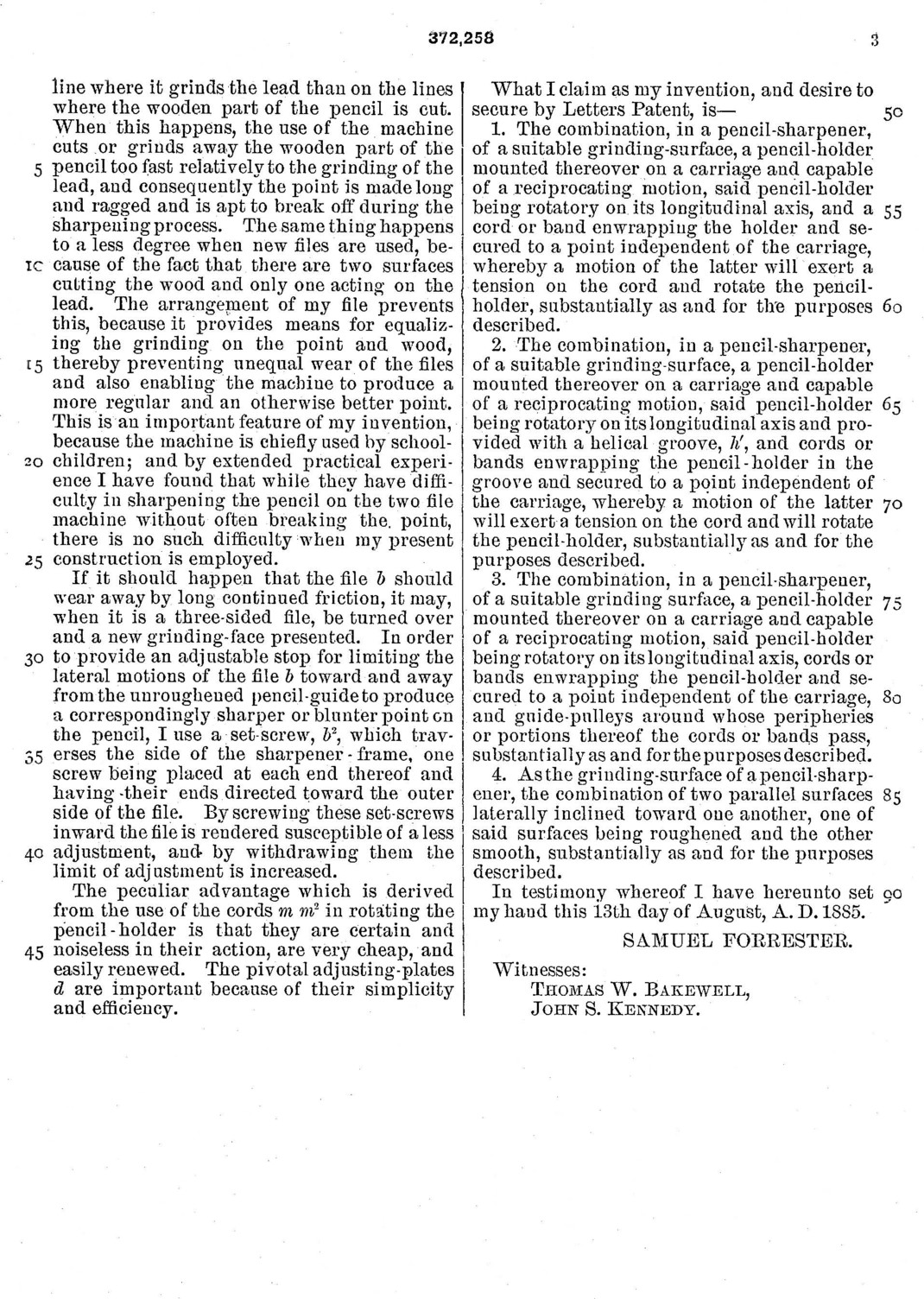
Samuel Forester produced a unique record of his efforts to invent and improve his pencil sharpener. His thought process is thoroughly documented in his three patents he applied for and were granted. For the readers convenance, all three patents are published above; just click on any thumbnail picture to download a large image.
The three patents and their crucial improvements are summarized below.
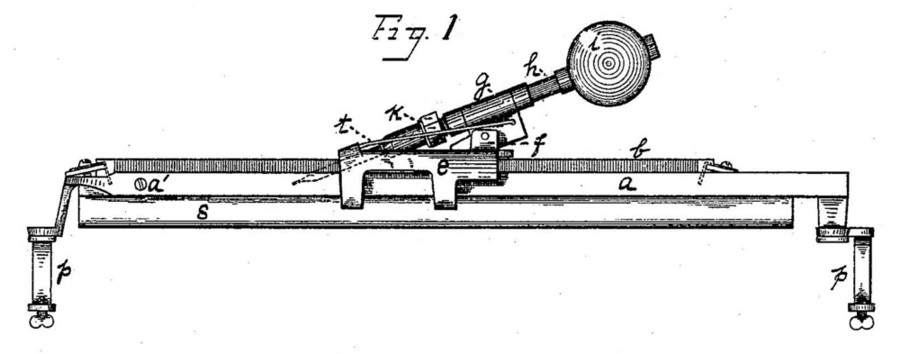
Forrester's initial idea was to have two adjacent parallel removable files with a polygonal cross section (more than two surfaces so the files can be turned and each surface can prolong the life of the file), The two files were intended to be arranged so they form a "V" shaped adjustable grinding surface. The two files were arranged close together without touching each other which allowed to create a long point of the pencil. The pencil holder is traveling parallel to the two files while being turned by the operator.
As far as I know, the machine described in the first patent was never manufactured; at least none are known to have survived. Second patent:
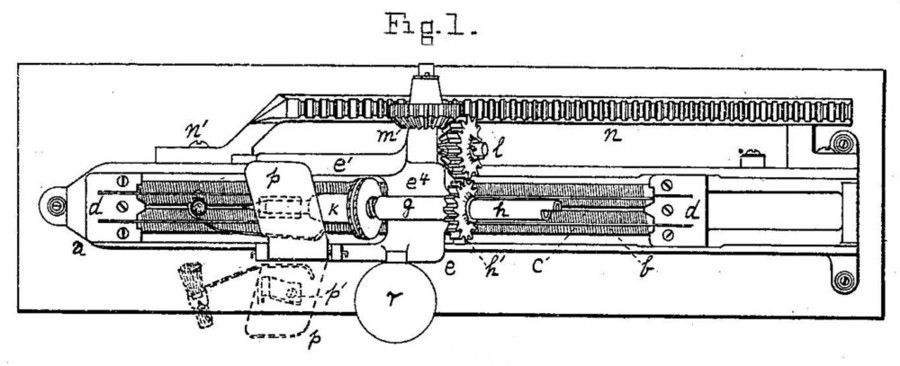 Forrester must have realized that turning the pencil randomly by the operator and not evenly through a mechanism, in a controlled manner by the back and forth movement, was not going to be a success. For this reason he improved his design for which his second patent was issued about a year later, on December 8, 1885.In this second patent, he utilized some sort of rack and pinion set up to turn the pencil in a controlled fashion. To make it work, he described the use of washers to bring the gears in proper contact with each other, and described the use of rubber pieces to prevent the machine from rattling. Part of the patent claim is the use of a brush attached to the carriage holding the pencil, for the purpose of cleaning the shavings from the two files while moving the pencil back and forth.
Third patent:
Forrester must have realized that turning the pencil randomly by the operator and not evenly through a mechanism, in a controlled manner by the back and forth movement, was not going to be a success. For this reason he improved his design for which his second patent was issued about a year later, on December 8, 1885.In this second patent, he utilized some sort of rack and pinion set up to turn the pencil in a controlled fashion. To make it work, he described the use of washers to bring the gears in proper contact with each other, and described the use of rubber pieces to prevent the machine from rattling. Part of the patent claim is the use of a brush attached to the carriage holding the pencil, for the purpose of cleaning the shavings from the two files while moving the pencil back and forth.
Third patent:
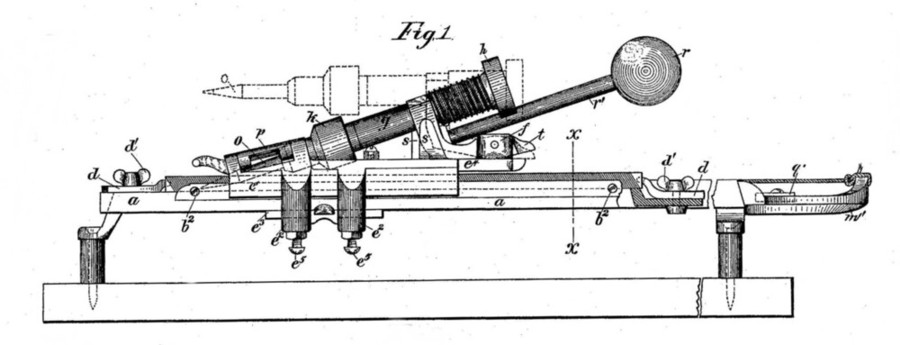 The idea with the rack and pinion was not practical, to expensive to produce, to noisy, and produced too much friction. on August 27, 1885, more than three month before his second patent was even granted, he already filed for his third patent which was only granted more than two years later, on October 25, 1887. In his second application, he only referred to his first application, not to his second.
Forrester abandoned his idea with the rack and pinion mechanisms to turn the pencil and cam up with his final design, the unique design with a leather cord and pulley drive to turn the pencil. This is the design of the pencil sharpener offered here and also the design of the other machine to be found on the internet,
In his third application, he abandoned the idea of using two files arranged in a "V" shape with a small gap between them, and instead, only uses one file with a triangular cross section and on the other side a "pencil guiding bar". Forrester explains in length the disadvantage of using two files over one in his application; an experience he only was able to make once he had a working model. Forrester mentions that School children would break the points with machines utilizing two files. Forrester also points out that leather cords are quiet and cheap.
Literature:
There are no advertisement know to have been discovered. There is a record of alleged sales to school districts.
Inventory Number 09367;
Price: $ 12,400.00.
Prices realized in the past:
NONE