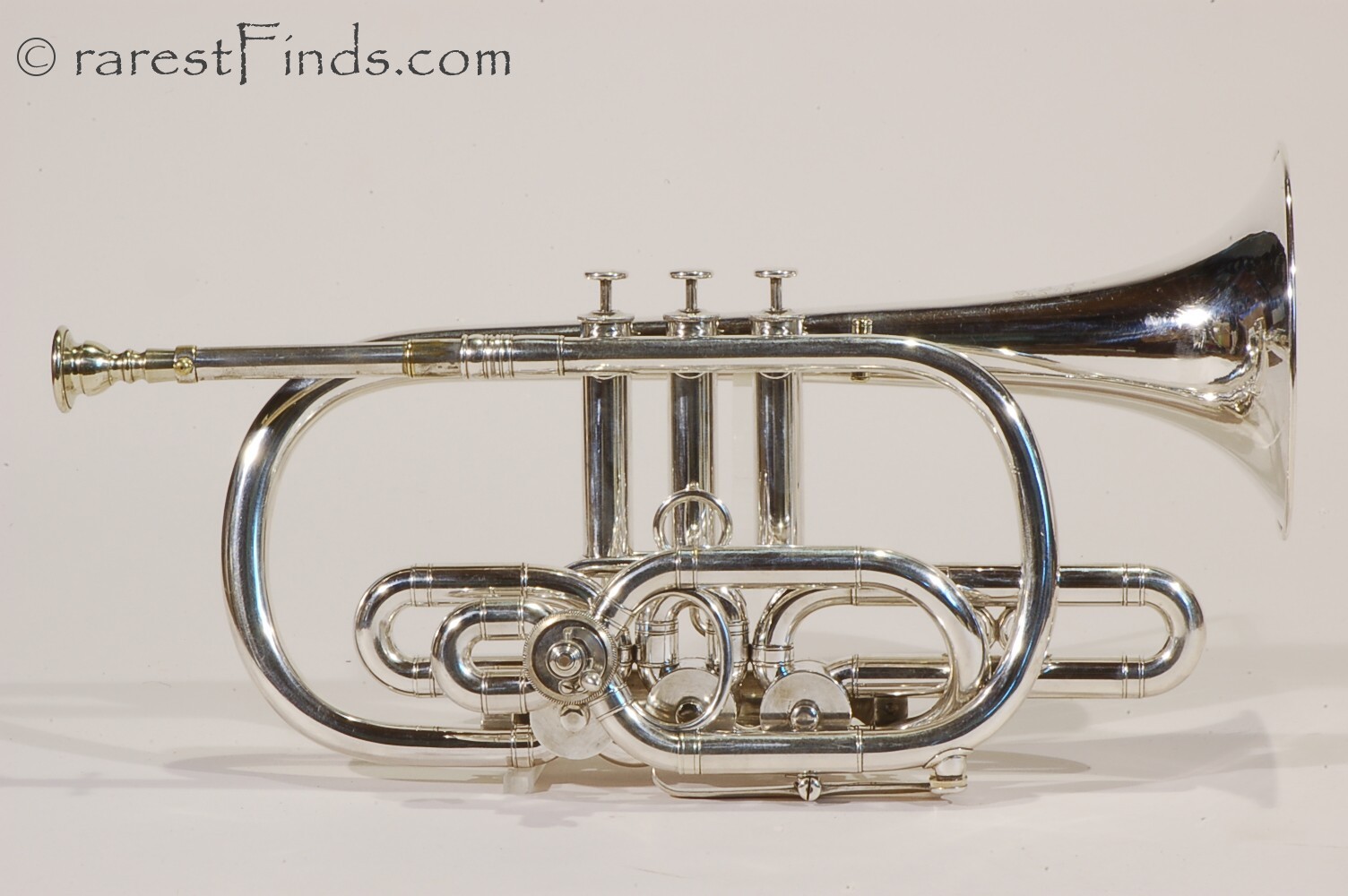
Very rare Isaac Fiske 1868 Bb Cornet with Push-rod String Rotary Valves. Sold!
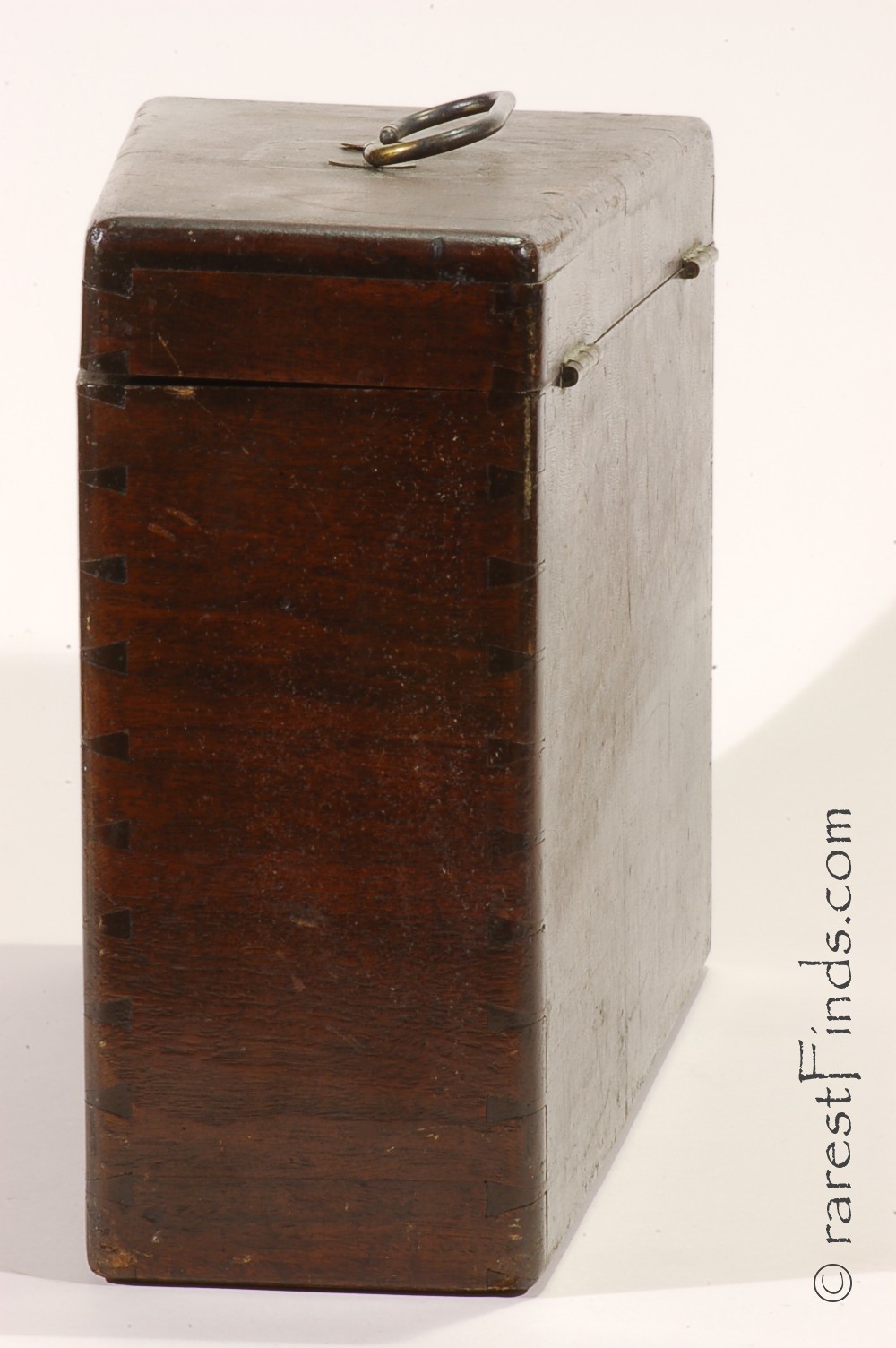
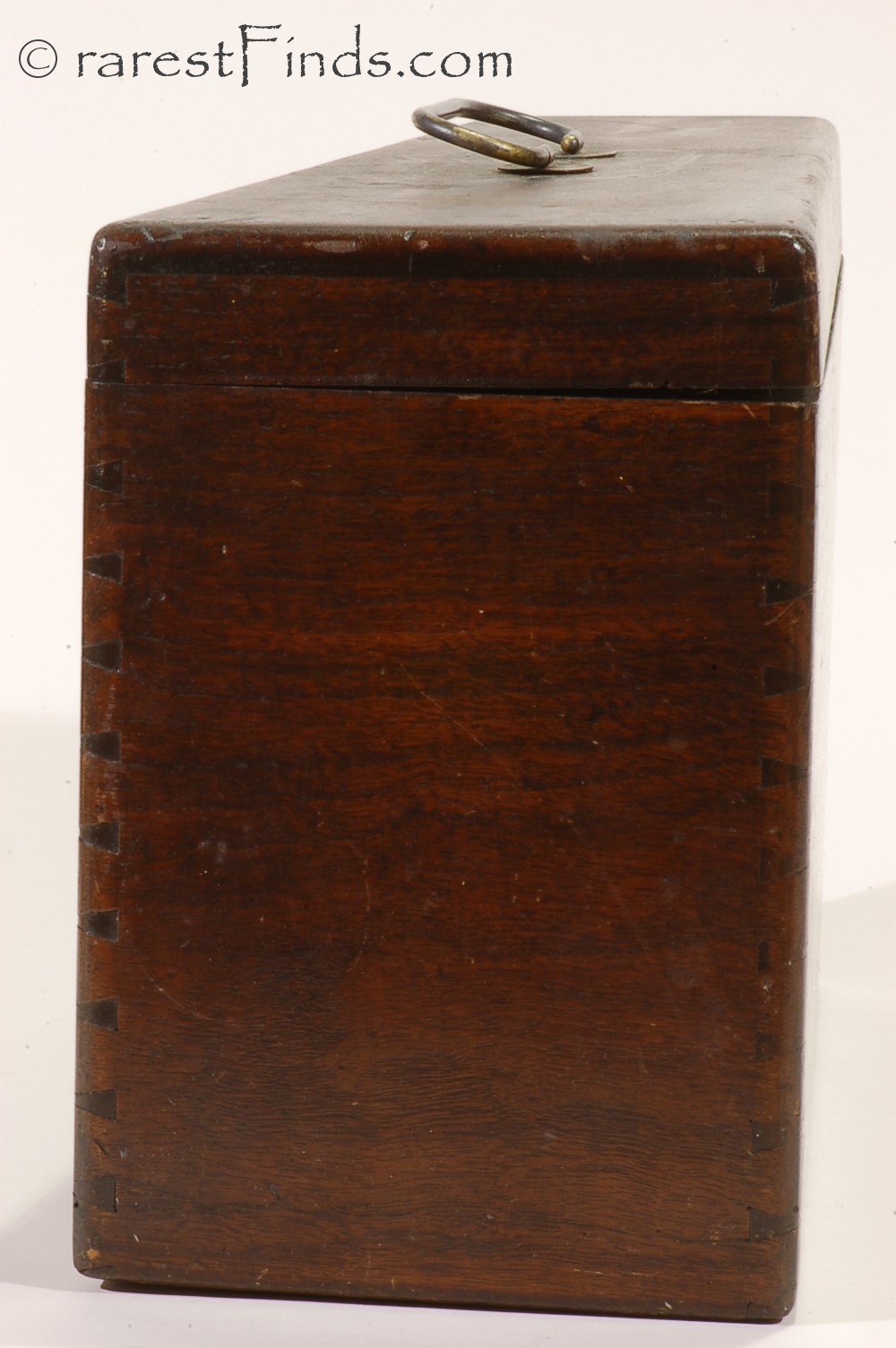
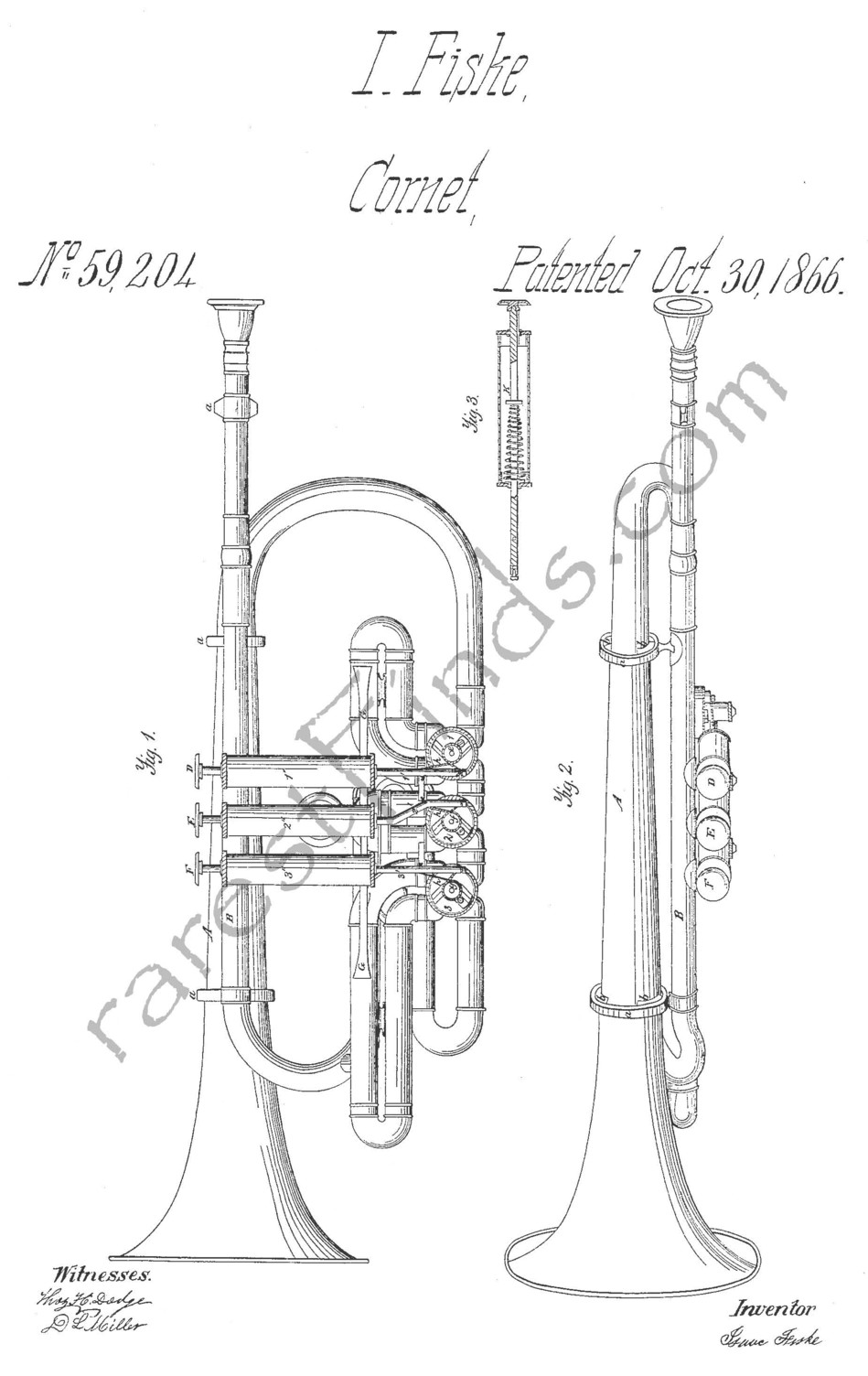
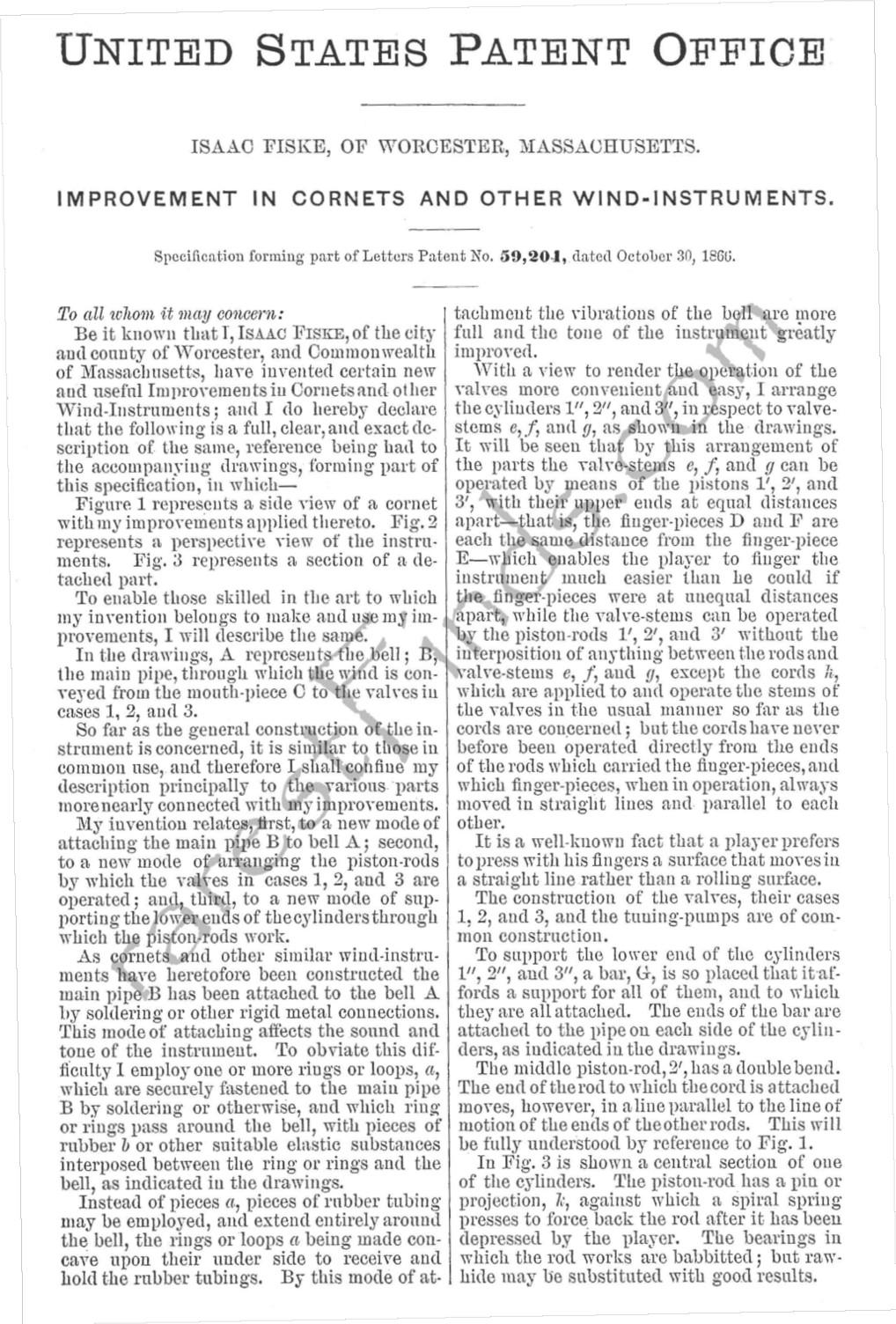
Patents, click on any image to see larger image!
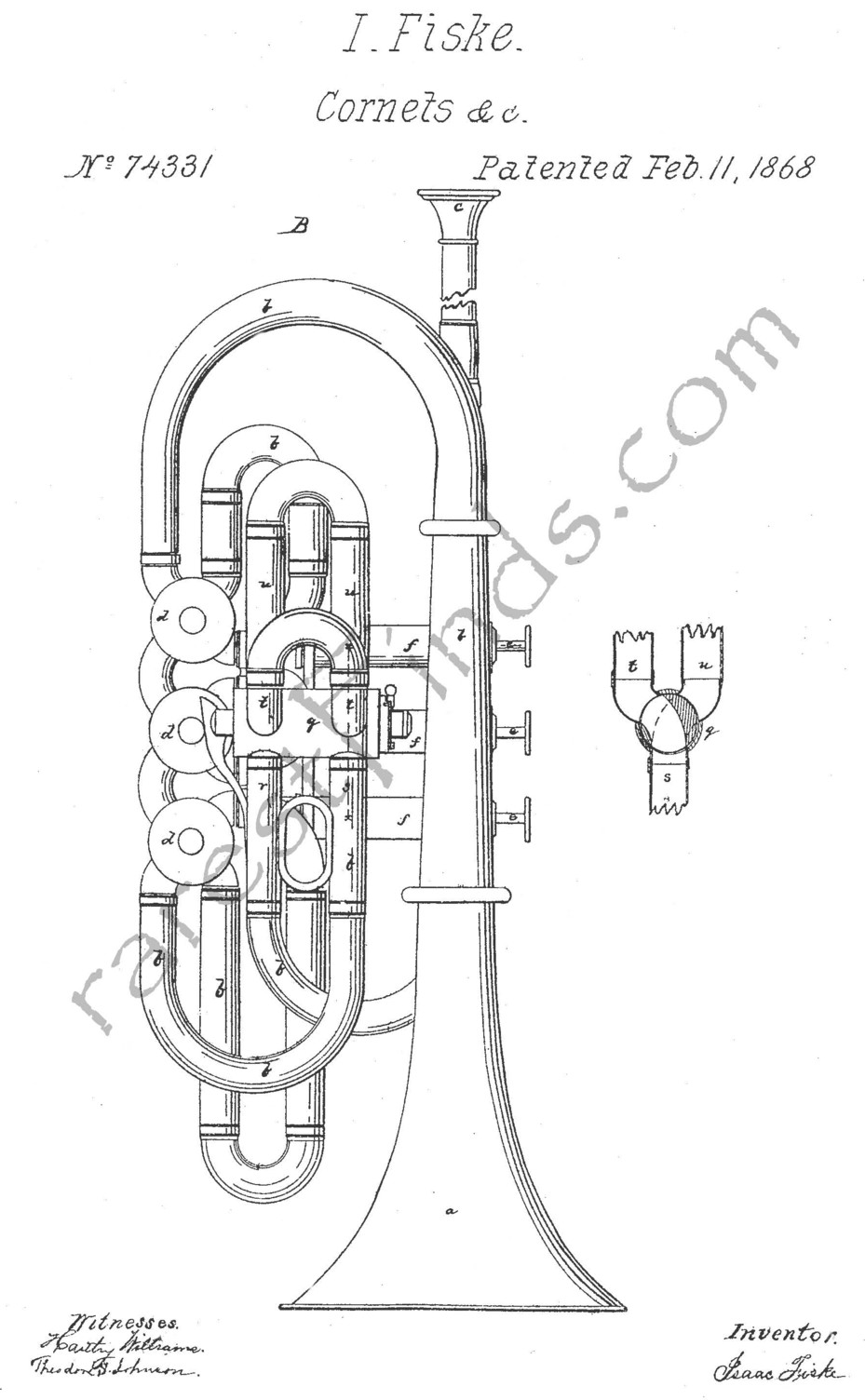
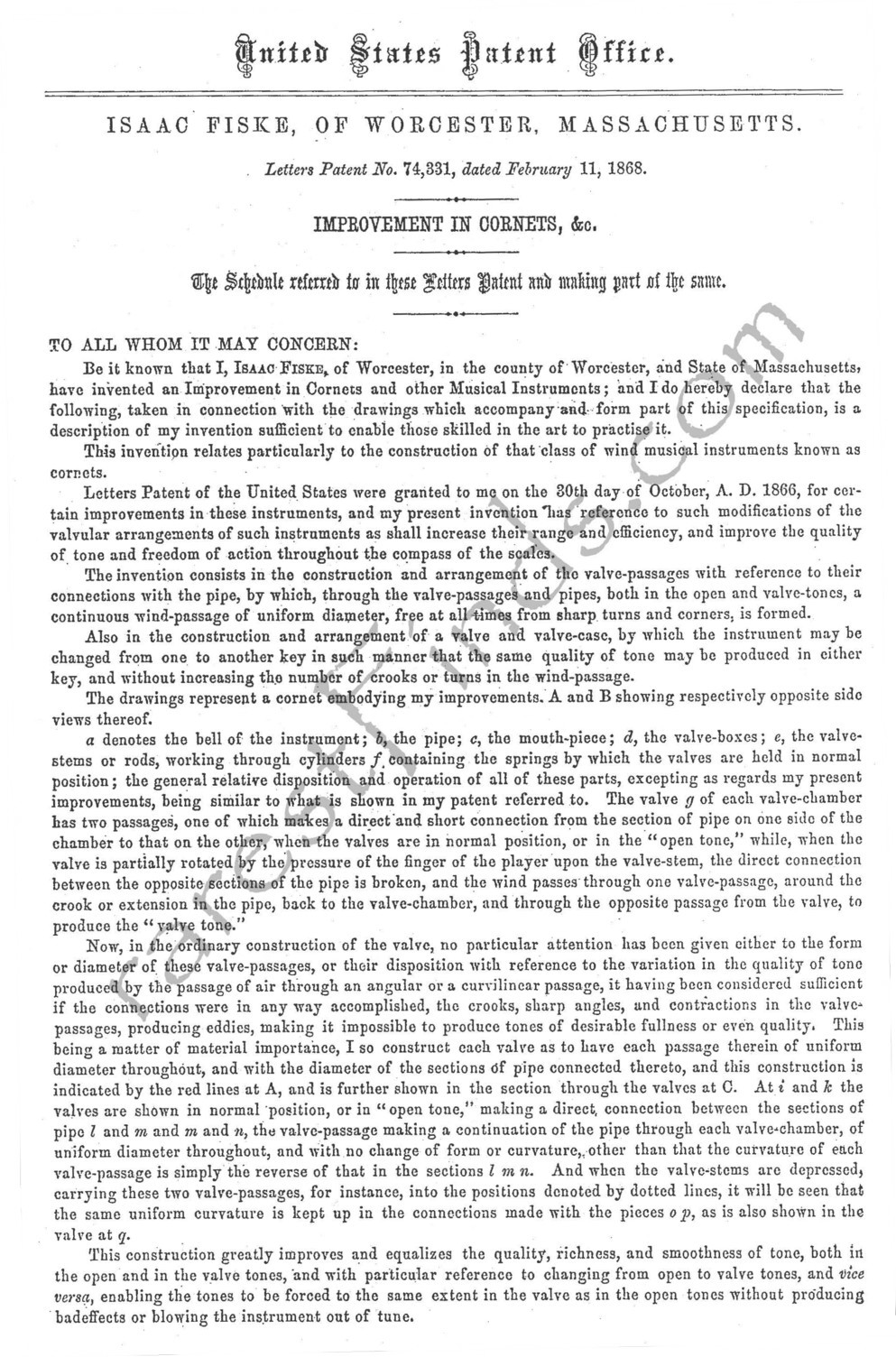
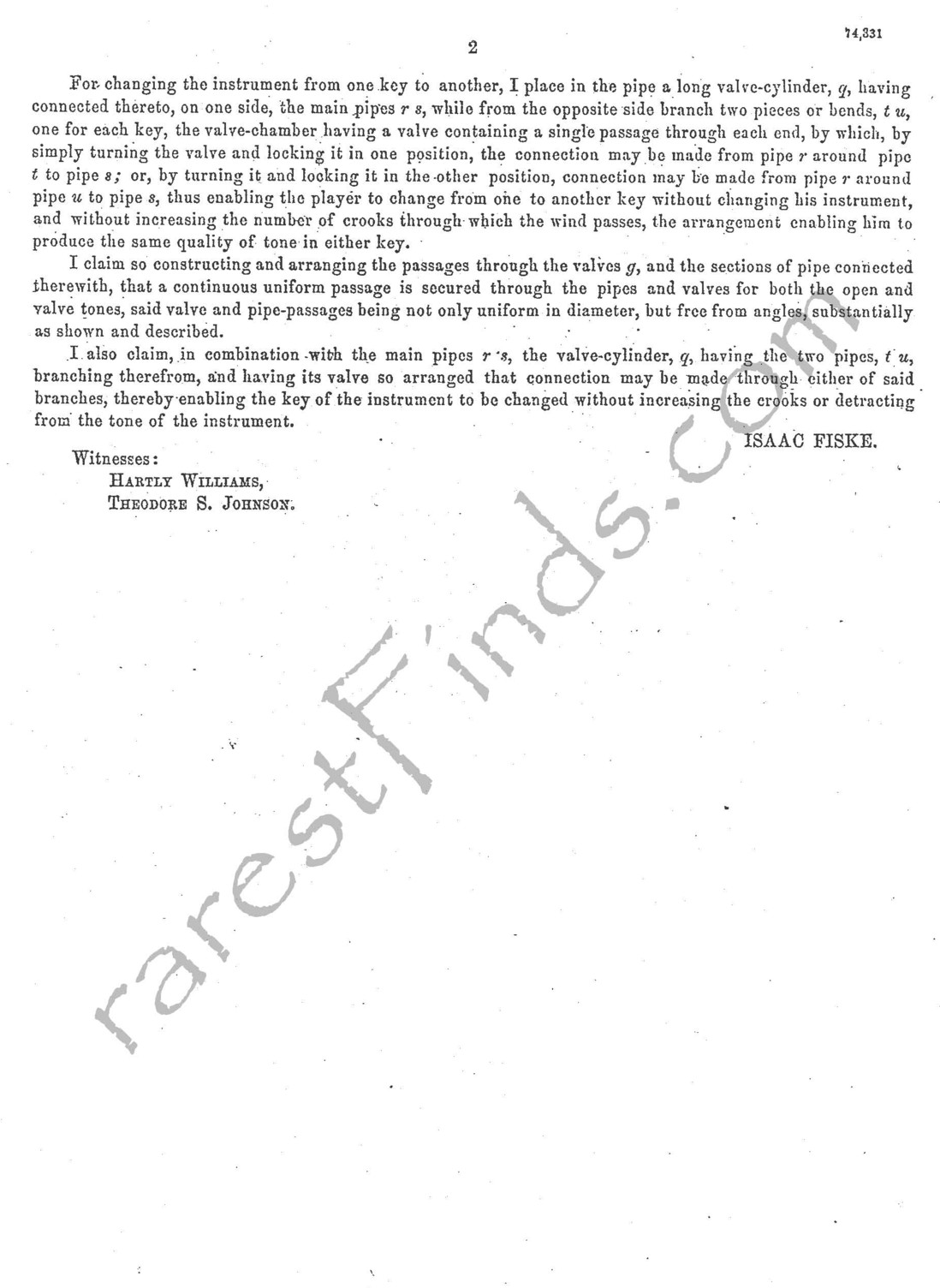
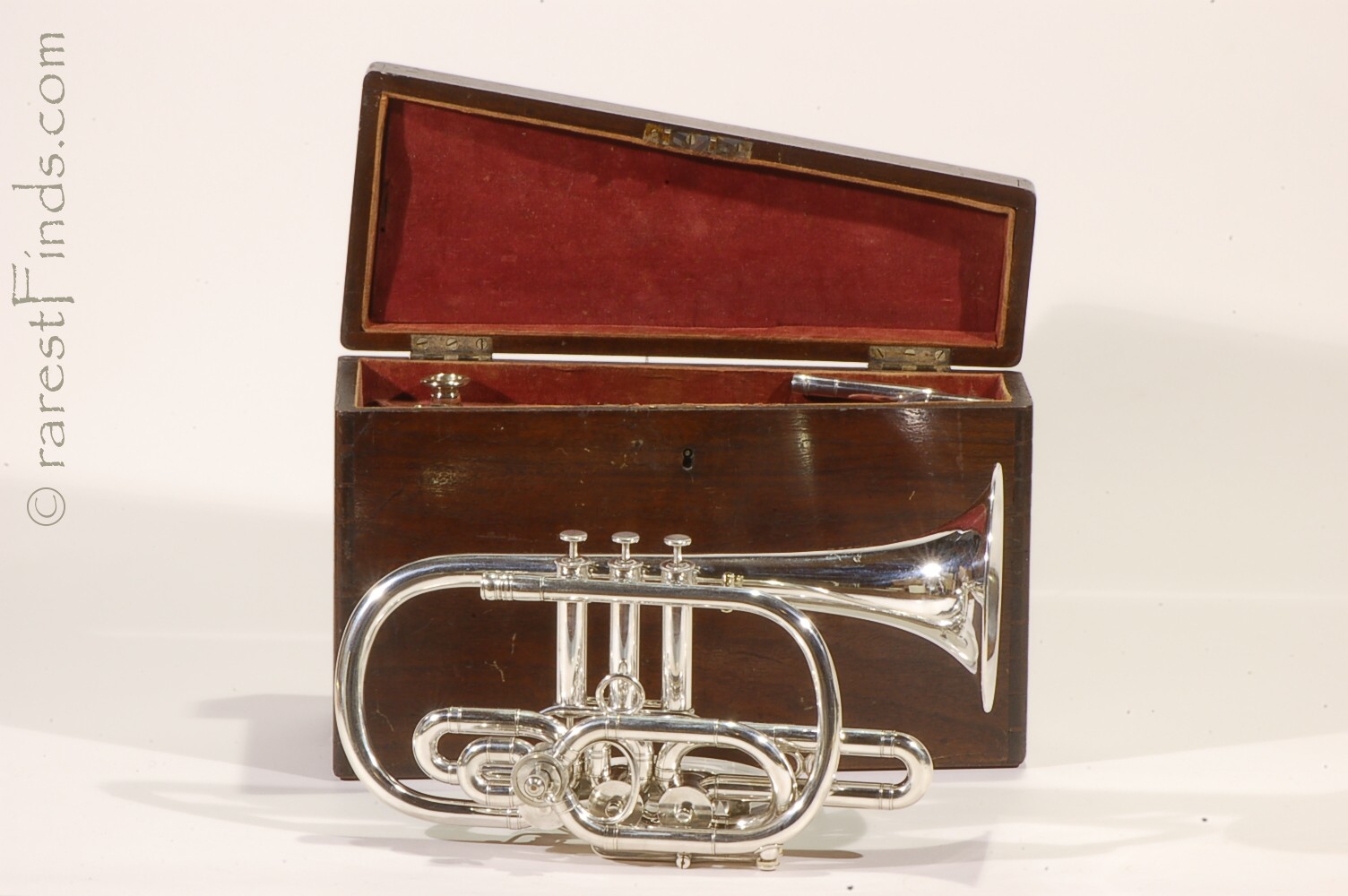
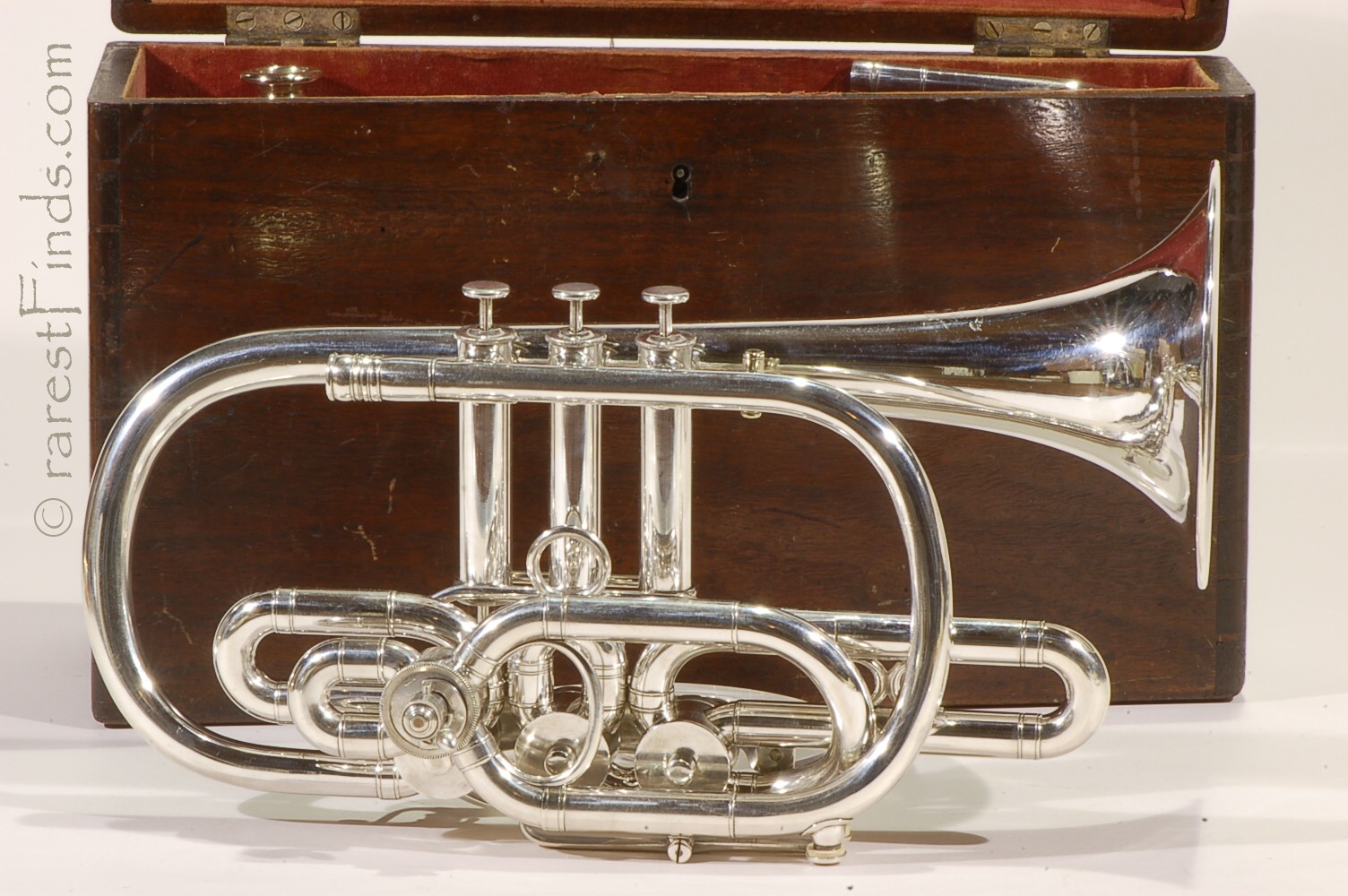
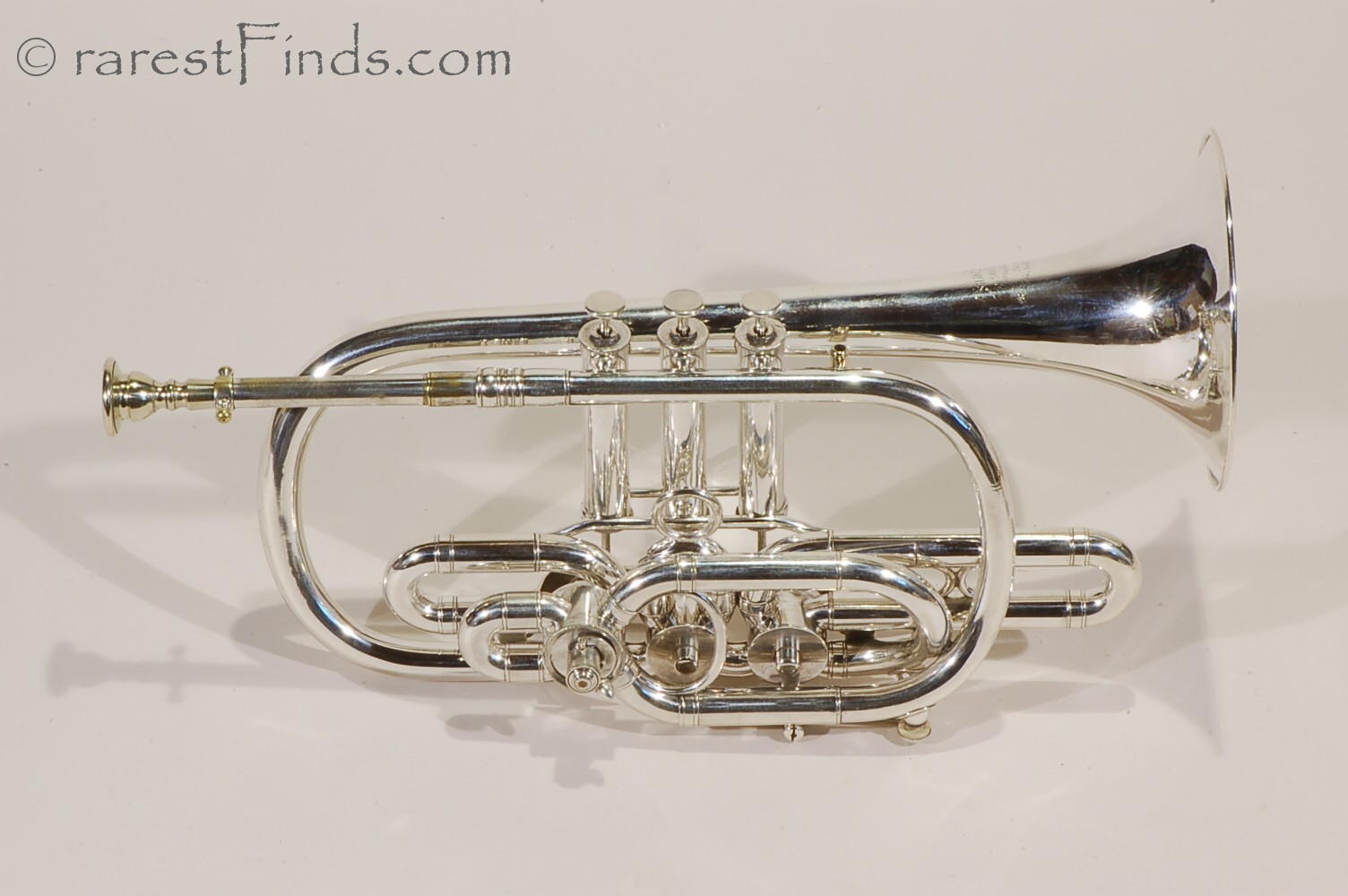
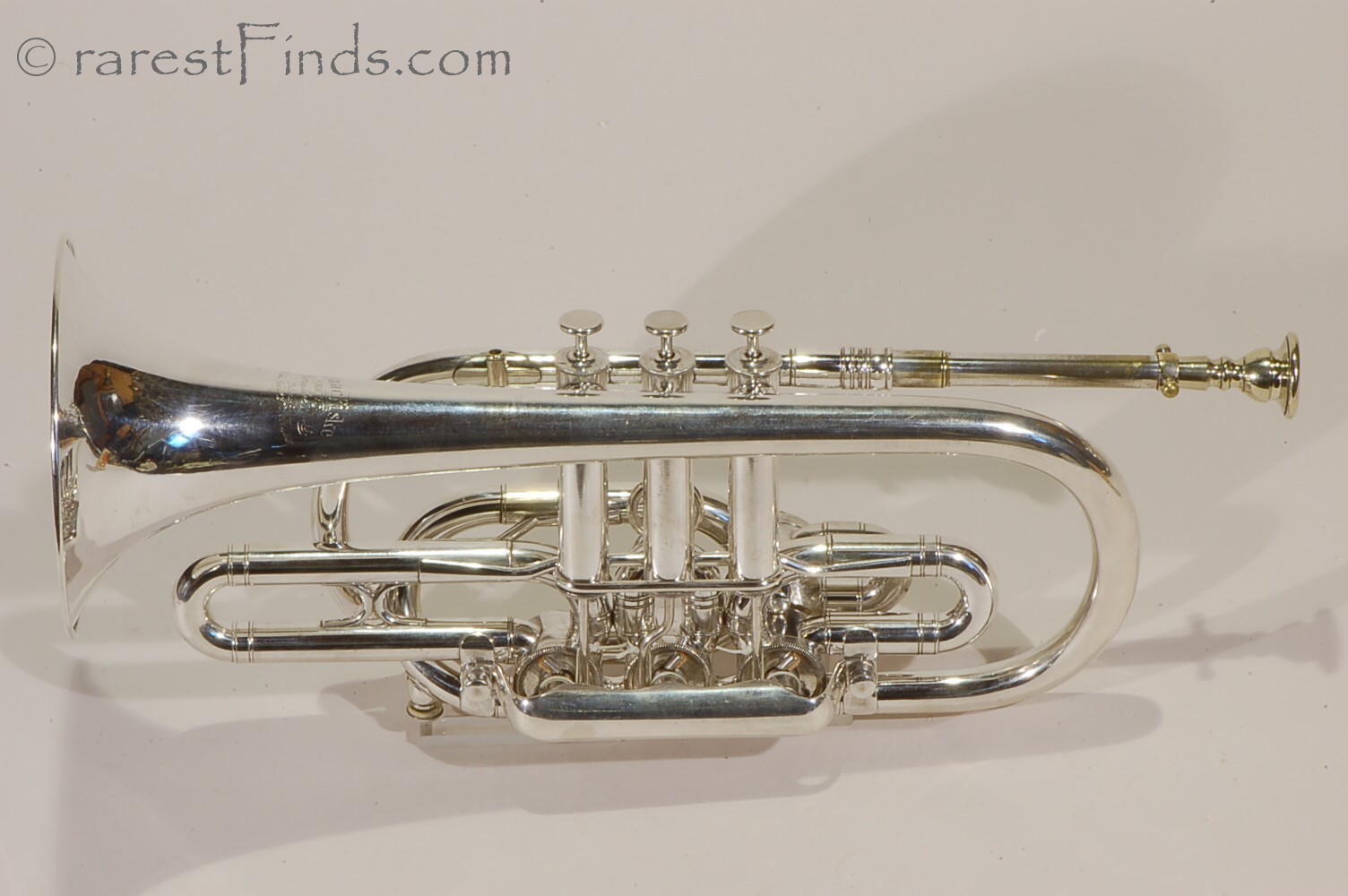
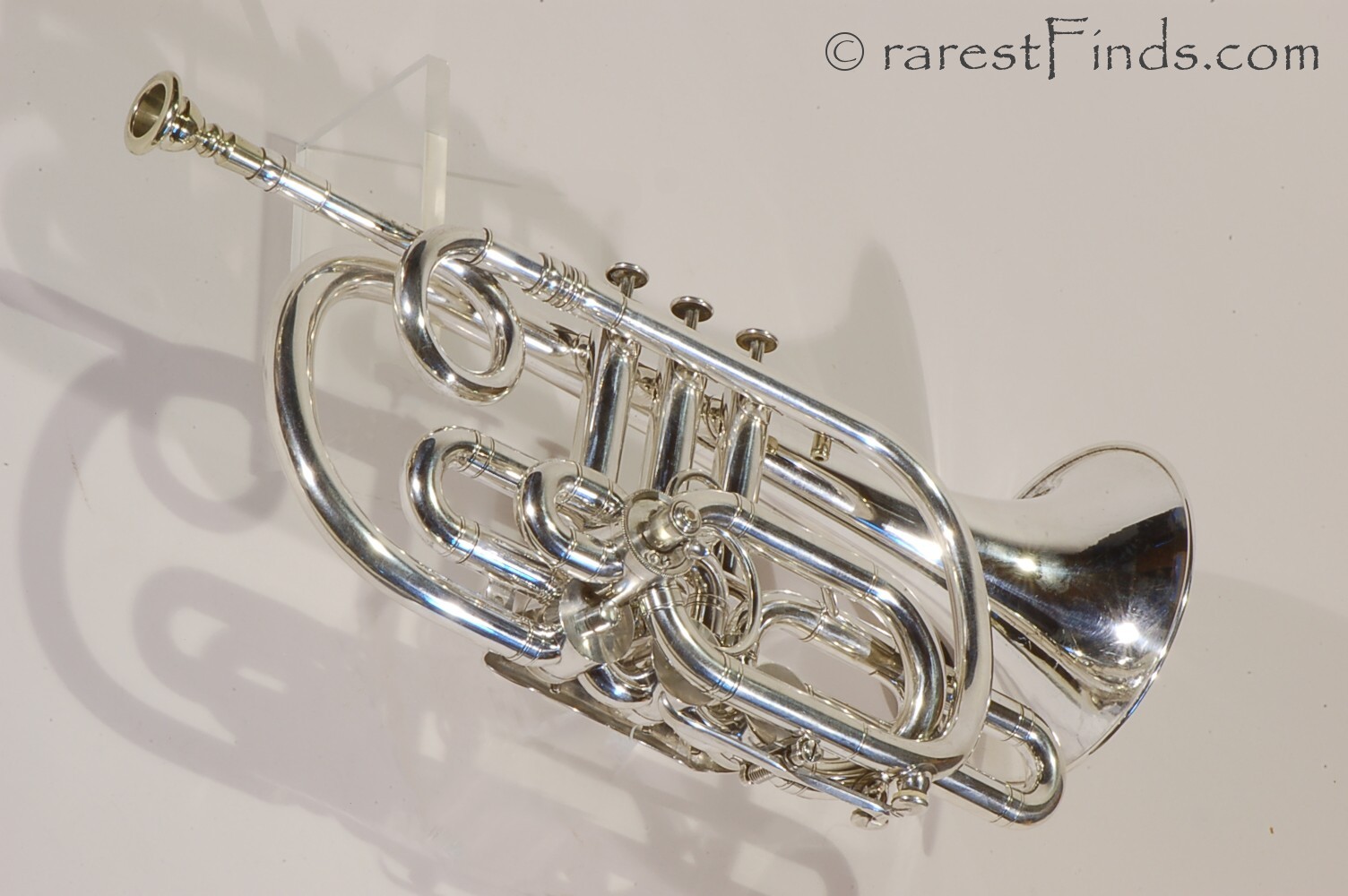
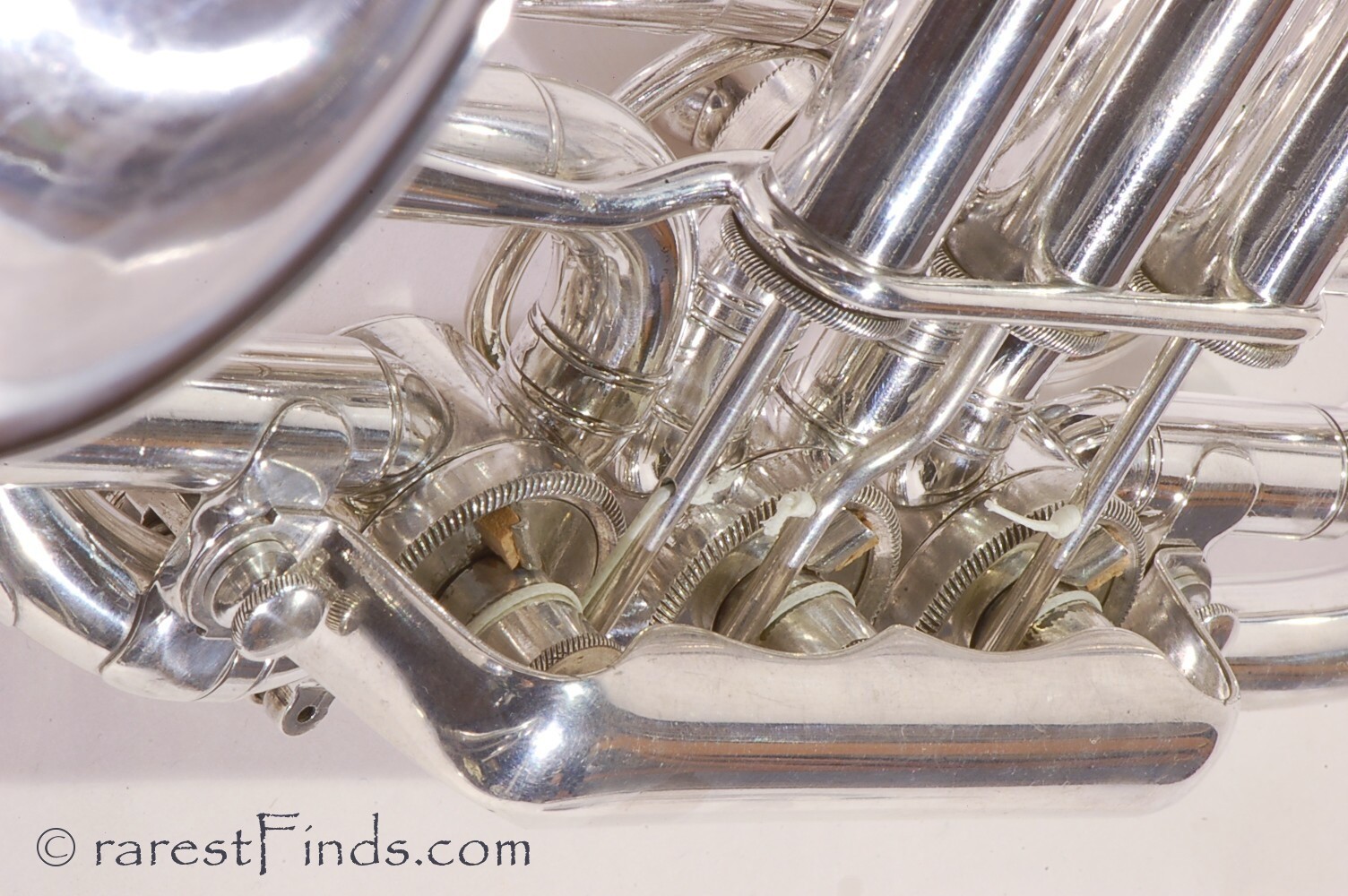
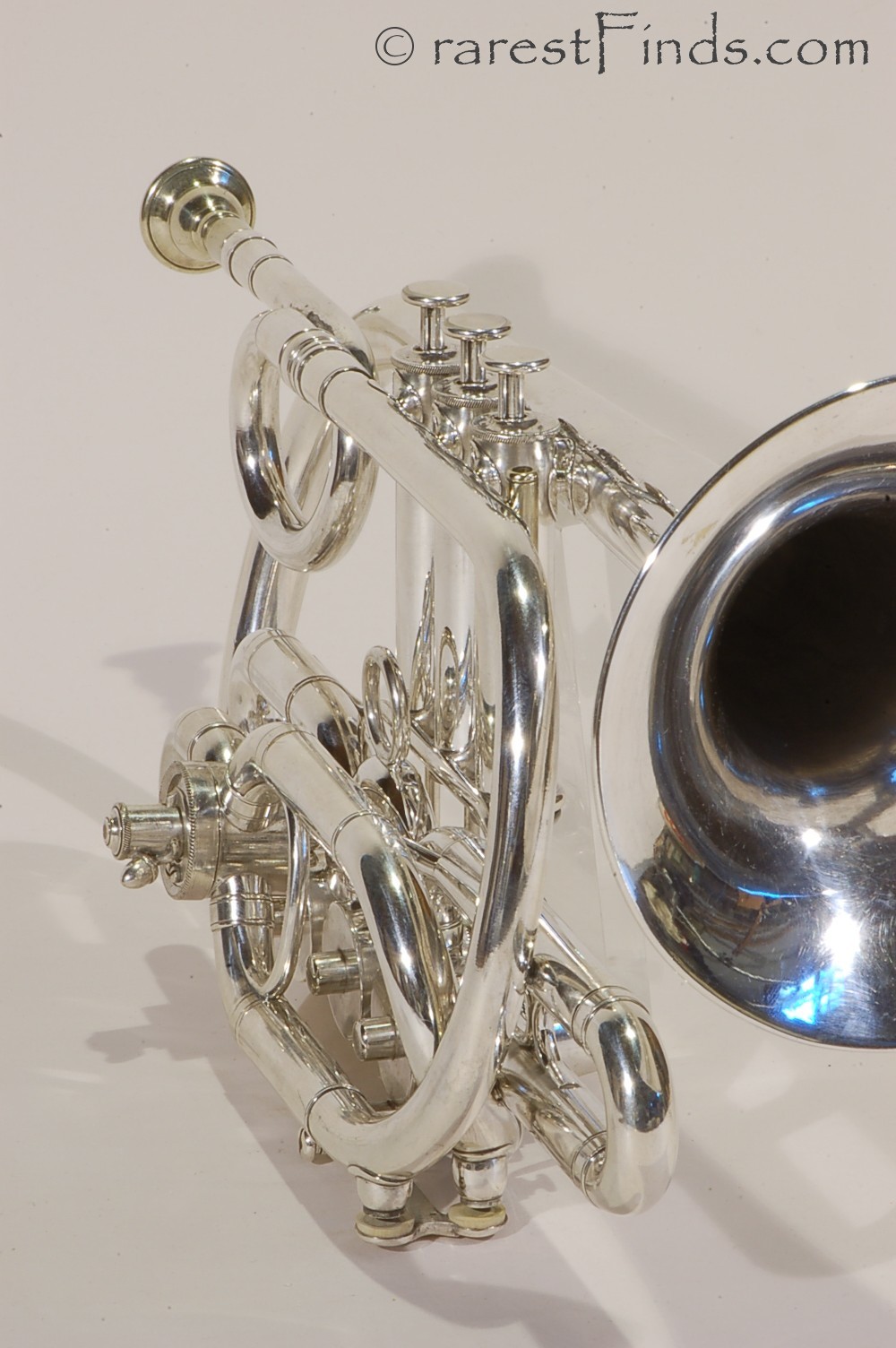
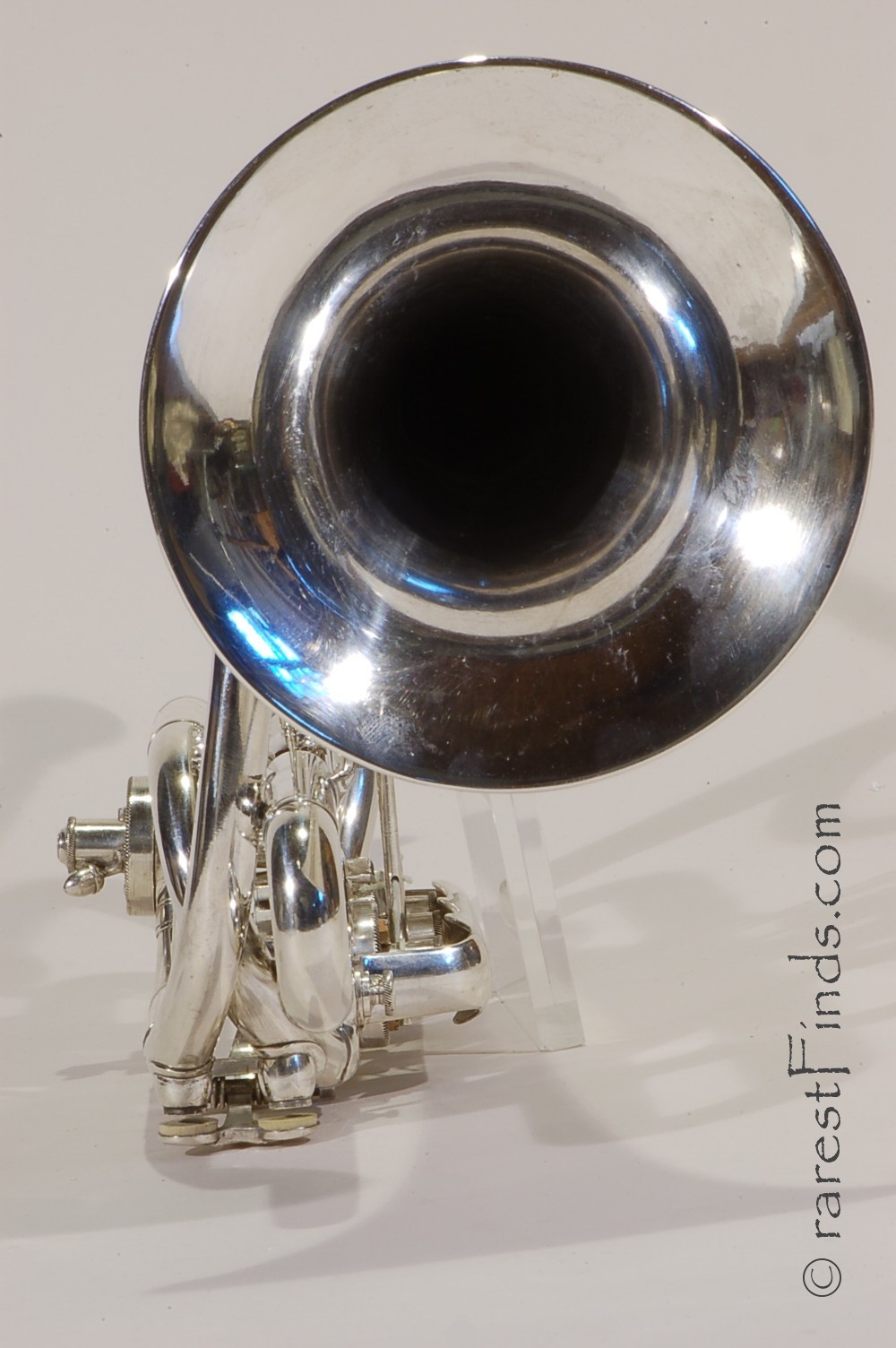
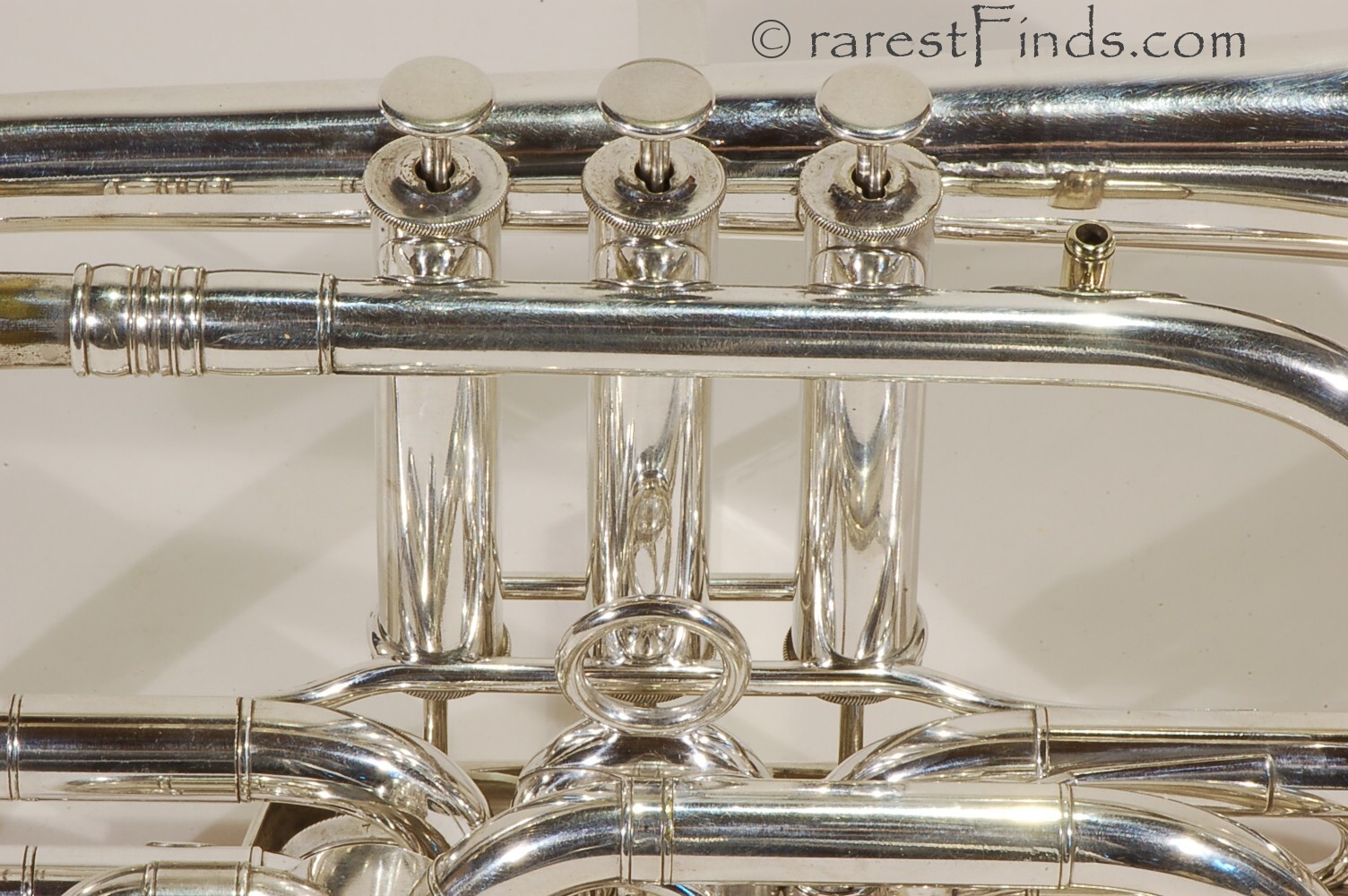
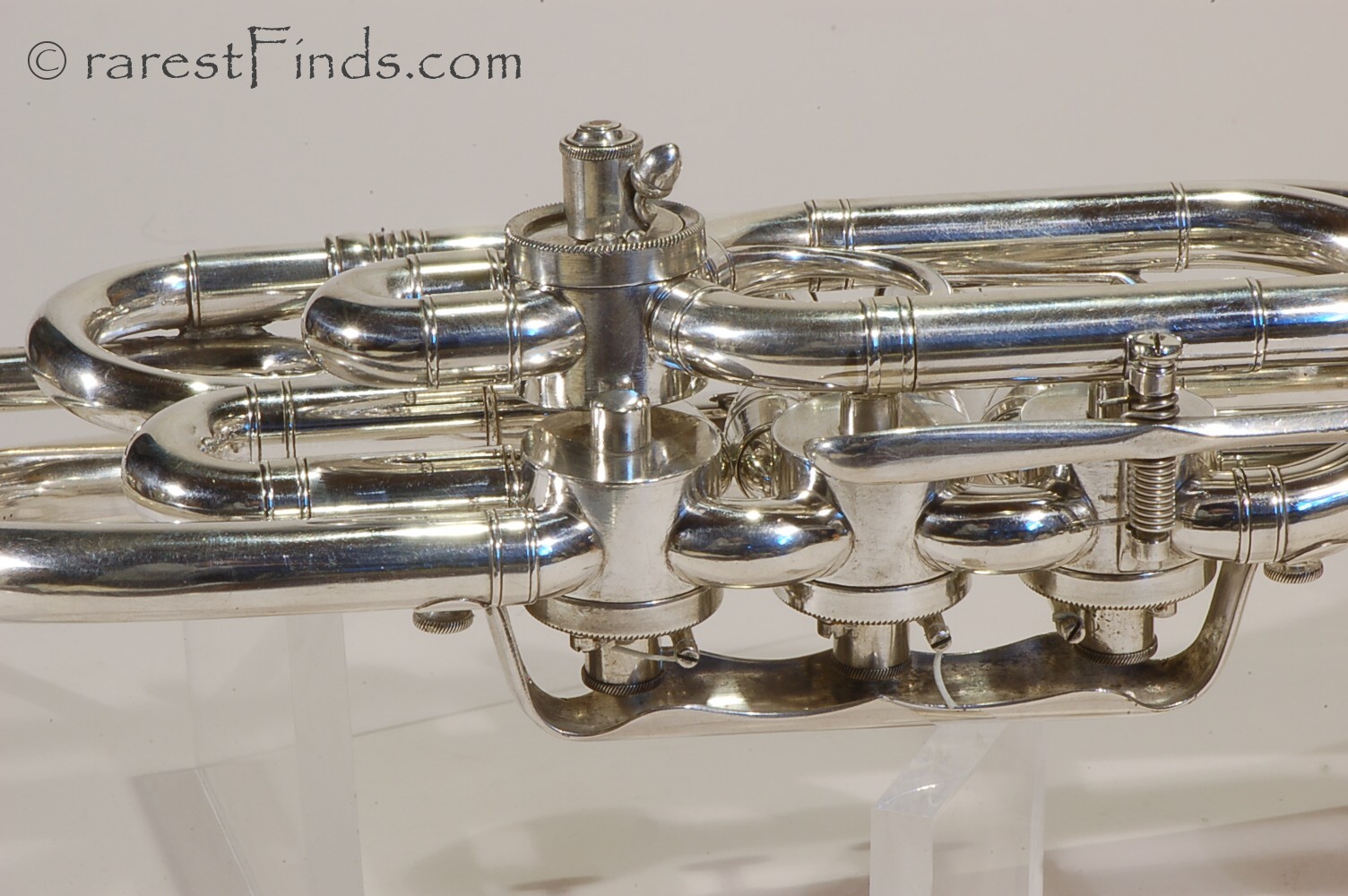
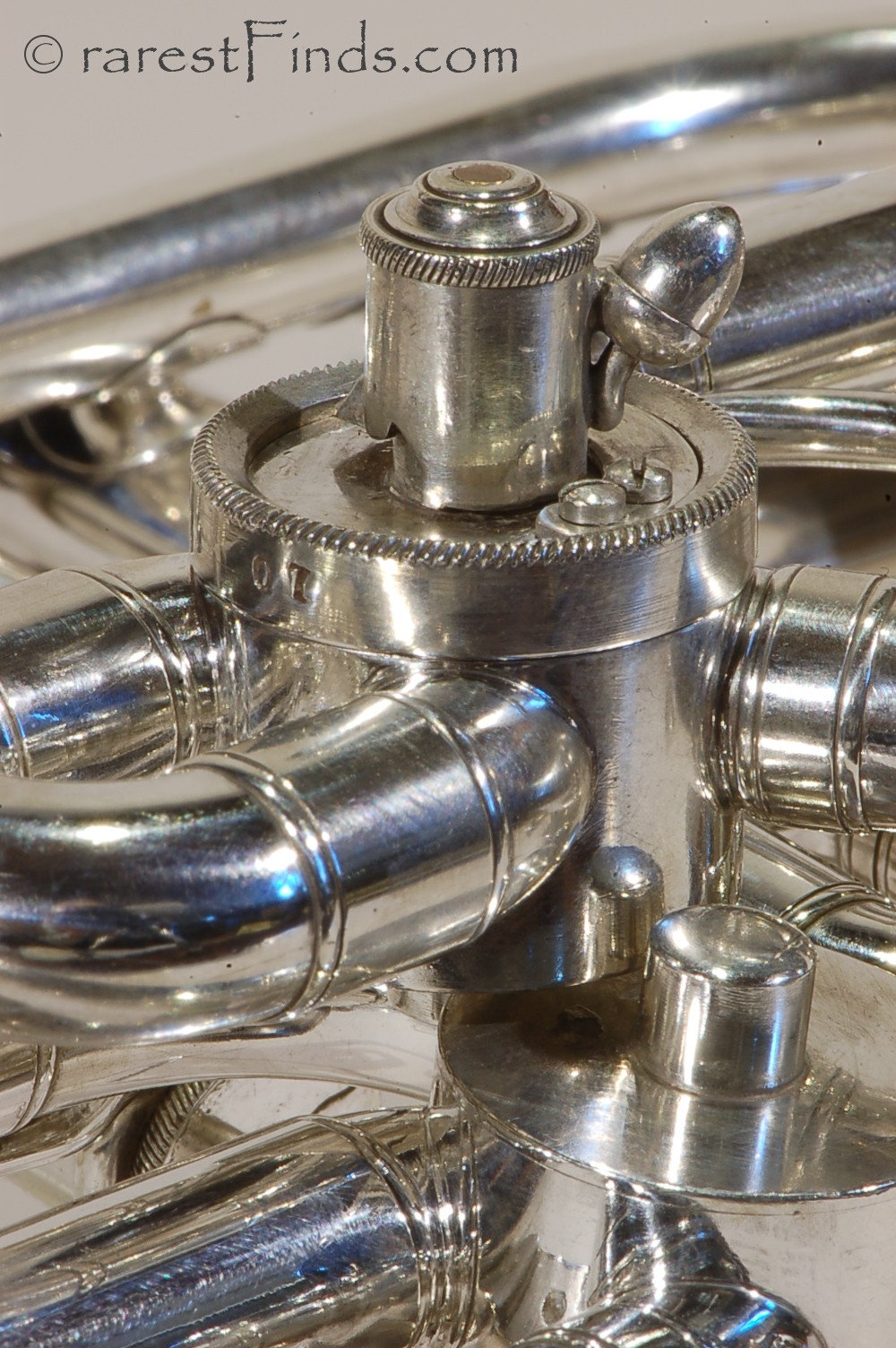
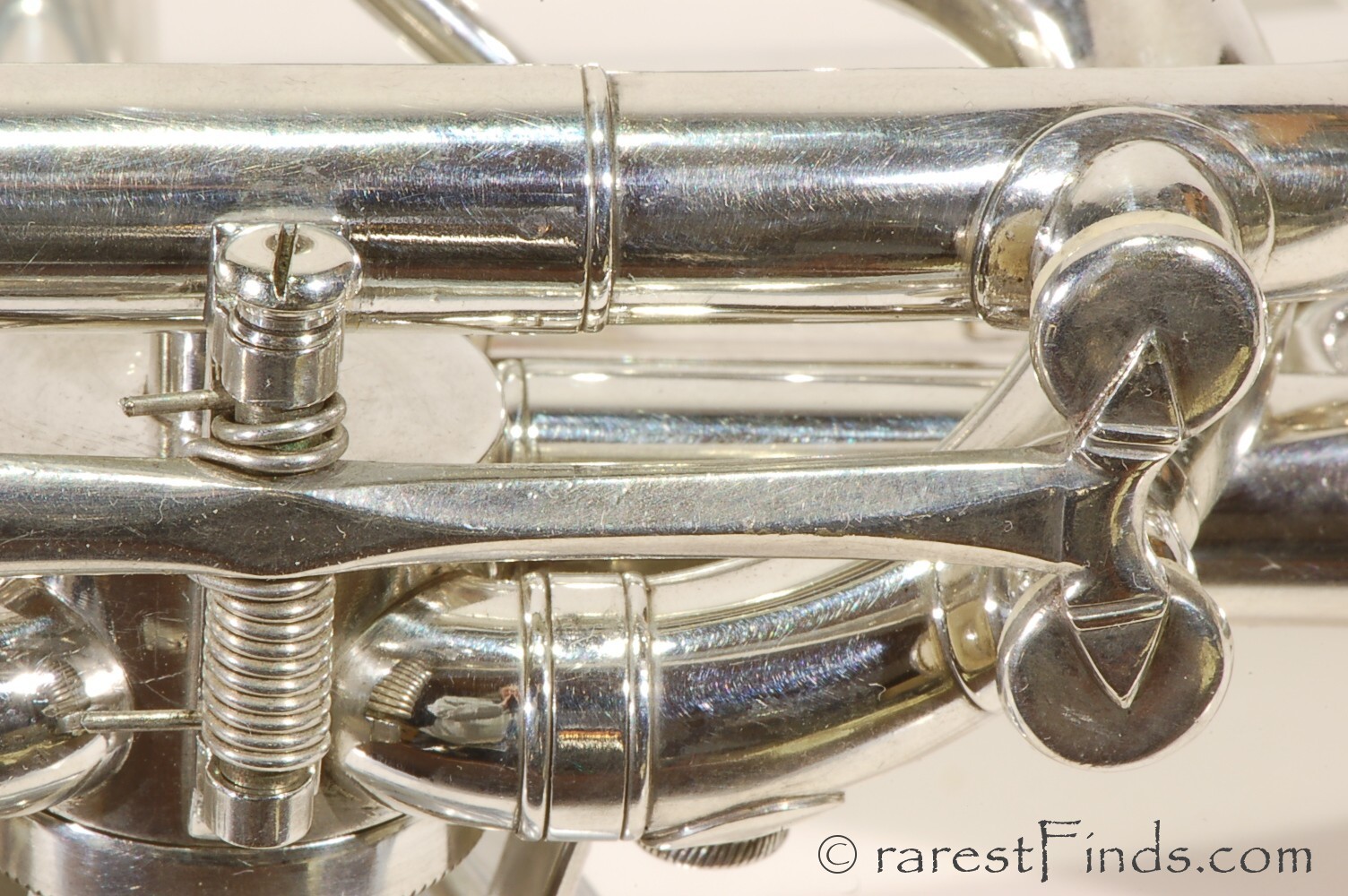
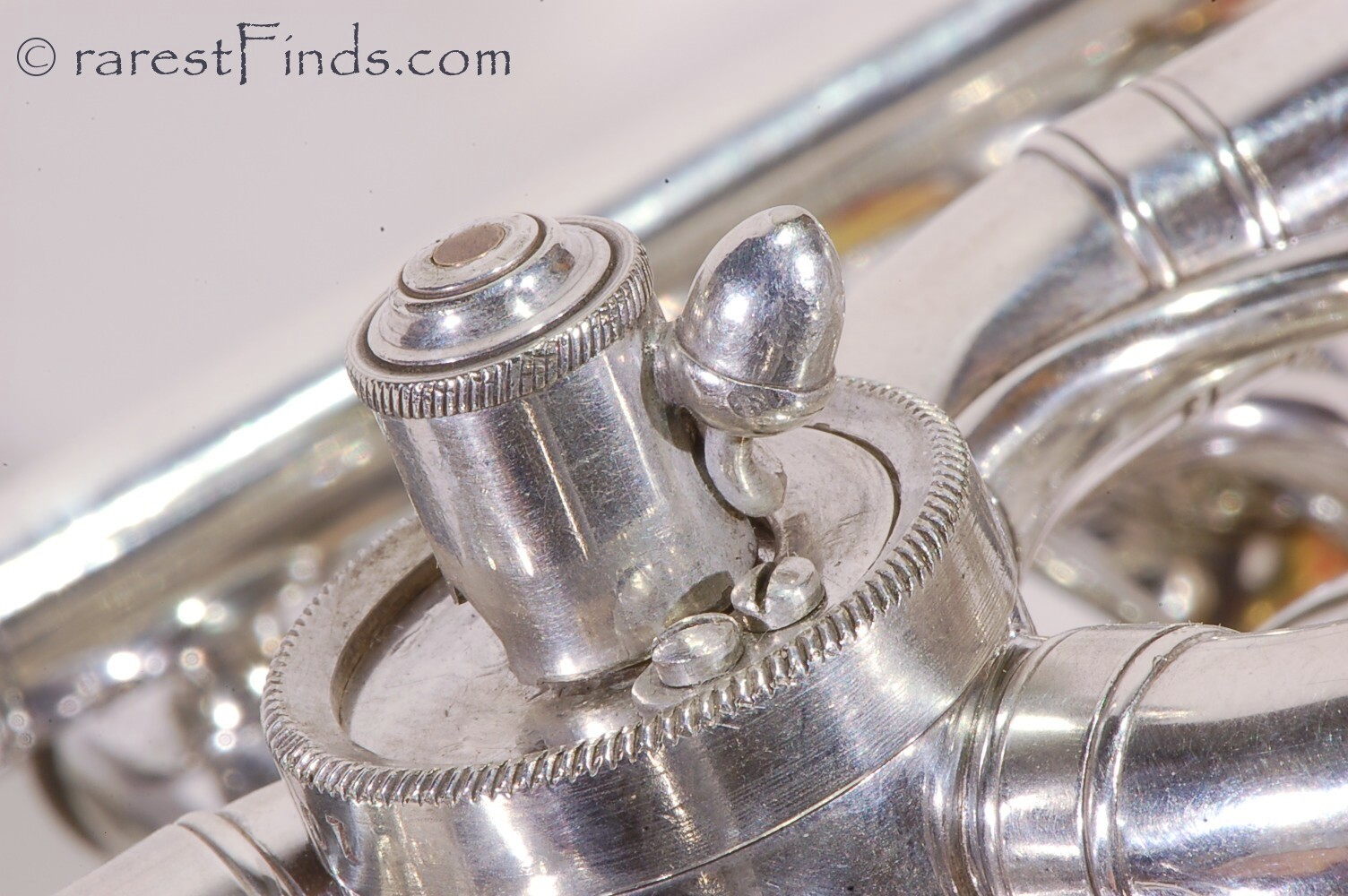
This rare Isaac Fiske Cornet features the famous and patented Push-rod String Rotary Valve design, [1] pages 245-48. It is the only 1868 Fiske cornet this writer has ever seen with the additional valve to change the key of the instrument. It has a number 10 which could be the serial number? See picture 14.
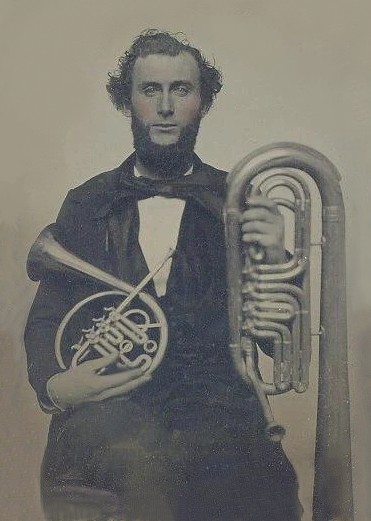 Isaac Fiske is famous for manufacturing musical instruments of the highest quality. He became “a maker of deserved celebrity,” recognized far beyond Worcester, Massachusetts.
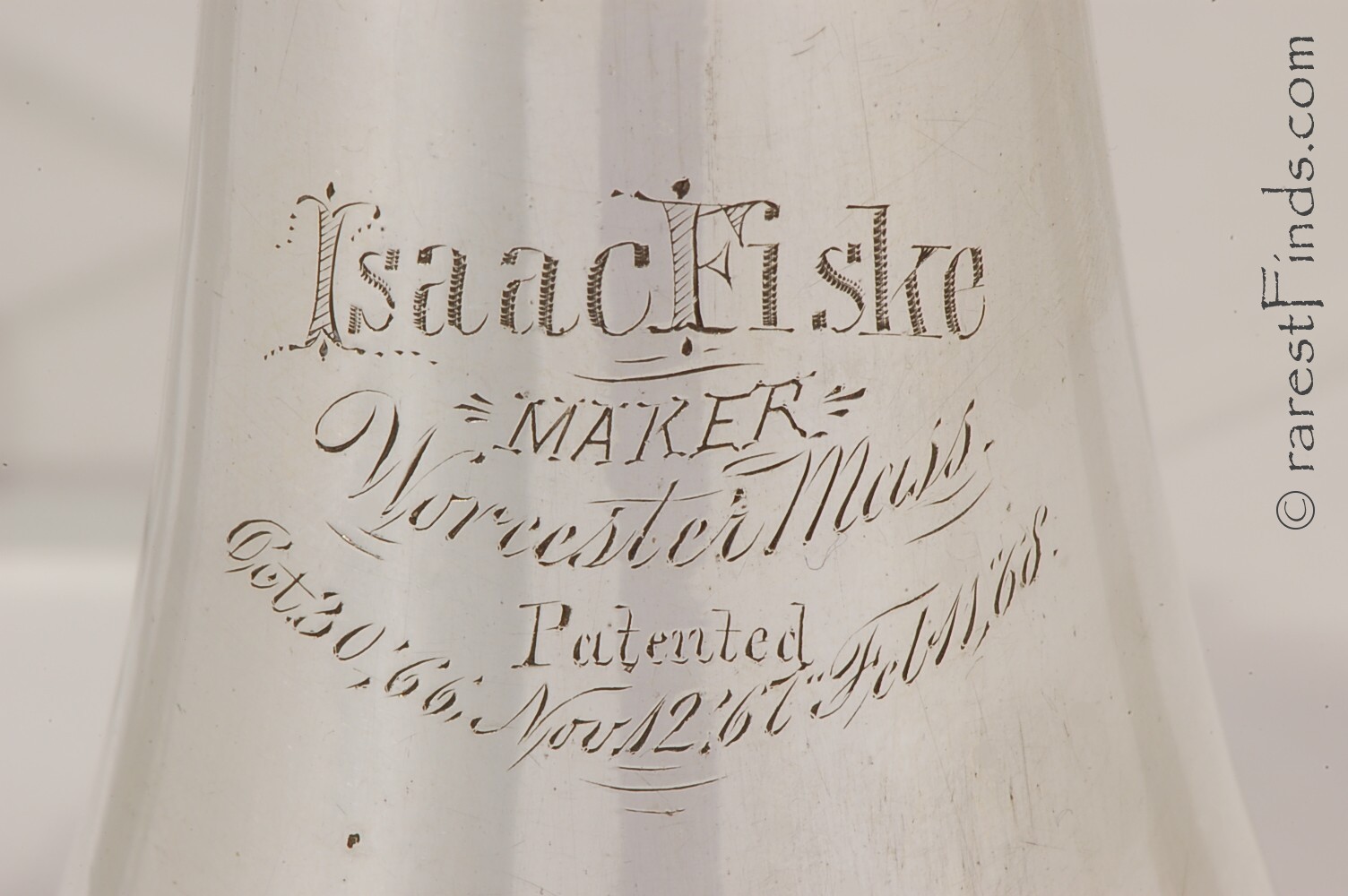
The unusual intricate and elaborate engraving on the Bell mentions the following three Patent Dates, Oct30,66,Nov12,67,Feb11,68, see picture 6, and [1] pages 245-48.
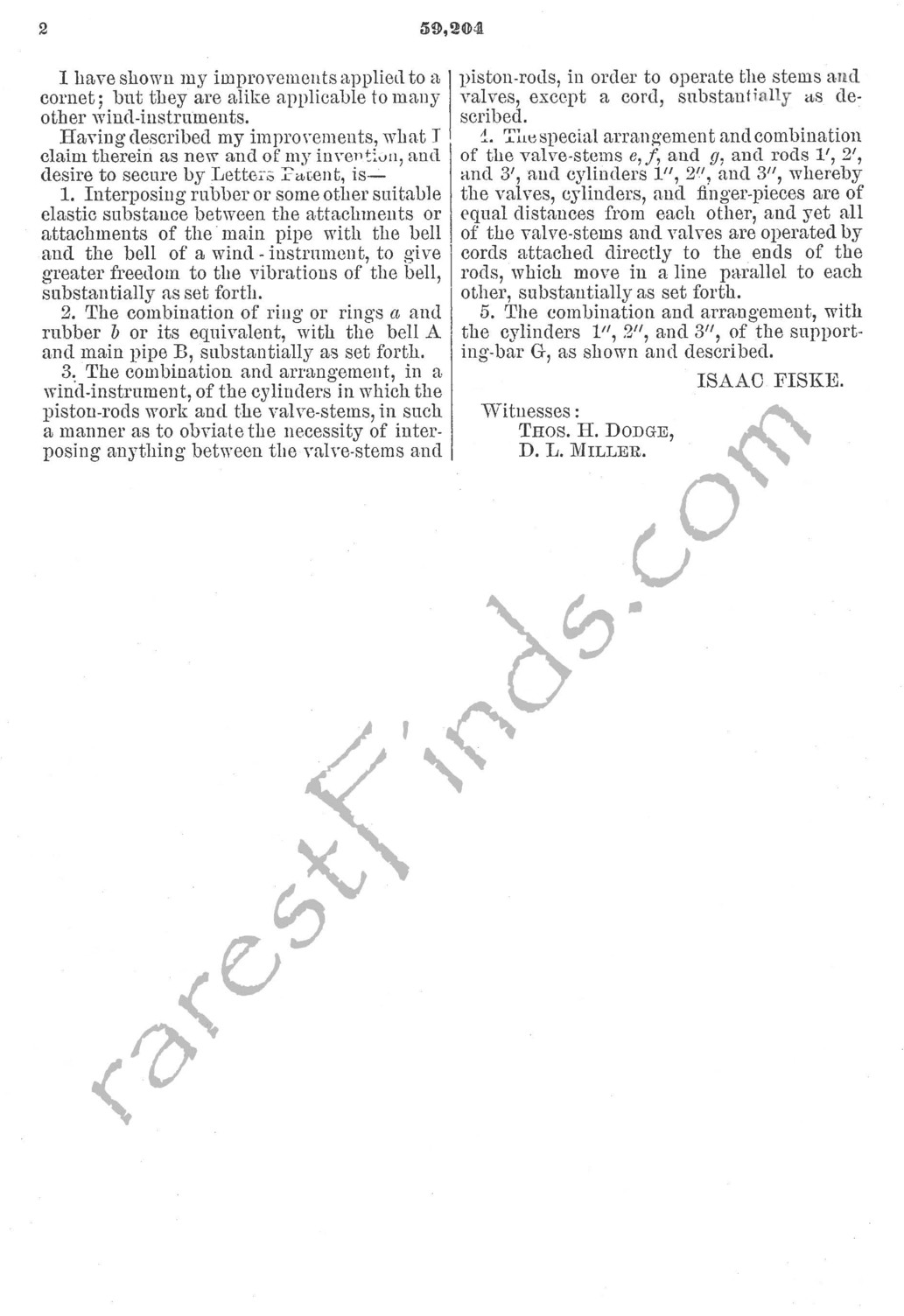
The 1866 Patent with number 59,204, granted to Fisk on October 30, 1866, was protecting his first piston activated string rotary valve design with three valves in a straight row, with "finger pieces are of equal distances from each other ...". This patent protected two other ideas which are not used in this cornet..
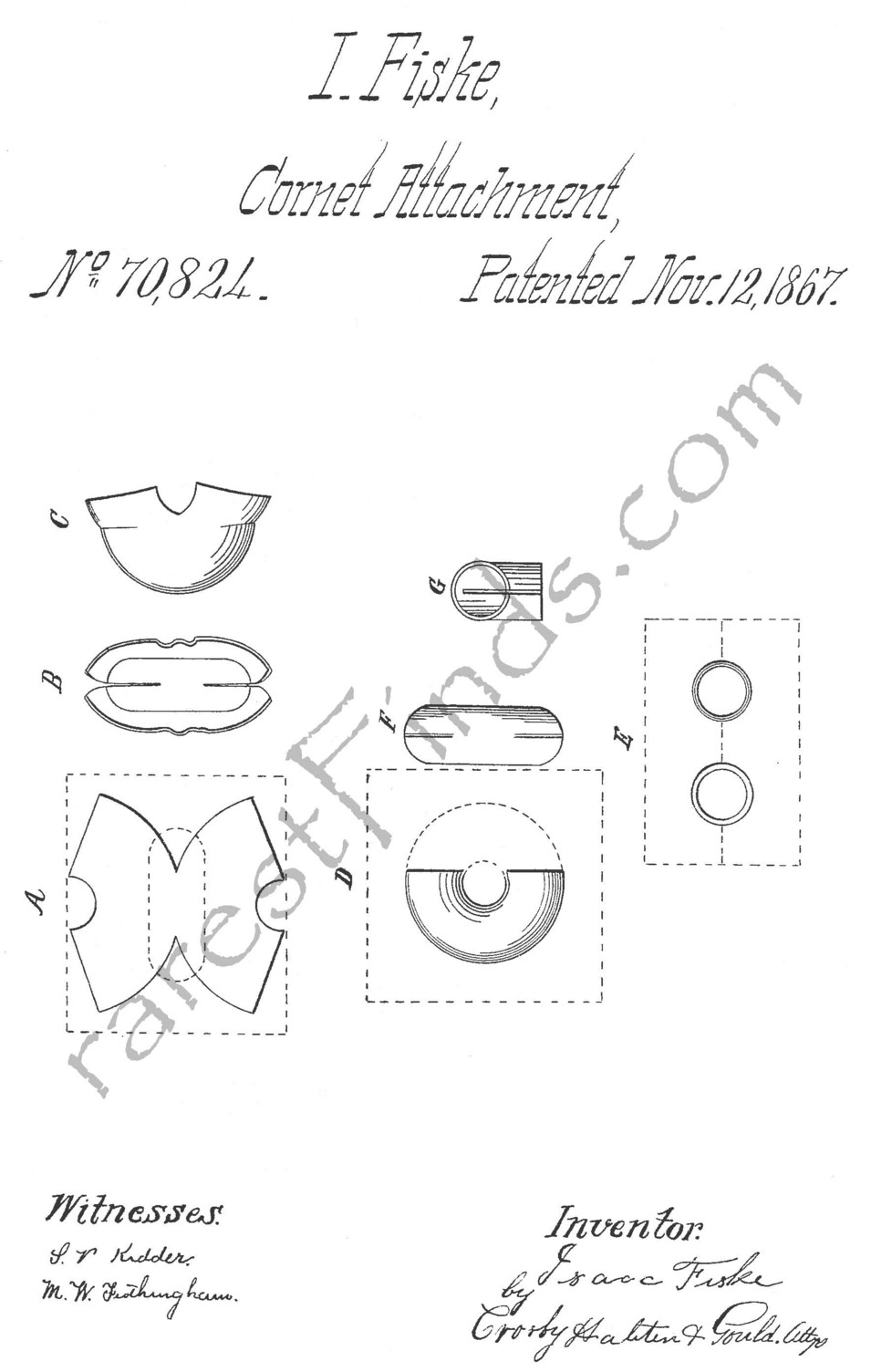
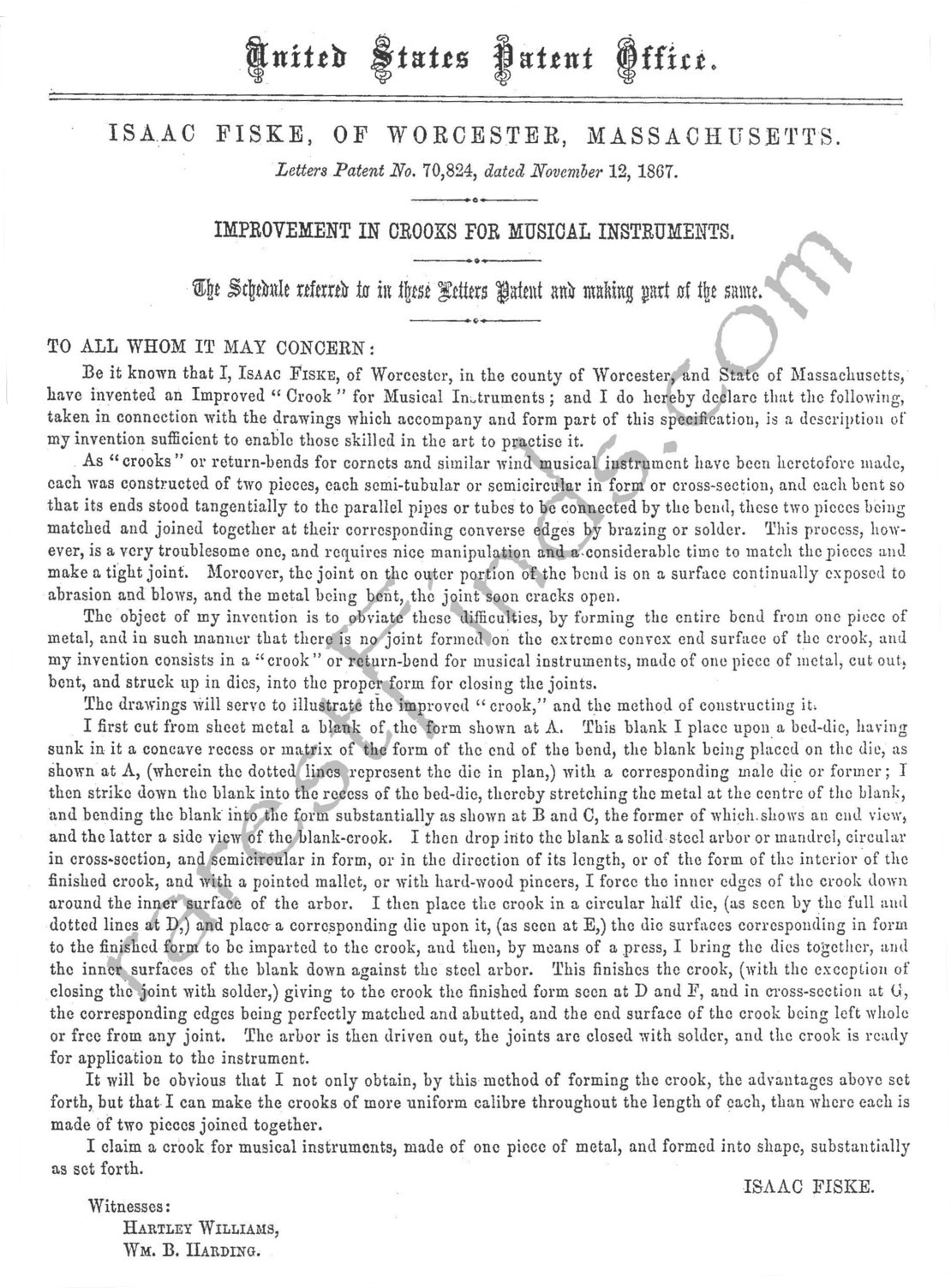
The 1867 Patent, granted on November 12 has the number 70,824 and covered his method of forming pipe bends from one piece instead of two pieces soldered together.
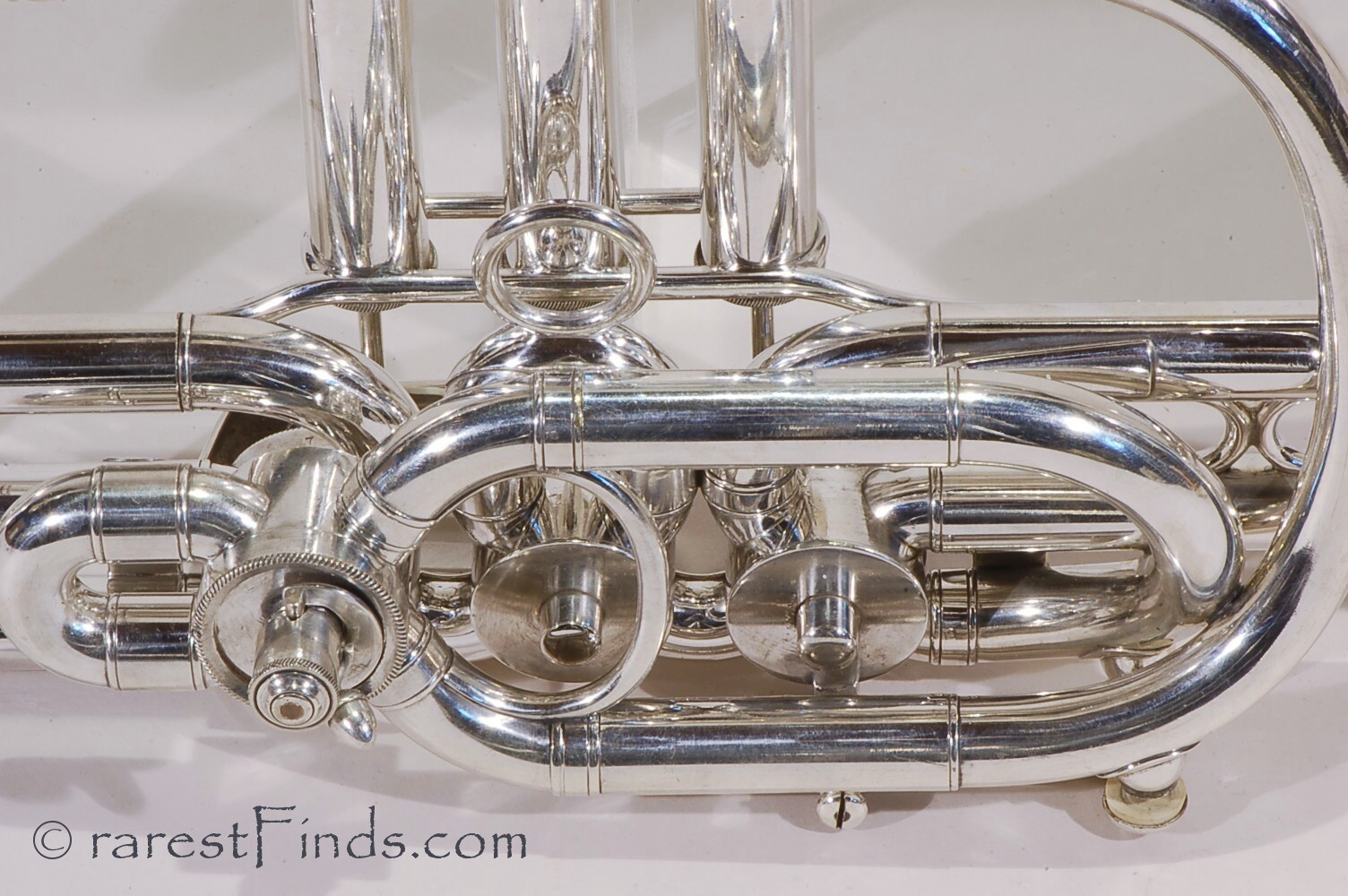
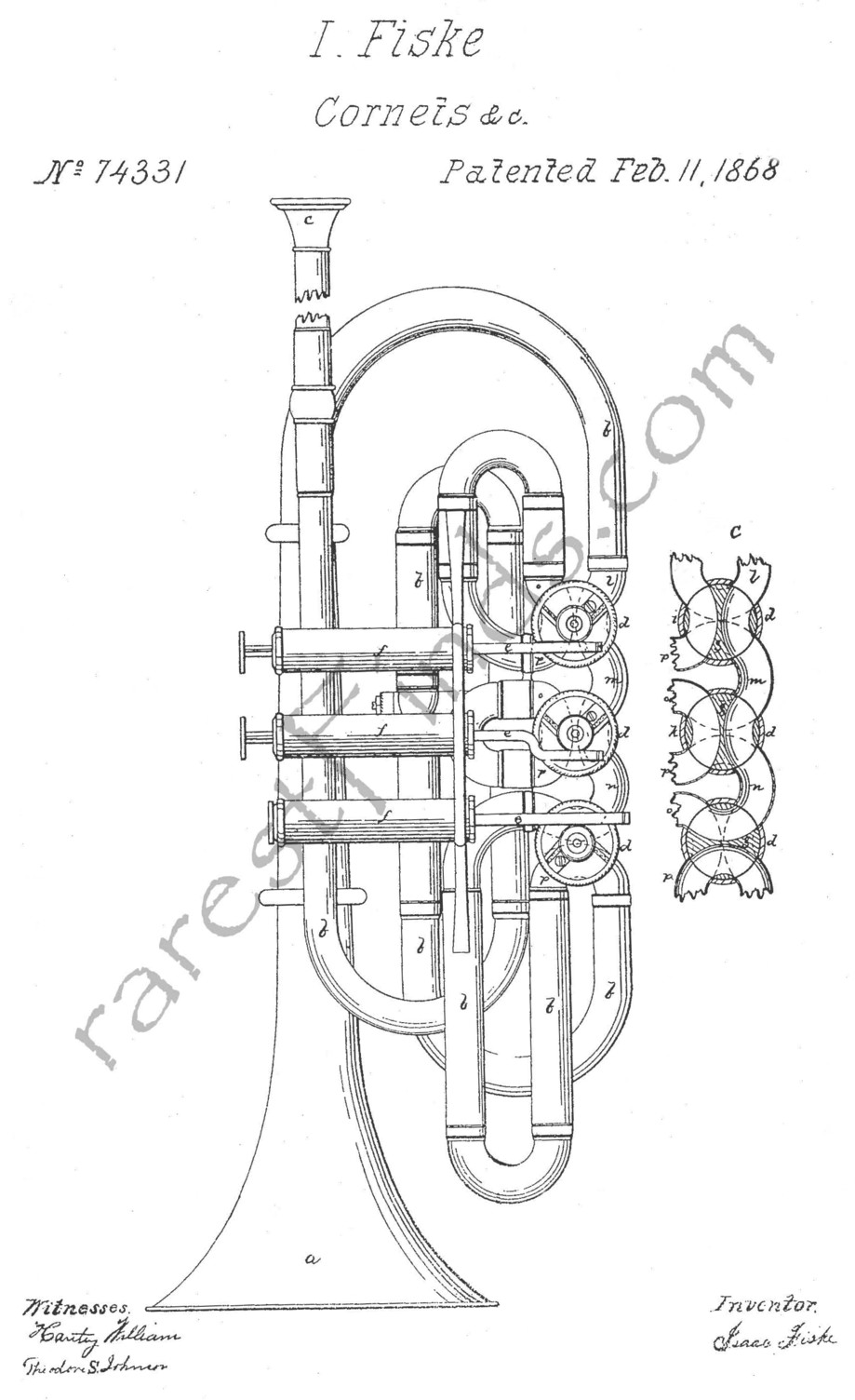
The third engraved date of February 11, 1868, with the number 74,331, was the patent for his idea of the famous quick key change valve, and improved valve passages, described in a report as an incredible development, "one of the best improvements ever introduced to any brass instruments. It is simply a newly shaped valve by which all sharp angles in the sounding tube are avoided." This improvement is not only advantages for the incredible sound and ease of valve action, see [1] pages 245-48. Experts have never seen another Fiske cornet with the quick key.
The unique features of the patented Fiske Cornet and Fiske's execution is also creating a most attractive compact appearance.
All three Patents are published above for the readers convenience.
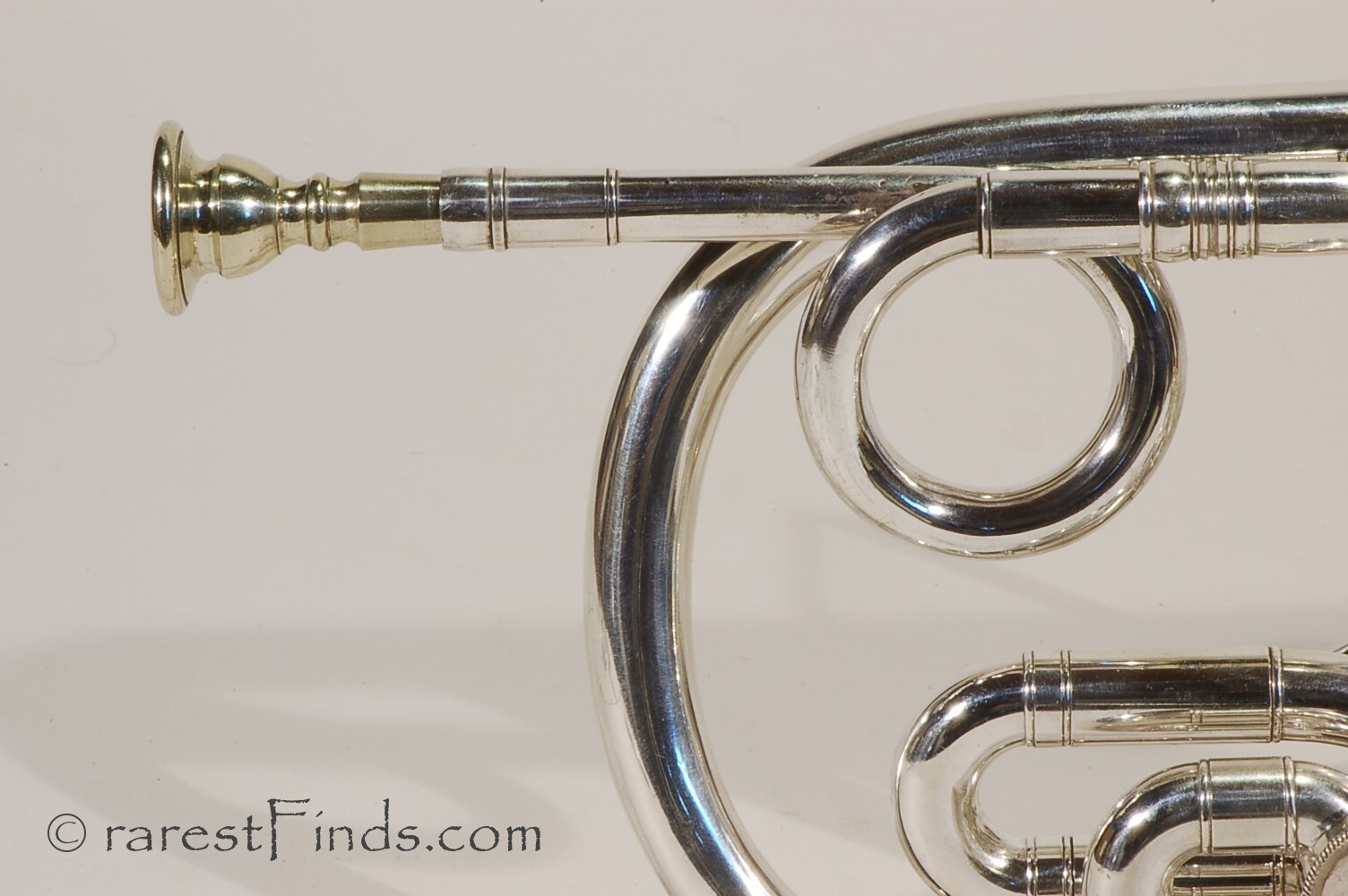
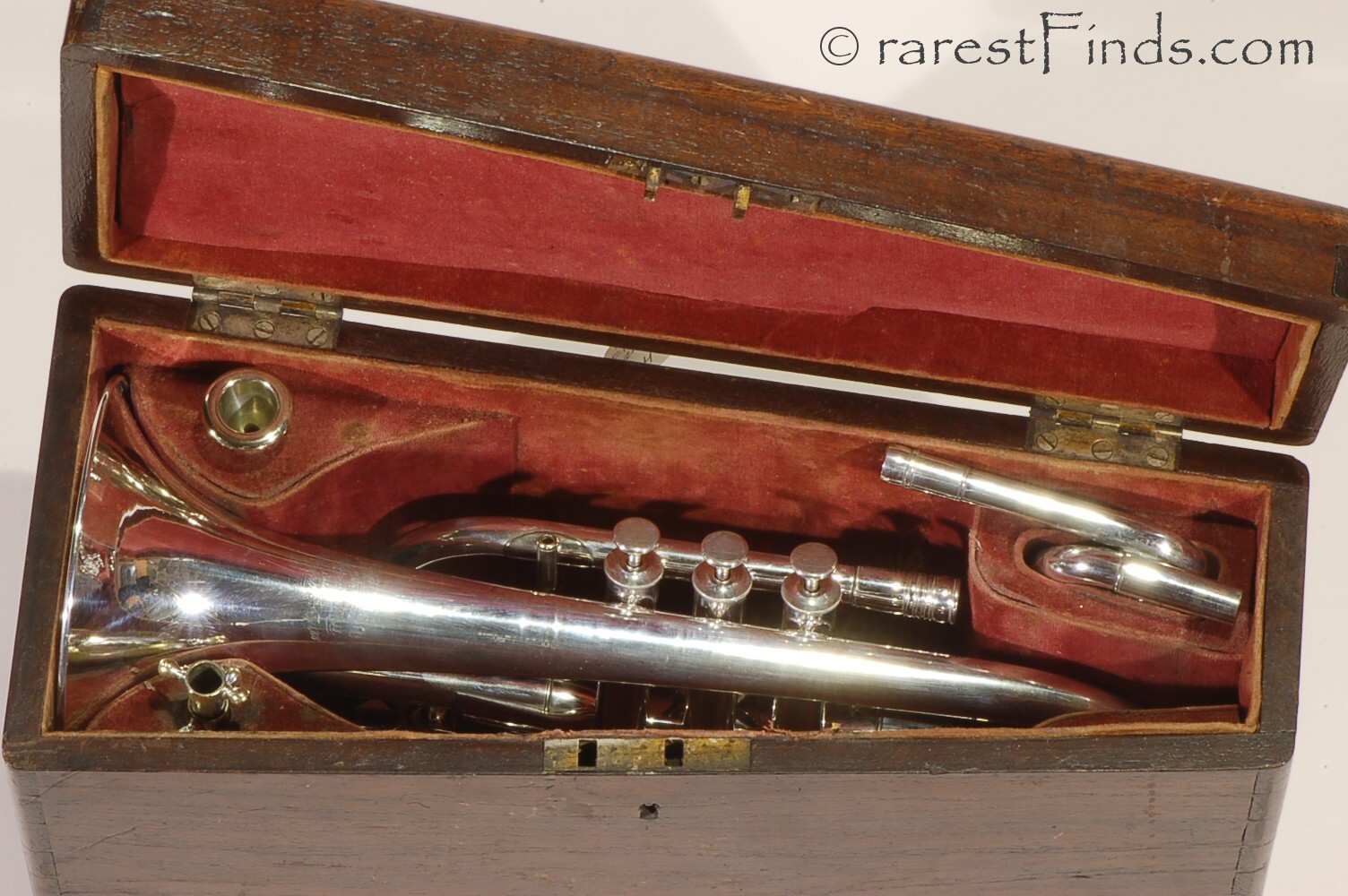
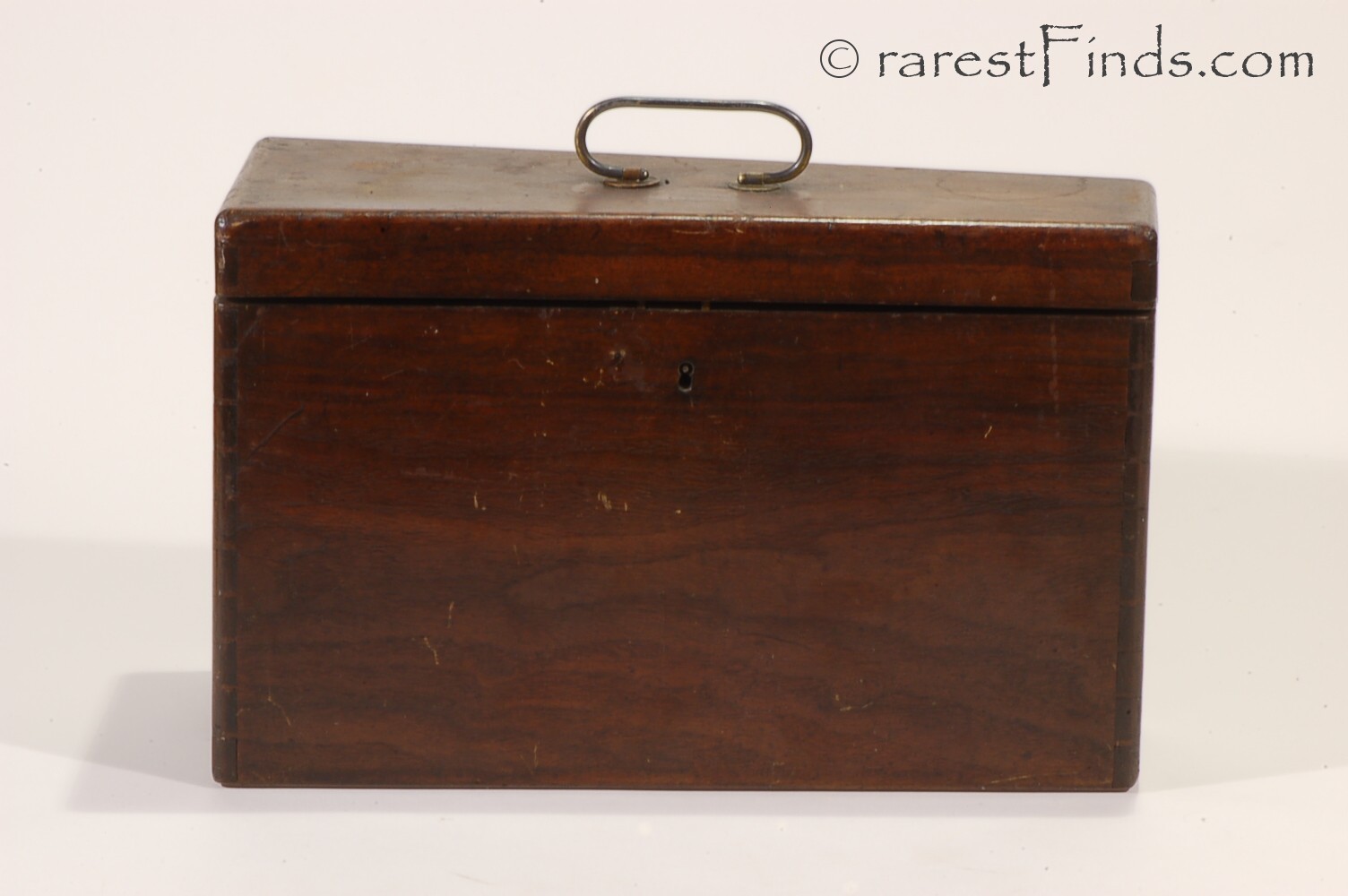
The fine Isaac Fiske instrument offered here is an excellent playing cornet and retains the original silver-plating, original American walnut case with Bb and A shanks, and mouthpiece (not sure whether they are original to the instrument), I'm not an expert by any stretch of your imagination.
The bore measures .468 inches, the bell rim diameter is 4 25/32 inches, and the overall length with mouthpiece removed is 12 7/8 inches. This beautiful one of a kind instrument is probably the nicest surviving example of any Fiske cornets according to the expert in the field, Robb Stewart, who restored it to be a perfect playing instrument.
As the writer took the pictures above, he noticed the number 10 on the instrument, serial number? The number is clearly visible if you know where to look. The number is on the key change valve shown in picture 14 on the knurled screw to open the valve. The number is opposite the acorn shaped lever to turn the quick key change valve.
Condition:
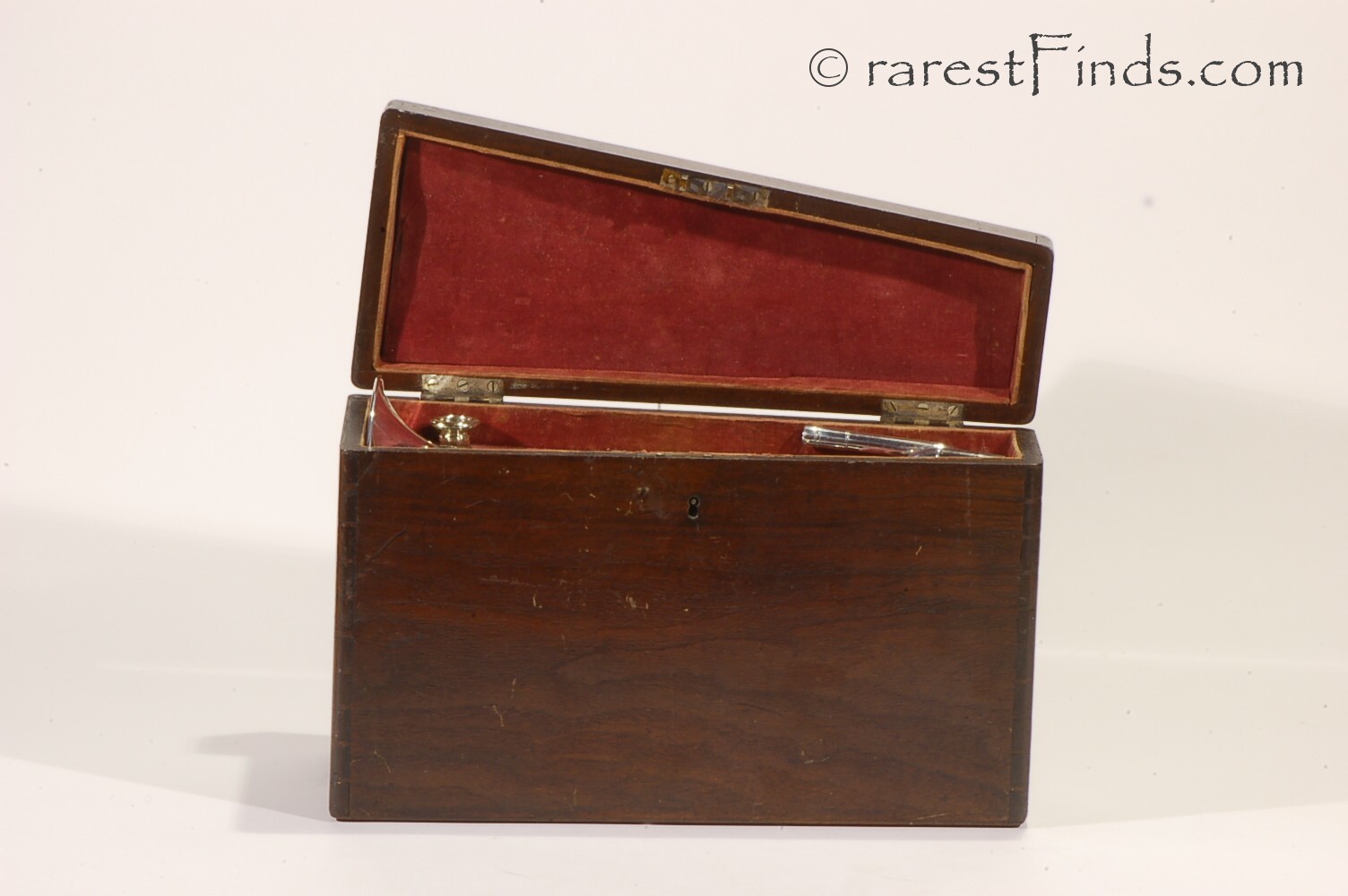
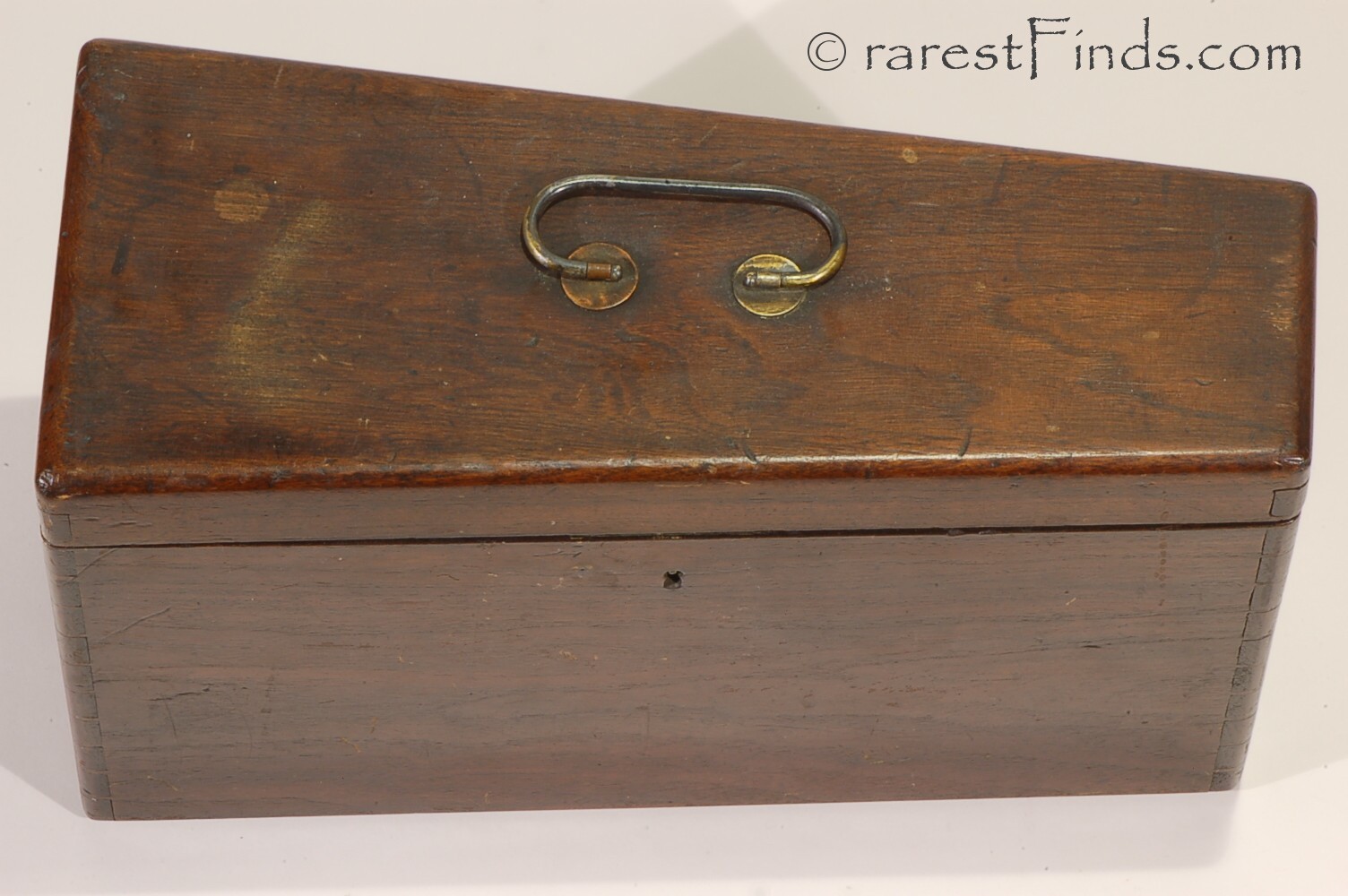
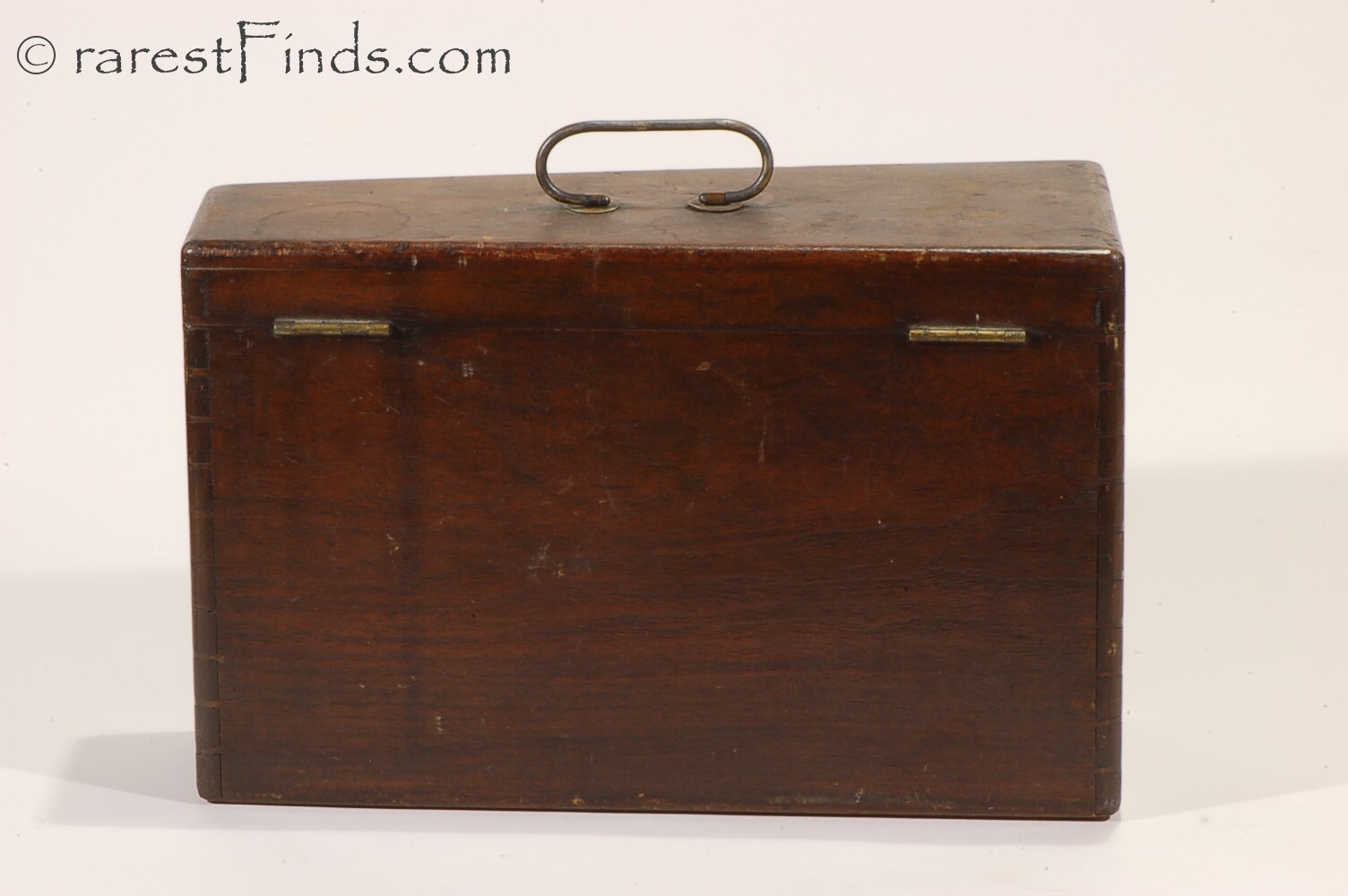
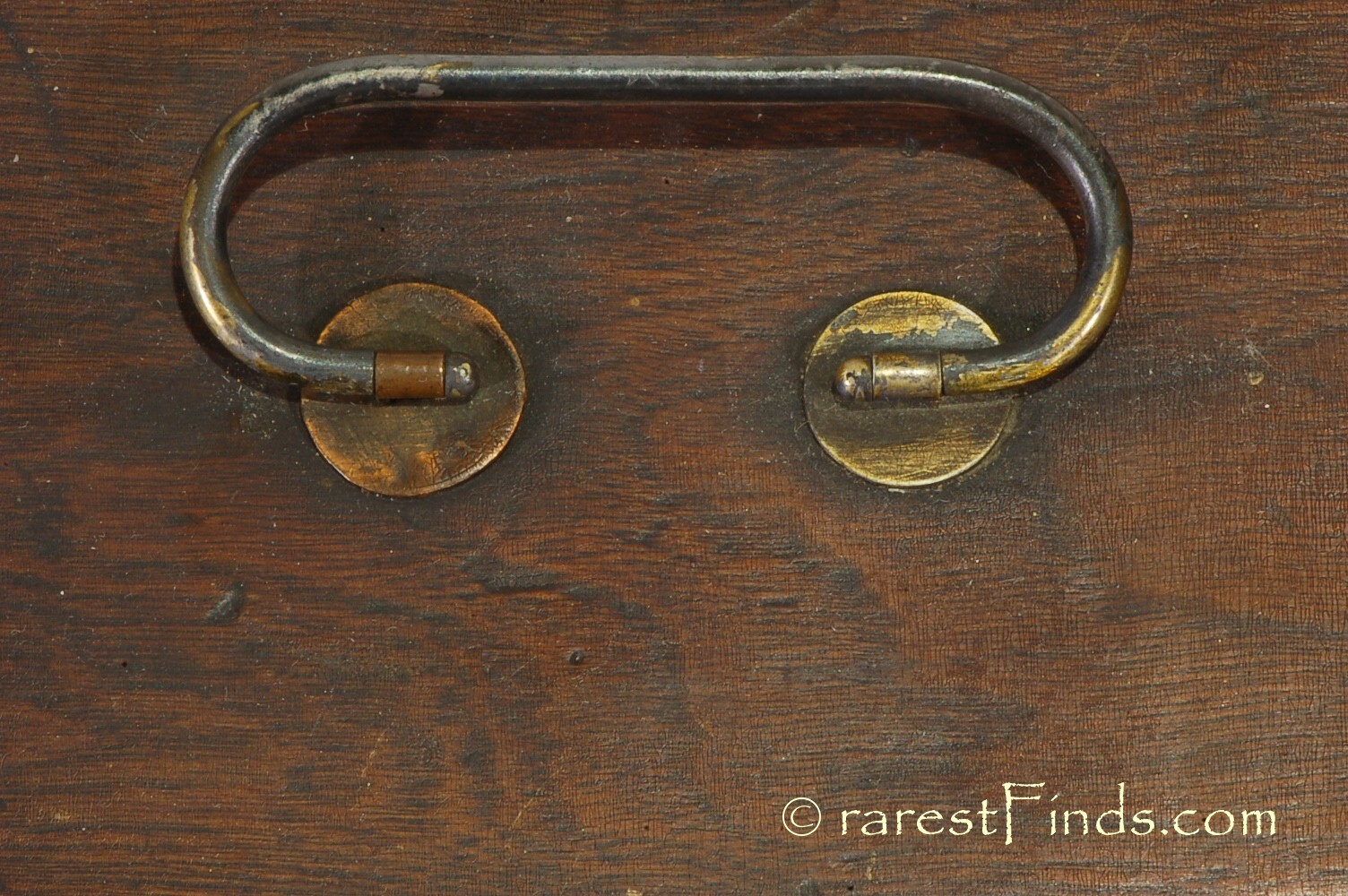
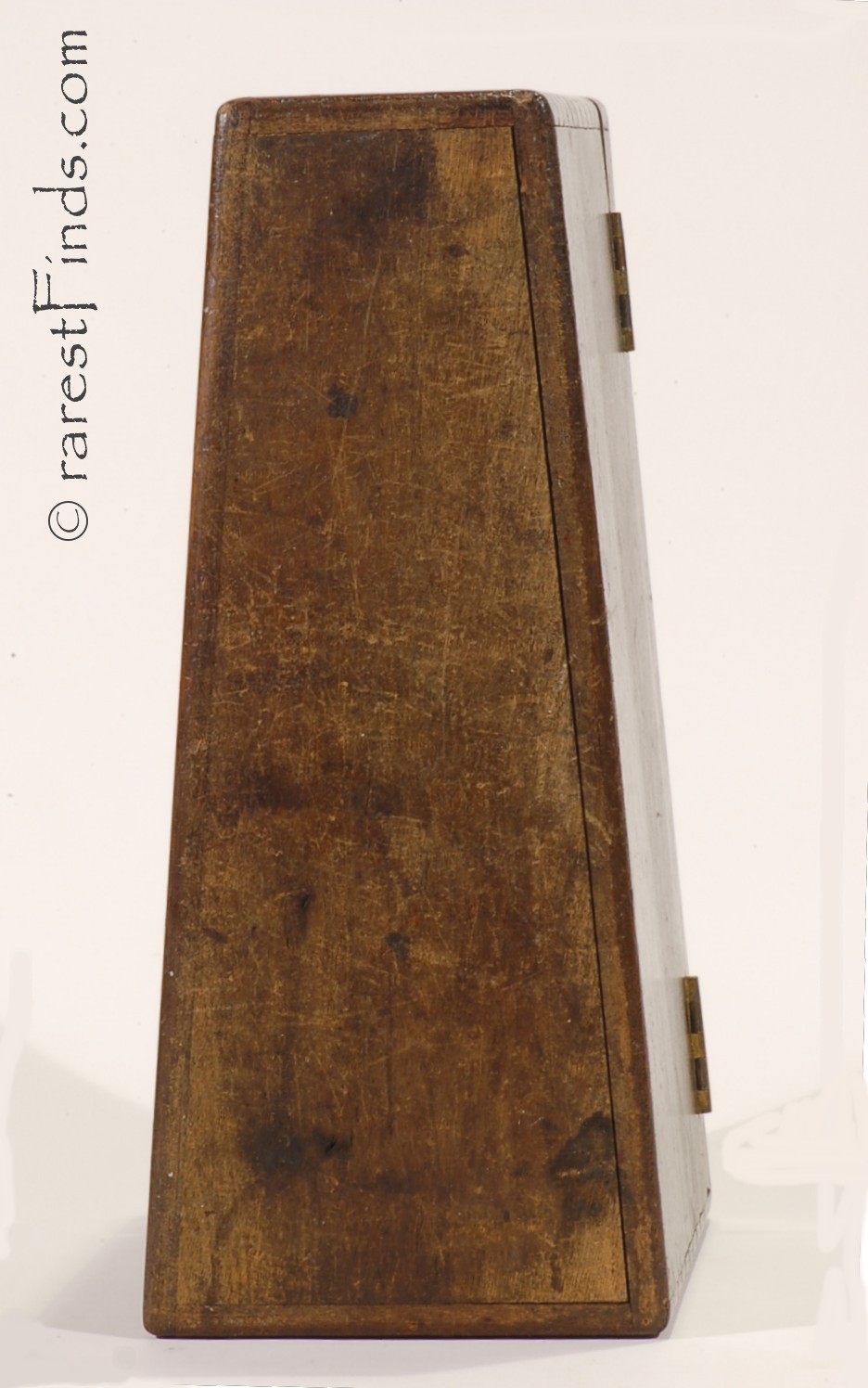
The pristine condition is due to the fact that it was found in an attic still in its red velvet lined American walnut Case.
Well protected by the sturdy case, the instrument does not show any signs of heavy use. In the case is still the short shank which gives it B-flat (high pitch), the long shank B-flat (low pitch), and the crook A. The key to lock the case is missing.
As the reader may noticed, this historic beauty is Silver over Nickel.
History:
Stephen Salisbury II (1798-1884) owned most of the farmland in Worcester in the first half of the 19th century which he leased to farmers. He realized that there was not enough of it for every young man to become a farmer any longer. More and more of them were forced to look for other work. Some of them attempted to become entrepreneurs but struggled.
Salisbury realized the need for space and other infrastructure needed by these industrious young men to pursue their ambitions, not unlike young farmers needed land to pursue farming. Salisbury financed the erection of a large industrial building to accommodate this need.
Sometimes before 1832 he built or inherited the building which came to be known as "Court Mill". He leased the space in 1832 to Samuel Davis who subleased it to manufacturers of any size under one roof, see [2] page 292. By 1835, William Trowbridge Merrifield occupied the building, [2] page 293.
The old Court Mill burned to the ground in October 1839, [2] page 293. The writer learned that fires were common back then. There was at least one fire a day on average in Manhattan, NY City. Wooden structures and open fires presented constant danger to fires.
Mr. Salisbury made a contract with William Trowbridge Merrifield to build a replacement for the lost Court Mill, bigger and better, to be finished no later than January first 1840 [2] [3]. Despite the winter weather, the new building was finished on January first, 1840, [2] page 121, 293.
The demand for power was larger than the supply, so that an engine purchased one year was discarded the next for a larger
one. Between 1840 and 1850, Mr. Merrifield put in five engines. The last one, in 1854, and known as the "Lawrence," was in continuous service for forty-six years until January 1, 1900, [2] page 221.
Eventually, in 1847, other buildings were added by Merrifield every year, the complex became known as the Merrifield Buildings or Court Mills, and occupied an entire city block surrounded by Union-, North Foster-, Cypress-, and Exchange Street.
Isaac Fiske, born on September 17, 1820 in Holden, Massachusetts, moved to Worcester at the age of twelve. His family sold their property in Holden. He shared a shop from 1846 to 1850, near the railroad depot with Joel H. Litch. On December 9, 1846, he married Clara M. Wood,
Stephen Salisbury's and W. T. Merrifield's idea to offer the infrastructure needed for start-ups had a profound impact in establishing Worcester as an industrial hot spot and promoted local innovation.
Considered the first industrial park in the U.S., the Merrifield buildings, finished January first, 1840, represented the heart of early industrial Worcester.
One source claims that Isaac Fiske rented space in the Merrifield building as early as 1842. The writer could not find a reliable source to find the exact date Fiske rented space from Merrifield and does not want to state misinformation. However, there is no doubt that Fiske was a tenant of Merrifield in 1854.
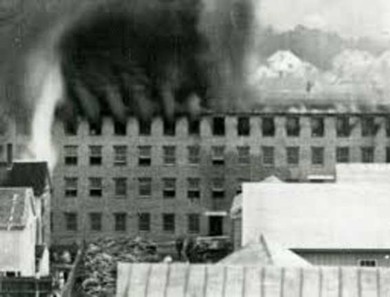
On June 15, 1854, the New York Times reported: "Tremendous fire in Worcester Mass. - $500,000 Worth of Property Destroyed!"
The devastating fire took place the day before, on June 14.
A daguerreotype taken of the fire in progress is thought to be one of the earliest examples of photojournalism, see image on the left. “View of the Great Fire in Worcester, twenty minutes after the alarm, as taken by the Hathaway Brothers, ” read the notice in the Worcester SPY of June 20, 1853:
“To the several Fire Companies in Worcester — The Hathaway brothers, will give to each a View of the Fire, to Hang in their Halls. ” (This is questionable as every daguerreotype is a unique image on a silver plated copper sheet, a photographic process introduced in 1839 by Louis Daguerre. The process does not involve a negative you can copy at will.)
The Hathaway brothers, Thomas and William, operated a daguerreotype studio at 222 Main Street in the Foster's building. The view of the picture taken suggests that the image was taken out of a window of the Hataway studio on the second or third floor as there are clearly roofs of one story buildings visible.
The only known surviving example of their daguerreotype or “View” is in the collection of the Museum of Worcester. Picture courtesy of the Museum of Worcester.
The “no loss of life” is due to the fact that it occurred at the time they would call "dinner" and everyone had gone home to eat.
In addition to the Merrifield buildings, the fire consumed two saloons, livery stage, a bowling alley, a grocery store, a boarding house, two private residences, a church, and more, [3] page 151.
Even so Fiske lost all his material, tools, and inventory, the building itself was the loss of Mr. Salisbury and Merrifield, or their insurance if they had insurance.
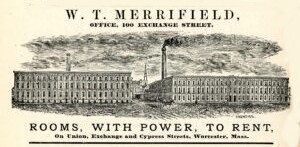
Immediately after the fire, Merrifield gathered his employees and tenants at his residence and announced his intention to rebuild as quickly as possible. The factory was up and running again within seven months. When rebuilt, the buildings measured over 1100 feet in length, 50 feet in width, and three stories in height. The area of the floors was over four acres and a half. The power was obtained from a new 350 hp steam engine, [2] page 294.
in 1855 Fiske bought two lots on Piedmont Street, which served as his home for the rest of his life.
In 1859 Mr. Merrifield had leased rooms and power in his buildings to over 50 firms each employing from two to eight employees, among them Isaac Fiske who at the time employed "six hands," [2] page 294.
Fiske remained in the Merrifield Building until 1887 when he retired after a forty-five years. He sold his business to Charles Gerard Conn. ‘I take great pleasure in announcing that I have purchased the Isaac Fiske Band Instrument Manufactory at Worcester, Mass, including all of its tools and machinery, which will enable me to fill all future orders of band instruments.’ C. G. Conn, May 1, 1887, (A Hundred Years Music in America, 1889).
Fiske died on the same day of the year as he was born, on his 74th birthday, September 17, in the year 1894 of apoplexy.
Literature:
(Click on any title to see the online version of the book or publication if there is one.
[1]
TRUMPETS AND OTHER HIGH BRASS, A History Inspired by the Joe R. and Joella F. Utley Collection, by Sabine Katharina Klaus, Vol. 3, ISBN: 978-0-9848269-5-7, pages 245-48.
[2]
Industrial Worcester by Charles G. Washburn, The Davis Press, Worcester, 1917, (362 pages, searchable!).
[3]
Proceedings of the Worcester Society of Antiquity, Vol. XVII. 1901, (776 pages, Index page 665, searchable!).
Inventory Number 09244;
Sold!
Prices realized in the past:
- The writer was unable to find even one auction record of the same, or a similar, instrument offered here.